

Among those likely to have scanned the new Emerson poll surveying hypothetical 2028 presidential matchups were the office staffers of embattled vice-president JD Vance. The results must have made for grim reading, as they forecast the end of their boss’s stay in the White House. The poll showed Vance, the putative Republican successor to Trump, trailing oft-touted Democrat possibilities Pete Buttigieg, Gavin Newsom, Alexandria Ocasio-Cortez and even Kamala Harris in a notional election vote. There will be 1,001 more polls between now and the actual election. But this one was notable in that it included a new contender to the stable of Democratic possibilities as the party continues its ill-defined talent search for the Democrat most likely to win in two years time: Jon Ossoff.
If this is the political age of the viral clip, then the Georgia senator, currently locked into a bitter state midterm campaign to return to Congress, has proven himself a master of the form. He is the reason global broadcast news and columns have suddenly been filled with detailed profiles of Natalie Harp, the hitherto obscure White House aide to president Donald Trump. At a rally in Atlanta last Sunday, Ossoff, in a half-hour skewering of both the sitting president and the administration, dropped this observation into his speech:
“See, he doesn’t want to do the job. He wants to build his ballroom and travel with Natalie on their apparently defenceless flying palace gifted by the Emir of Qatar.”
He was alluding to the fact Harp was among the very few who travelled with the president on the “decoy” plane used as the US delegation departed the Nato summit in Turkey last month. Something about that sentence cut like a laser beam through the political cant. Even Democratic strategists were queasy about the reference, with David Axelrod, former chief adviser to Barack Obama, noting that although Ossoff had been peerless in his prosecution of Trump’s shortcomings, referencing Harp by name “seemed gratuitous and unnecessary”.
READ MORE


The Republican commentariat was incensed by the employment of the staffer’s first name, which instantly ignited a blaze of salacious conjecture on Harp’s role in the White House. Republican grandee Newt Gingrich called on Ossoff to apologise for “misogynistic language diminishing and smearing someone who is simply doing their job”. Scott Jennings, the Republican strategist and commentator frequently mentioned as a possible inheritor of Karoline Leavitt’s soon-to-be vacant White House press secretary role, wrote: “This is quite the message for the Democratic Party to send to young women working in politics. Party of women? Pretty ugly stuff.”
Steven Cheung, the White House communications director, sought to elevate the rhetoric by jumping online to issue this rebuke via social media: “Jon Jackoff has to be the biggest cuck loser in politics. Instead of denigrating hard working people serving their country, Jon should look deep into his soul and ask himself why he’s a miserable person who hates this country. It’s because he’s a radical, extremist Dumocrat.”
In his next public appearance, Ossoff clearly had no intention of asking himself any such thing and appeared far from miserable. He was unrepentant about his remark, instead doubling down in an interview with MNS on Wednesday.
“It’s been amazing to watch this White House melt down over this all week. And about Natalie Harp – these White House staffers are adults; public officials paid by the tax payer with immense power in positions of public trust. And whether it is Natalie Harp printing out Donald Trump’s daily dose of delusion and flattery, or Peter Navarro steering tax payer funded loans to Trump family investments, or Pete Hegseth deluding the president daily into deepening this quagmire in the Middle East … no one cares about their feelings.”
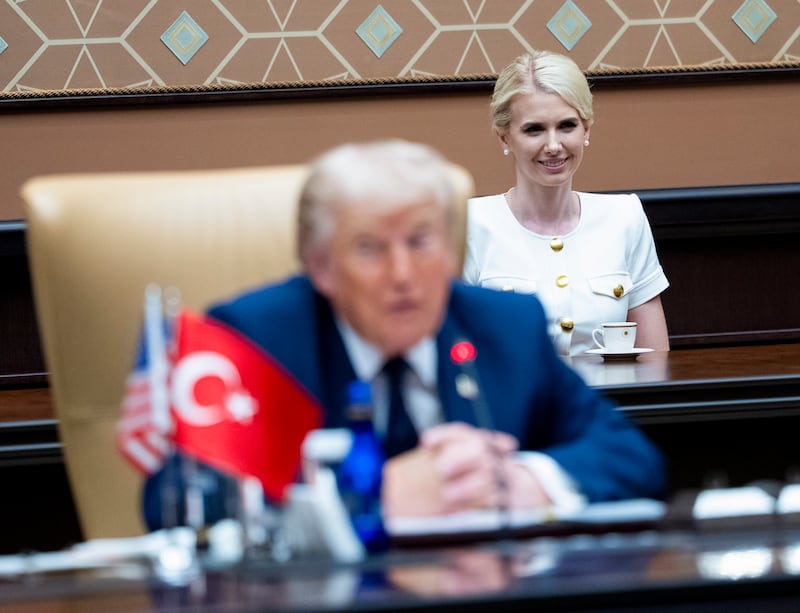
But the furore over the Harp comments was both a blessing and a curse for Ossoff. That single line has propelled him from the regional to national spotlight with an extraordinary intensity – as it has Harp: CNN featured an extremely uncomfortable interview with her estranged brother earlier this week. The attention has intensified speculation that Ossoff is, pending a successful return to the Senate in November, planning to run for president in 2028. It’s a subject he would prefer to avoid over the next few months. He said he had “zero interest” in pursuing the nomination.
But the attention generated by that single phrase has also obscured what was a riveting half-hour rally speech that offered a snapshot of the kind of charged and succinct rhetoric he could offer the Democrats if running on the national platform. Here is a larger section of his speech including the controversial reference to Trump’s aide.
“And while the sailors on the [USS Abraham] Lincoln fight his war while he fruitlessly drains our munitions and oil reserves, the president sleeps through his meetings. He golfs, and trades stocks. See he doesn’t want to do the job. He wants to build his ballroom and travel with Natalie on their apparently defenceless flying palace gifted by the Emir of Qatar. And above all, Donald wants to get money. How much have you heard about the president’s stock trading? When he first announced the tariffs … remember that? He called it Liberation Day. And he crashed the markets because it was clown policy.”
The Harp reference was less clunky within the context of a denunciation of Trump’s second term that was caustic and persuasive and moved smoothly from the historical and panoramic to the specific and statistical. Ossoff’s talent as a communicator and a purveyor of a pithy phrase – he spoke of “the Epstein class” earlier in the year – has led to comparisons with Obama. But his style is more urgent and less folksy than Obama’s, his message carrying a burning urgency suited to the moment. He doesn’t attempt to disguise his cold contempt for the current administration. His approach to campaigning against Mike Collins, the Georgia congressman who is the Republican nominee, has been equally merciless.
“Mike Collins is pro-war, pro-tariffs, pro-cutting your health care. He’s a bigot and a Trump puppet,” he said on Sunday last, calling on his opponent to release communications between his office and white supremacist figures with whom he has reportedly been in contact. One of those, David Alan Scheer II, was revealed to have a detailed history of sharing online white supremacist and anti-Semitic messages. Scheer is Collins’s son-in-law.
“There is no place for white nationalism in the United States Senate,” Ossoff told the crowd in Atlanta, “and this fall we will teach Mike Collins a career-ending lesson he will never forget.”
But for all that, Ossoff stands alone as the only Democratic senator up for re-election this autumn in a state that Trump won in 2024. Most polls show Ossoff with a seven-to-nine percentage point lead over Collins, but that is expected to tighten over the next eight weeks. Georgia Republicans have sought to portray Ossoff as an empty shell: a “vapid self-promoter” in the words of Georgia congressman Buddy Carter. Ossoff is Jewish and has been notably critical of Binyamin Netanyahu’s carpet bombing of Gaza. The Atlanta Jewish Times recently published an open letter to Ossoff written by its publisher, Michael Morris. It said:
“Your antagonism toward Israel has remained steadfast. You backed some of Senator Sanders’ resolutions to cut off Israel’s weapons in late 2024, again in July 2025, and on April 15th, 2026, you went furthest yet – voting to block every sale on the floor. Your vote continues to demonstrate a lack of support for the Jewish state.”
Other criticisms include the insinuation that Ossoff, a senator for six years, was fortunate in that he managed to harness a momentum driven by the state’s senior senator, pastor Raphael Warnock.

So, as summer draws to a close, Ossoff finds himself on a threshold between two worlds: embroiled in what will be a bare-knuckle election campaign just to keep his Senate seat while being mentioned as a potential Oval Office occupant in two years time.
There’s a persuasiveness about the idea of Ossoff as the antidote to a berserk political decade. After three successive terms of old, white presidents, the US electorate will crave youth in the White House. Ossoff is 39, the father of two young girls and married to Dr Alisha Kramer, an obstetrician and assistant professor at Emory. The couple met in high school. He himself has squeezed into the intervening years an education in Georgetown and the London School of Economics, a period as an investigative documentarian and six years as a senator.
For most of that time, he has remained determinedly low-profile, eschewing the broadcast-news circuit but occasionally making news because of the withering articulacy of his senate committee interrogations of administrative figures. He’s a southerner who lives conservatively, progressive without being radical. Part of his campaign pitch is that two Republican mayors in Georgia have endorsed him and joined his campaign: that he can be a bridging figure.
And an increasing number of Democrat commentators are beginning to see that potential. The field of candidates is heavy with talent. But with many other leading Democratic contenders comes the risk as to whether they are “too much”: too Californian, too coastal, too elite, too socialist. With AOC, the Democrats would once again be asking American voters to do what they have never done before by putting a woman in the White House. With Buttigieg, they’d be banking on electing an openly gay man for the first time. Ossoff is steadfast centre-left and telegenic without being dazzling or appearing vain. In 2024, Harris, after a campaign that badly derailed, only lost the election by two million votes. Ossoff might just, for the Democrats, emerge as the plausible, acceptable alternative to America’s decade of chaos.
Back in 2017, John Lewis, the Georgia civil-rights icon (for whom Ossoff worked), gave the young politician the imprimatur of dreams when he said: ‘‘I’ve met every president since President Kennedy. And I tell you, President Kennedy – young, smart and gifted. John Ossoff is young, smart and gifted.’’
These days, the comparisons to JFK are beginning to come thick and fast. But the more apt comparison may be to Robert Kennedy, with the sharp and sometimes savage turn of phrase and the urgent sense of mission. But whether Ossoff is at the beginning of an absorbing political ascent or the end of a senatorial life will depend on events in the Peach State over the next two months.


