
She never takes a day off, not even Sunday. She works out of the Oval Office and she has a regular seat on the Marine One presidential helicopter. She texts world leaders on the president’s behalf. She stays up late with him drafting social media posts.
She rarely speaks on camera and yet she is never not there, ever-present with a wide smile and her eyes fixed on the president.
She is Natalie Harp, the 35-year-old West Wing aide who is the utmost gatekeeper to US president Donald Trump, a one-woman conduit of information operating entirely outside the usual chain of command. The public’s interest in Harp grew dramatically after she was revealed last week to be one of the lucky few who joined the president inside an aircraft catering container to be whisked out of Turkey under threat of attack by Iran.
This week she became the subject of a political attack line delivered by Democratic senator Jon Ossoff, who said of the president: “He doesn’t want to do the job. He wants to build his ballroom and travel with Natalie on their apparently defenceless flying palace gifted by the emir of Qatar.”
READ MORE


The senator’s singling out of Harp triggered a particularly ferocious response from many corners of Trump world. White House aides, politicians on Capitol Hill, conservative influencers and at least one cabinet member took to the ramparts on the social media platform X to defend Harp.
[ Inside Donald Trump’s AI ‘slopaganda’ machineOpens in new window ]
There were accusations of sexism from the right and cries of snowflakery from the left. Trump deflected when a reporter from CNN asked him about Ossoff’s comments. But a social media account run by the administration then attacked the reporter in unusually personal terms, invoking her children.
The furore intensified the spotlight on this seldom-heard-from woman who has long fascinated and frustrated people around the president. This article is based on interviews with a half-dozen people with knowledge of her role. Harp did not respond to a request for comment.
The unique power Trump affords her says much about how he functions as president.
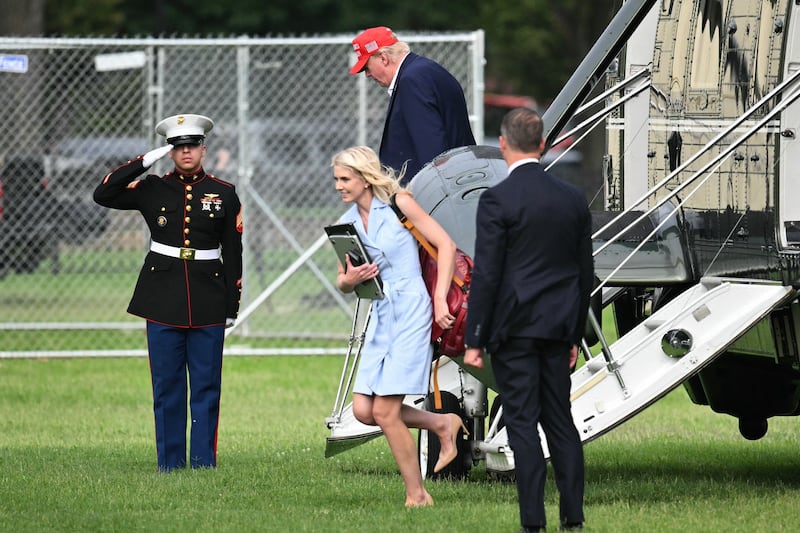
As long as Harp is around, he enjoys an unvetted flow of information, some of it poisonous and counterproductive, at least as far as a number of his other advisers are concerned. She supplies him with content she fishes from social media (such as the video he posted depicting the Obamas as apes) and provides him with a view from the world outside official Washington, of which he has always been mistrustful. Her moniker is “the human printer”, because she tails the president with a portable printer so she can hand him information in hard copy.
She is a geyser of positivity, there to buck him up when the going gets rough. She believes, or at least vehemently claims to believe, that he won the 2020 presidential election. In the book Regime Change, by New York Times reporters Maggie Haberman and Jonathan Swan, Trump is described as explaining to people that Harp is the only one who loves him as much as his wife and children. All his other staff will go off and make money, Trump would say, but Harp will never leave him.
“Natalie Harp is one of the most loyal and hardest-working aides on president Trump’s team,” Karoline Leavitt, the White House press secretary who will soon be leaving her post, said in response to questions about the nature of Harp’s position and why she was chosen to join the president on the secret food-delivery-truck rescue gambit.
‘When I was sick, I started watching the Republican debates. He was my first exposure to politics, and I loved it. Like, this guy, he gets it’
— Natalie Harp on Donald Trump
Harp collects a taxpayer-funded salary of $150,000 (€128,000). Her titles are special assistant to the president and executive assistant to the president. At work she can be a bit of a loner. Even in this West Wing, in which loyalty to the president seems to know no bounds, Harp’s displays of devotion have unnerved some of her colleagues.
Several videos shared with the Times show Harp sprinting across great distances to keep up with Trump’s golf cart as it putters across his course in Scotland. “I also am sorry if I was an embarrassment walking the course in Scotland,” she wrote in a letter to the president that was viewed by the New York Times.
The letter goes on to say: “I want things to always be right between us. I also know I’ve been distracted all week (forgetting to eat throughout the days, and even forgetting to sleep, and only catching a couple hours at a time).”
The letter concludes: “With all my heart, Natalie.”
Harp’s connection to this president runs deep. She credits him with saving her life.
She has said that she suffered from bone cancer, and that it was legislation Trump signed in 2018 that provided her with access to experimental treatments. (She has not publicly detailed which treatments).
She was recounting that experience on Fox News in 2019 when she caught the president’s eye. He invited her to speak at the Republican National Convention in 2020. She spent the next two years repeating his election lies as an anchor on the far-right One America News Network. In 2022, she finally joined his team.
A “War Room”-style documentary filmed during Trump’s 2024 campaign, called Art of the Surge, provides glimpses of Harp hard at work.
“Politics was never something I liked,” she explains in one scene that was filmed at Mar-a-Lago. “But when I was sick, I started watching the Republican debates. He was my first exposure to politics, and I loved it. Like, this guy, he gets it.”
The film cuts to Trump introducing Harp in 2019 at something called the Faith & Freedom Coalition’s Road to Majority conference.
“They were preparing her for death,” he says. “Her name is Natalie Harp, and because of ‘right to try’, she’s now living, and I think doing phenomenally well. And somebody said she’s here. Are you here, Natalie? Where’s Natalie? Will you come up here, please?”
The woman who walks across the stage to hug him is not yet the full-fledged Trump aide she would soon become.
“I had cancer and he saved my life, signed that Bill,” she says in the film, “and ever since he found out, he stayed in touch with me. Made sure I was okay.” – This article originally appeared in The New York Times


