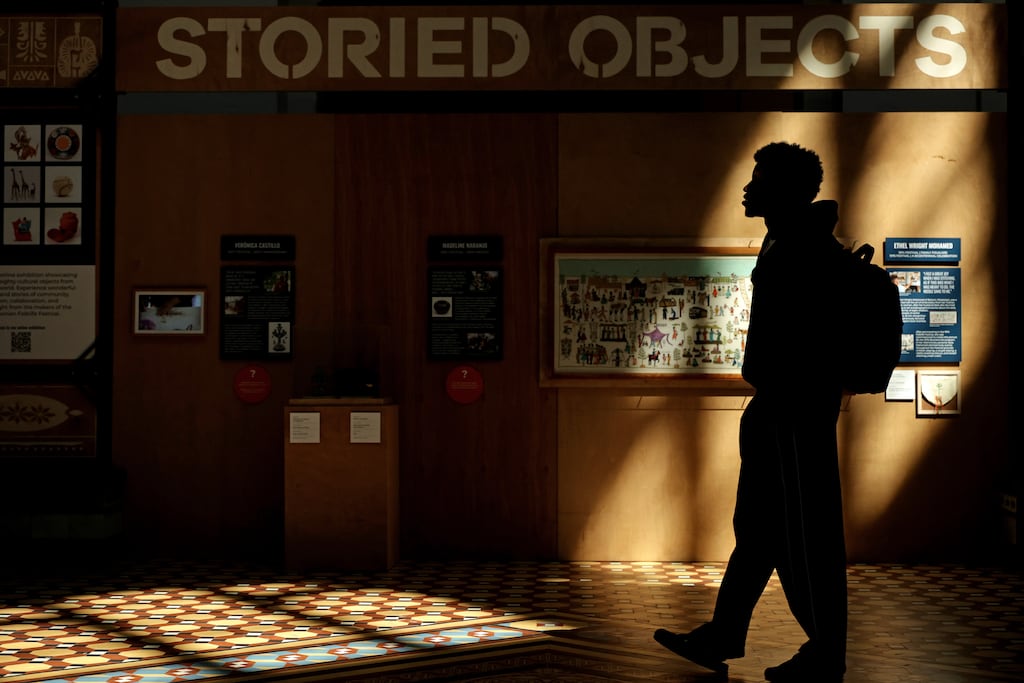
In a matter of weeks, visitors to the museum that tells the story of America will be encouraged by Donald Trump’s administration to reject the evidence of their eyes and ears.
By presidential decree, temporary street signage in downtown Washington will direct passersby to a report that claims the Smithsonian’s National Museum of American History (NMAH) has fallen victim to “ideological capture” by overemphasising the legacy of slavery and conquest at the cost of celebrating the country’s greatness.
The planned placards are the latest salvo in a 250-year-old war over how to frame American history. The conflict has intensified in Trump’s second presidency, as right-wing campaigners seek to wind back what they see as a “woke” revolution supercharged by the Black Lives Matter movement.
Behind the crusade is Lindsey Halligan, a 37-year-old lawyer who first met Trump at one of his golf clubs, and who last year alerted the president – whom she described as “not much of a museum go-er” – to curatorial choices across the Smithsonian’s network of institutions.
READ MORE


According to Halligan, who worked at the White House and briefly as a federal prosecutor in Virginia, artefacts are too often interpreted through the lens of race, gender or sexual identity.

“It’s a pattern that’s impossible to ignore,” she told media personality Bill O’Reilly recently. “The Smithsonian is not the same Smithsonian that you visited on your sixth-grade class trip.”
Halligan’s gripes include a 1950s Wurlitzer jukebox exhibit that “became a lesson on white supremacy and segregation”. The music machine, which featured rock’n’roll songs from African-American artists, appalled those who thought it might encourage racial integration, the museum noted.
Trump last year echoed some of Halligan’s concerns, declaring the Smithsonian “OUT OF CONTROL”, and claiming that “everything discussed is how horrible our Country is, how bad Slavery was and how unaccomplished the downtrodden have been”.
The escalating conflict over the leadership of the Smithsonian is emblematic of a broader culture war playing out across the US. Republicans have restored Confederate names to military bases and sought to revive the reputations of Confederate generals, while Trump has stamped his personal brand on Washington’s cultural hub, seizing control of the Kennedy Centre and attempting to attach his name to the building.
But a 162-page report released last month by the White House, called Saving America’s Story, opened up a new front against the Smithsonian, taking aim at “thinly veiled anti-Americanism” at the NMAH.
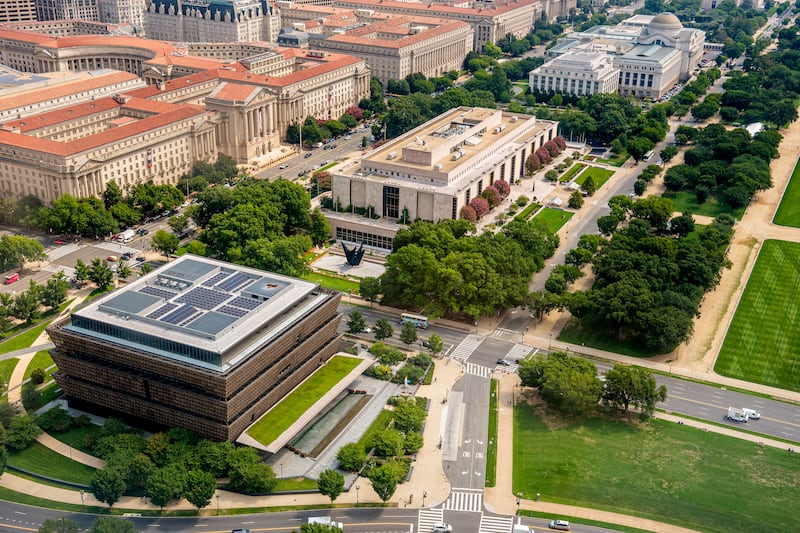
It said the museum’s founders wanted it to tell the “inspiring story” of the US, and that the cold war-era president Lyndon Johnson wanted it to “foster patriotism”. The report criticised several exhibits, including those that allude to Alexander Hamilton and Benjamin Franklin owning slaves, that celebrate drag queens and that highlight the displacement and decimation of Native American tribes.
The report concluded: “Museum leadership has explicitly adopted an ideological framework that no longer treats the American story as a shared national inheritance to be taught or celebrated, but as a political instrument to divide, dispirit and discourage our citizens.”
The report horrified some professional historians. The document is “part of the anti – DEI [diversity, equity and inclusion], anti ‘woke’ agenda of the administration,” said Beth English, the head of the Organization of American Historians. The OAH has decried the White House’s “federal assault on history” for seeking to “turn back the clock”.
“If we’re not careful, we will end up with what the great writer Toni Morrison called ‘statist history’,” Yale historian David Blight warned lawmakers at a hearing on Capitol Hill last month. “And it will create what she called ‘sanctioned ignorance’.”
But Matthew Spalding, a vice-president at the conservative Hillsdale College which partnered with the White House to tell the story of American history, said reform of the Smithsonian would merely mean a return to the “liberal consensus of American history” that told the story of the revolution in chronological order.
“We should talk about slavery, we should talk about the Indians – all of these things. But to understand those questions ... you have got to give [visitors] something from which they can understand the context of that discussion.”

While the White House has successfully exerted its control over historical plaques at national parks, which are managed by federal authorities, it has struggled to bring about change at the Smithsonian – hence the presidential order to install warning signs in Washington.
Although it receives more than $1 billion in annual federal funding, the Smithsonian, established by Congress in 1846, is not directly controlled by the US government and is governed by a bipartisan board. Board members include the chief justice of the supreme court, vice-president JD Vance and members of Congress.
The Smithsonian has faced political pressure before. In the early 1990s a proposed exhibition about the Enola Gay, the US bomber that dropped the atomic bomb on Hiroshima, was in effect cancelled following an outcry in Congress and led to the resignation of a senior Smithsonian official.
But the institution’s current leadership – in particular secretary Lonnie Bunch, the first black person to hold that role – has largely resisted the Trump administration’s onslaught.
Anthea Hartig, the NMAH’s director, defended the institution in front of Congress last month. “History is incredibly challenging ... if we tell it in its richness, we absolutely have objects that can make people uncomfortable,” she said.
On a visit this week to the museum’s In Pursuit of Life, Liberty and Happiness exhibition, the target of much White House wrath, the FT found that the wall texts and placards condemned by the recent report were unchanged.
A Smithsonian tour guide explained how Thomas Jefferson owned “enslaved people” and how George Washington rotated his slaves in and out of the free state of Pennsylvania – home to America’s first elected government – to keep them in servitude.
The Smithsonian declined to comment.
In a statement to the FT, Vince Haley, the White House official behind the Smithsonian report, said “very few” Americans wanted the history museum to be used as a tool of social justice or “instrument of ideological activism and advocacy”.
He added the institution should provide an “honest and inspiring account of American history ... telling the story of our founding fathers – who they were, what they did and what they built”.
Some resistance to the Trump administration has also emerged in Congress, where Republican senator Lisa Murkowski joined Democrat Jeff Merkley in challenging the White House’s proposed signage.
But Mike Gonzalez, a conservative author and senior fellow at The Heritage Foundation, whose work has been cited by the White House, said he wants to win bipartisan support for making sure the Smithsonian is never again funded to be an “incubator of grievances”.
“If we continue making the case ... that this is not a good way for a nation to conduct itself, then nobody’s going to come in, of either party, and all of a sudden again put in exhibits that denigrate the country,” said Gonzalez.
“Only foolish people will pay $1.1 billion for their own cultural erasure.” – Copyright The Financial Times Limited 2026