The phone call on that Thursday afternoon brought an emphatic demand: report to the CIA office immediately.
Shauni Kerkhoff had been with the agency for four years and would have normally been at work then. But her schedule had been altered during the government shutdown, so she was enjoying a day off, curled up in her livingroom, the dogs nearby.
It did not cross Kerkhoff’s mind to decline or demand more information from her supervisor. She had made it a habit to be professional and upbeat, having chosen law enforcement because she believed she could be helpful to the community.
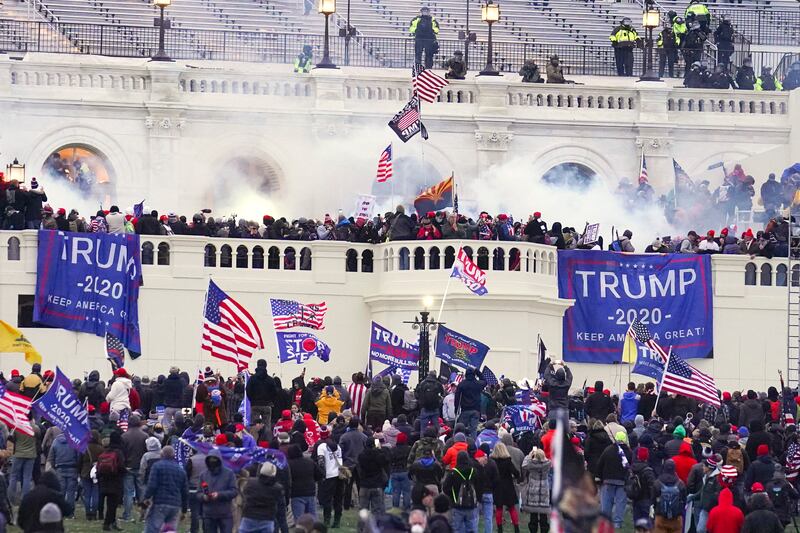
At 31 years old, her enthusiasm for her career had already been tested, and in an unimaginable way. Her first job in the Washington area was as a Capitol police officer, and she had faced off against the mob of rioters on January 6th, 2021.
READ MORE


She relived the insurrection while working with federal prosecutors and testifying in two criminal trials – and then watched those convictions unravel when US president Donald Trump pardoned hundreds of the day’s participants.
She had gone on to join the CIA, where she received multiple promotions and performance awards. But when she arrived at the federal building in Virginia on November 6th, 2025, she was told to join two FBI agents in a windowless conference room.
The agents had come, they said, because of what had taken place the night before the storming of the Capitol. On January 5th, 2021, surveillance cameras captured someone placing pipe bombs near the headquarters of the Democratic and Republican national committees. The bombs did not detonate, but their discovery the next day diverted law enforcement resources away from the Capitol as the riots broke out.
The case had famously remained unsolved. However, Kerkhoff said the two agents informed her that they had recently come across some “online chatter” concerning a new suspect.
Then the questions began.
Where had Kerkhoff been the night of January 5th, 2021? Who was she with? What sort of training did she have in building bombs? Did she own a certain type of sneakers?
And would she hand over her phone? Because she was now under investigation.
Conspiracy theories
The January 6th attack inspired conspiracy theories almost from the moment Trump’s supporters overcame the police and charged into the Capitol. The one that gained the most traction held that the riot was a “fedsurrection,” an inside job orchestrated by a network of law enforcement officers intending to sabotage Trump.
A particularly tantalising subject to “fedsurrection” believers was the identity of the Capitol Hill pipe bomber. The suspect was wearing a mask, a grey hooded sweatshirt and Nike Air Max Speed Turf shoes while planting the bombs between 7.30pm and 8.30pm.
Over the years, the FBI, working with other agencies, said it had a team devoted to the case, while encouraging the public to study footage of the individual.
“You may recognise their gait, body language or mannerisms,” the FBI said in a statement.
In January 2025, a congressional committee issued a report scrutinising what it saw as a stalled investigation. That same day, the FBI released a new detail: the suspect stood approximately 5ft 7ins.
Last autumn, Blaze Media, an outlet with a news site, podcasts and streaming app that bills itself as “the home of dissent from woke capital,” was putting together its own purported investigation. It promised to deliver a “bombshell revelation”.
The Blaze piece published on November 8th, two days after Kerkhoff was first interrogated by the FBI. The headline read: “Former Capitol Police officer a forensic match for Jan. 6 pipe bomber, sources say.” The officer was Kerkhoff.
The piece was written by Steve Baker and Joseph M Hanneman.
In their story, Baker and Hanneman wrote that they had arranged a forensic study of Kerkhoff’s gait by an unnamed analyst. A “software algorithm,” the story said, showed she was a 94 per cent match to the pipe bomber. The analyst determined that the match was closer to 98 per cent based on “visual observations”. The story also said the findings had been confirmed by several anonymous intelligence sources.
The writers said this “gait analysis” had been done by using security video of Kerkhoff as well as footage of her playing soccer eight years earlier, and comparing them with the January 5th video of the pipe-bomb suspect.
They concluded that Kerkhoff’s height – 5ft, 7 ins, a figure written on her online athlete bio – and the fact that she had broken her leg in a college soccer game was more proof. The broken leg, they surmised, had given Kerkhoff a distinct limp, which they said matched that of the pipe bomber. (Kerkhoff, in fact, made a full recovery and does not present a limp.)
“The prospect of a Capitol Police officer being the perpetrator, if confirmed, could recast the entire story of Jan. 6,” Baker and Hanneman wrote.
Baker said he may have helped trigger the investigation of Kerkhoff. In an interview with The New York Times, Baker said that shortly before his story was published, he had taken his theory to sources at the office of the director of national intelligence.
Baker and Hanneman did not contact Kerkhoff before publication to give her an opportunity to respond to the accusations or present information that might contradict their story.

Bomb truck
In the meeting with the FBI agents, Kerkhoff said she felt an odd relief when she learned why she had been called in. It was such an absurd notion that she thought: “Oh, this can be cleared up easily.”
But the nature and seriousness of the questions became increasingly bewildering as they dragged on for about three hours. Because she was at her place of work, a government agency, she felt compelled to engage. As an officer, she also held the FBI in high regard. She never requested to speak to a lawyer.
Afterwards, she and Daniel Dickert, a fellow officer she had begun dating in 2018 and lives with, who had driven her to the meeting, headed home, alarmed. Agents had said they were going to meet them there.
Shortly after entering their house in Alexandria, the couple said, they saw a caravan of vehicles descend upon their street, one blocking their driveway. A bomb truck arrived, as did a canine trained in detecting explosives. They heard a helicopter thrumming above. Officers in tactical gear emerged, their guns drawn.
Kerkhoff was told that everything could be cleared up if she went to an FBI field office to do a polygraph interview that night.
The polygraph took about 30 minutes, she said. Then she was interrogated for another 2½ hours.
She and Dickert began blindly searching online for a lawyer. “I didn’t even know where to start, who to talk to, how to address this,” recalled Dickert.
The next day, the Blaze piece was published. The couple’s phones lit up with texts.
“I mean, I was just flabbergasted,” Kerkhoff said after reading it. “This is why they’re investigating me? Gait analysis?”
Conspiracy theorists ran with it, reposting the story as proof of the “fedsurrection”. The report fuelled podcasts and YouTube videos. Trolls swooped in with memes and slurs on social media, even adding comments to videos of Kerkhoff’s college soccer career.
Perhaps most painful was the desecration of her mother’s obituary that appeared on a funeral home’s website. Kerkhoff had to call multiple times to get the Trump memes removed.
Innocence
Video of her dog ultimately proved Kerkhoff’s innocence.
When she was first questioned about her whereabouts on January 5th, 2021, she could not recall. Nearly five years had passed.
But images from her phone revealed that she and Dickert had been in their livingroom, laughing at how their new greyhound, Bella, was twitching in her sleep.
By then, a mutual acquaintance had connected Kerkhoff with Steve Bunnell, a lawyer who had previously worked at the department of homeland security and the US attorney’s office in Washington. Bunnell told The New York Times he had arranged a meeting in which the video could be given to FBI agents and federal prosecutors.
Metadata showed that the video had been filmed at nearly the same time the pipe bombs were planted. After reviewing additional forensic evidence and confirming Kerkhoff’s alibi, the agency eventually cleared her of any wrongdoing, Bunnell said. The FBI declined to comment on their investigation to The New York Times.
On December 4th, she and Dickert were watching the news when it was announced that Brian Cole jnr (30) of Woodbridge, Virginia, had been charged with placing the pipe bombs.
That day, The Blaze removed the story identifying Kerkhoff as the suspect – 26 days after it originally published. It was replaced with a statement that read, in part, “At all times, the reporting adhered to professional journalistic standards and was published with a good-faith belief in its truth.”
Christopher Bedford, the editor-in-chief of The Blaze, acknowledged in a statement to The New York Times that the removal was in response to the arrest of Cole.
Baker was fired this month for being unwilling to submit his work to “serious editorial and legal review”, according to a post on the social platform X by Bedford. Hanneman resigned around the same time.
Baker and Hanneman have started a new site where they continue to post stories about Kerkhoff and insist that authorities have charged the wrong person. Contacted for comment by email, Hanneman deferred to Baker.
On Tuesday, Kerkhoff filed a defamation lawsuit accusing Blaze Media, Baker and Hanneman of inventing a damaging theory about her.
In response to the suit, Blaze Media cited the US constitution’s first amendment and Virginia’s anti-Slapp law, which aims to protect those exercising free speech from frivolous claims.
Cole, the man now charged as the pipe bomber, pleaded not guilty and awaits trial. His lawyers recently filed court documents that hinted at plans for a possible defence: that it was Kerkhoff, not Cole, who planted the bombs, even though the FBI had cleared her of doing so. – This article originally appeared in The New York Times.