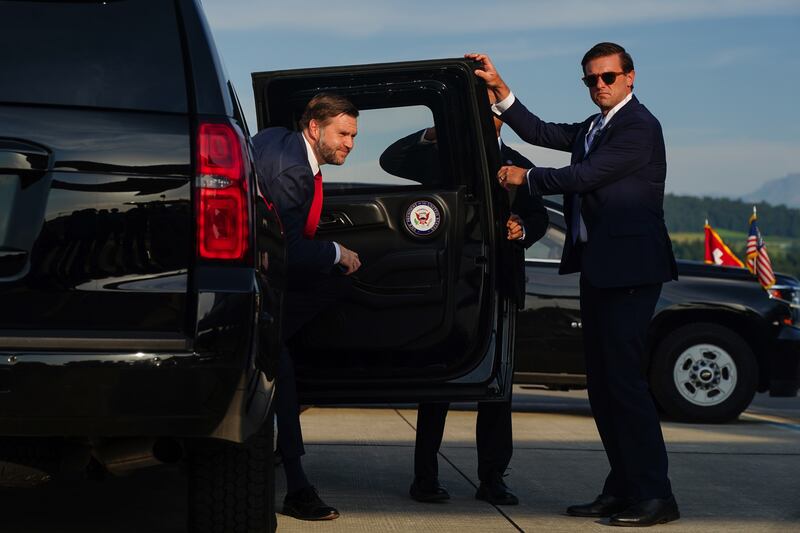
As US vice-president JD Vance entered the fifth hour of negotiations with Iranian leaders over the weekend, US president Donald Trump weighed in with an ill-timed threat to start bombing again.
If the Iranians closed the Strait of Hormuz, Trump told a Fox News reporter, the negotiators talking to Vance would never make it back to their country – in fact, they would have no country to return to at all.
For Vance, this was the latest example of his increasingly tricky role as the frontman in the US negotiations with Iran, as Trump repeatedly creates disruptions in his path.
On Monday, Vance said the first round of talks had laid “a successful foundation” for peace. But now, Vance will have to find a way to end a war that he opposed at the start, while navigating his boss’s whims and an adversary that has proven itself, at least in part, immune to Trump’s threats.
READ MORE


“What we told the Iranians yesterday is when you guys engage in what us millennials might call trash talk, you can’t expect the president of the United States not to respond and not to correct the record,” he said on Monday at a news conference. “So when they say things that aren’t true, the president is going to respond to it.”
[ Trump’s Iran deal leaves him facing a Carter-like dilemmaOpens in new window ]
Both sides have signed a memorandum of understanding to end hostilities and are now trying to strike a lasting nuclear deal in 60 days. But for Vance, the presumptive favourite for the 2028 Republican nomination, the situation remains politically precarious.
“If it works out, I’m going to take the credit,” Trump said of the peace deal last week. “If it doesn’t work out, I’m blaming JD.”
Vance has said the president was joking, but Trump has never shied away from deflecting blame on to others – and how Vance handles the future of the negotiations will factor into Republicans’ performance in the midterm elections and his future as a potential successor to Trump.

Karim Sadjadpour, a senior fellow at the Carnegie Endowment for International Peace, said Vance was in a risky spot. He could get credit for ending an unpopular war, Sadjadpour said. Or he may end up being “viewed as the architect of an American humiliation and a deal that concedes billions of dollars to a committed US adversary”.
Making the situation even more difficult, the vice-president must depend on the co-operation of Iran’s Revolutionary Guard commanders.
“That’s not an auspicious position for any American politician, let alone an aspiring president,” Sadjadpour said.
And even as Americans are clamouring for the Trump administration to stop the fighting and bring down energy costs, Sadjadpour argued that Americans seem to care more about how wars end. He pointed out that president Joe Biden nosedived in the polls after the withdrawal of American forces from Afghanistan, during which 13 US service members were killed.
“Americans dislike wars, but they dislike defeats even more,” he said.
Almost immediately after Vance left Switzerland, the foundation he outlined for a possible longer-term deal started showing cracks. The vice-president said Iran had agreed to invite UN nuclear inspectors into the country, but the Iranians said they had made “no new commitments”.
Vance also described a potential funding scheme in which Qatar would unfreeze assets for the Iranians to use to buy American soy, corn and wheat. Hours later, Trump repeated that idea in the Oval Office and said food for the Iranian population was “going to be bought exclusively through the United States from our farmers”. Iranian officials rejected that idea and have said in the past that the money would be going towards rebuilding its infrastructure.
Conflicting narratives about the state of the negotiations have become common in recent weeks as US and Iranian officials try to appease their domestic audiences and bring an end to the conflict.
Vance tried to downplay the public disagreements.
“I would just encourage the media: mistrust a little bit what you see coming out of Iranian social media,” he told reporters before boarding Air Force Two to return to Washington. “They can be confusing negotiators, but we feel like we’re making progress.”
It was a markedly different tone than Vance’s last face-to-face meeting with the Iranians when he spent 21 hours in Pakistan and left with “bad news”, saying they were not “able to make headway”.
As Vance works to balance the negotiations and his own political future, Trump has been quizzing aides and allies over the last several months about whether they think Vance has what it takes to win the presidency.

He often compares Vance with US secretary of state Marco Rubio – and he will have another opportunity to size up the two men this week when Rubio heads to the Gulf to discuss the Iran deal with allies.
When asked on Monday how Vance and Rubio were doing, Trump said they were doing a “fantastic job”.
“Our secretary is fantastic,” he said of Rubio. “I think he’s maybe going to go down as the best ever. And I thought JD Vance this morning was fantastic. I watched his news conference from Switzerland. He’s a very smart guy. He did a great job.”
This article originally appeared in The New York Times.