Australia’s Qantas Airways and Air New Zealand said on Tuesday they were hiking fares due to the Middle East conflict, underscoring how global airlines are struggling to cope with the sudden and soaring costs of fuel.
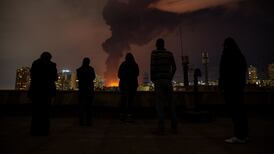
The US-Israeli war on Iran has sent oil prices surging, upending global travel, pushing airline tickets on some routes sky-high, sparking fears of a deep travel slump and the potential for the widespread grounding of planes.
Jet fuel prices, which were about $85 to $90 (€73-€77) per barrel before the conflict, have increased sharply to between $150 and $200 (€128-171) per barrel in recent days.
Highlighting the chaos around Middle Eastern airspace, planes arriving into Dubai were briefly placed in a holding pattern on Tuesday morning due to a potential missile attack, flight tracking service Flightradar24 said on X. The planes eventually landed.
READ MORE


Eric Luke, a photojournalist from Dublin, was at the airport when passengers received a message warning them to stay away from windows and doors.
“Due to the current situation, potential missile threats, immediately seek a safe place in the closest secure building, steer away from windows, doors, and open areas,” the message stated.
Luke told The Irish Times the situation was “well handled by the airport staff”.
“They just moved everyone in the concourse down to ground level, until they got the all clear.”
Luke, who is en route from Australia to Ireland, said passengers were moved from higher levels to the ground floor “away from windows and glass, as ordered”.
Qantas said that in addition to increasing international fares, it was exploring options to redeploy capacity to Europe as airlines and passengers seek to evade disruptions in the Middle East, where drone and missile fire have curtailed flights.
The Australian airline said its flights to Europe are more than 90 per cent full in March, compared with the usual 75 per cent at this time of year.
Airfares have soared on Asia-Europe routes due to airspace closures and capacity constraints, and Hong Kong’s Cathay Pacific Airways said on Tuesday it was adding extra flights to London and Zurich in March.
Air New Zealand said it had raised one-way economy fares by NZ$10 (€5.15) on domestic routes, NZ$20 (€10.20) on short-haul international services and NZ$90 (€46) on long-haul flights, with further price, network and schedule changes possible if jet fuel costs remain elevated.
Hong Kong Airlines said on its website it would raise its fuel surcharges by up to 35.2 per cent from Thursday, with the sharpest increase on flights between Hong Kong and the Maldives, Bangladesh and Nepal where charges will rise to HK$384 (€42) from HK$284(€31.20).
Cathay Pacific said it reviewed its fuel surcharges on a monthly basis. It kept them flat last month at $72.90 (€63) each way on flights between Hong Kong and Europe and North America before the conflict began.
Vietnam Airlines has asked local authorities to remove an environmental tax on jet fuel to help it maintain operations. The southeast Asian nation’s government said Vietnamese airlines’ operating costs have risen 60 per cent to 70 per cent due to the rise in jet fuel prices and fuel suppliers were facing difficulties in meeting airline demand.
High fuel prices could have severe implications for the global travel industry, with airlines already navigating tight airspace as pilots reroute to avoid the Middle East conflict and capacity on popular routes fills up.
Combined, Emirates, Qatar Airways and Etihad normally fly about one-third of the passengers from Europe to Asia and more than half of all passengers from Europe to Australia, New Zealand and nearby Pacific Islands, according to aviation analytics group Cirium.
- Reuters