“There’s very little hope,” says Daniel Borges, who has spent the past three weeks sleeping in a tent pitched on one of Lisbon’s most prominent squares, on a rainy Monday night in the Portuguese capital.
“For a long time, we were told that we would be the most educated generation ever in Portugal – and that’s true," he says. “But what they didn’t tell us is that being the most educated doesn’t mean being the ones with the highest pay or the best living conditions."
The 26-year-old’s tent is on King Pedro IV Square, between Lisbon’s downtown and old town neighbourhoods. Commonly called Rossio, it is among the busiest plazas in the city centre. Rossio is visited by tourists and locals alike. It is lined with upmarket shops and is home to Portugal’s national theatre.
Since October 17th, however, it has been the epicentre of the country’s housing rights movement. More than 200 people have established an encampment on the square to protest against the centre-right government’s planned rental reforms and other grievances.
READ MORE


Portugal is grappling with one of Europe’s worst housing crises, with young people among the hardest hit. House prices have more than doubled since 2017 and rents for new leases have soared. The protesters are demanding the government scrap a bill that makes evictions easier and ends rent caps on new leases.
“There’s a major housing crisis in Portugal,” says Leonor Canadas (30), an organiser of the Rossio encampment. “It’s not a new thing, it’s very structural and it’s deepening with the proposal by the government . . . this just brought up a new level of anger and outrage in Portuguese society."
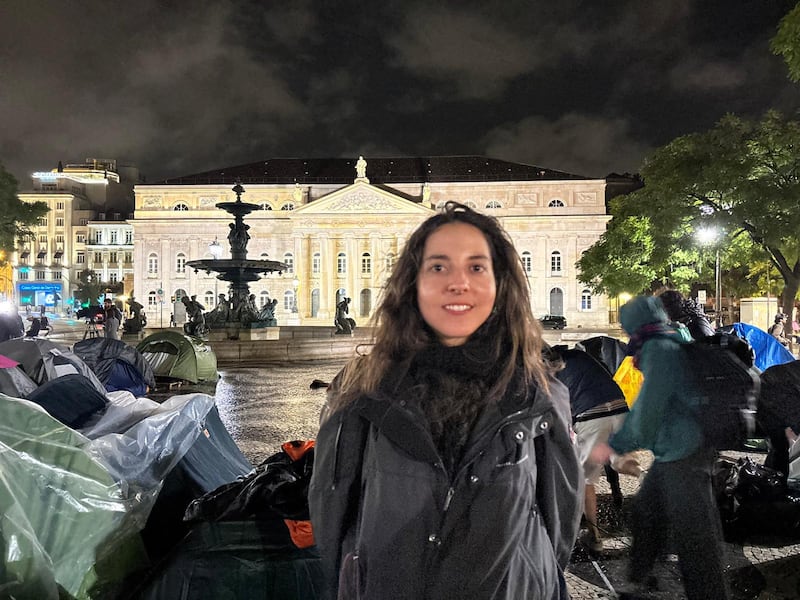
“You have people who are working full-time jobs and they are living in their cars [or] on the streets. They wake up in the morning, they go to work, they come back from work and they go back to a tent – sometimes not even a tent,” she says.
“Portugal has one of the lowest levels of public housing in Europe . . . which obviously contributes to [price] speculation and the increase in housing rents and costs, which at the moment occupies a very, very significant part of people’s incomes.
“And the amount of houses in Lisbon which could be used for housing people, but instead they’re used for Airbnbs and other kinds of tourist accommodation like hotels, or they’re being used for the sake of speculation: they’re kept [empty] for the purpose of raising the prices."
Alongside other organisers of the encampment, Canadas spoke to local and national media at about 9.30pm on Monday night to announce the end of the weeks-long demonstration that has become a mainstay in Portugal’s headlines.
“We’re removing the tents today because we decided we need to enlarge the movement. We need to go elsewhere,” she tells The Irish Times.
This wave of protests first emerged in Porto, in the north of the country, in early October before spreading to other cities, most notably Lisbon. The city’s police force has made three attempts to remove the encampment, arresting more than 90 people in the process.
“The police interventions were quite severe and brutal,” Canadas says.
Organisers say more than 25 people were treated in local hospitals for injuries.
While the housing rights movement has wide, if somewhat low-key support across Portuguese society, those within the encampment were at first seen as troublemakers. This was partly because of graffiti sprayed on the monument at the centre of the square, named in honour of a 19th-century king of Portugal and emperor of Brazil.
There was also a perception of anarchy within the encampment, although public support for the activists swelled after the police interventions, which have been condemned by civil rights organisations.
There have been various legal interventions, with the city’s administrative court ruling the demonstrators can stay in place but the country’s constitutional court overturning that decision. The protest was ultimately disbanded after the mayor’s office ordered their removal to make way for a Christmas market.
The end of the encampment on Monday night coincided with the start of Web Summit, the technology conference organised by Wicklow native Paddy Cosgrave that attracts up to 70,000 people to Lisbon alongside some of the biggest names in technology, media and business.
Protest organisers say they are planning a demonstration outside the conference on Wednesday.
[ At Web Summit opener, Palestine gets a brief mention and the loudest cheerOpens in new window ]
The Christmas market, Canadas says, “is just another reiteration of the housing project for Lisbon and for the country”. She adds: “They say yes to tourism, yes to the interests of capital and no to the interests and the rights of the people."
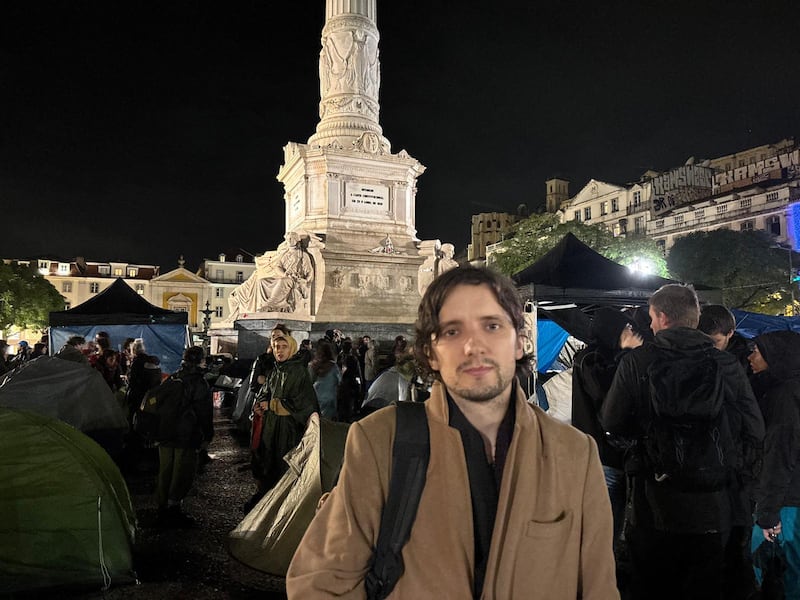
Borges says for most people of his generation, “it’s very hard to get out of your parents’ house”, even if they are paid far in excess of the national minimum wage of €920 per month.
“There’s a very specific young generation who is protesting for their rights,” he says. “In a way, it’s the right to have a future – because if you can’t afford your own house, you’re living on borrowed housing, borrowed money, borrowed time. You won’t have the right to a future."
The intermittent downpours of rain grow heavier as it approaches 10pm and, after the decision to end the encampment is shared with the wider group, many of the tents are quickly disassembled.
The road that wraps around the square – only accessible to taxis, cyclists and public buses – is surprisingly busy for a Monday night. Beeps of support from cars are welcomed with large cheers from the demonstrators.
“Thoughts about leaving?” Borges asks himself, as he gazes up to the statue of the 19th-century king atop a 23-metre high monument that now has banners with protest slogans at its foot. “It’s okay – we’ll come back stronger.”