

Whoever masters scent can master the human heart: that was the central claim of the 1985 German bestseller Das Parfum (Perfume). Four decades on Ulrich Siegmund, a 35-year-old German scent specialist, hopes he can make that claim reality after pivoting from smells to political slogans. It starts here; Everything is possible; Proud again. These are the messages that Siegmund hopes will trigger one of the greatest political upsets in postwar German history.
On September 6th, voters in the eastern state of Saxony-Anhalt choose a new parliament that is likely to be dominated by his local branch of the far-right Alternative for Germany (AfD). The AfD is well ahead in polls on 43 per cent, more than twice as popular as the second-placed centre-right Christian Democratic Union (CDU) that has governed here for 23 years.
Depending on turnout, and how its rivals perform, Siegmund’s AfD could even secure an absolute majority in the state parliament in Magdeburg. With that Saxony-Anhalt, home to just 2.6 per cent of the German population, could deliver a blueprint for future AfD state victories. And by 2029, so they hope, a real chance of power at federal level in Berlin.
At a campaign rally in a drizzly beer garden near Dessau, the sizzle of Bratwurst in the air mixes with a giddy whiff of approaching victory. Onstage, Siegmund – tight suit and open-necked white shirt – delivers a snappy speech with lines as sharp as his fade haircut.
READ MORE


“I don’t want that one centimetre more of our wonderful fatherland falls victim to crazy politics,” he says to cheers. “We are the future, the future is the AfD. Let us make history on September 6th, let’s take back our country.”

When a budgie, most likely an escaped pet, flies over the stage, its light blue feathers – the AfD’s blue party colour – attracts Siegmund’s eye. He tells the awed crowd: “It’s a sign.”
The gathering has the familiar, friendly atmosphere of people who have found their tribe. Their disillusionment with mainstream politics has yielded to confident good humour, thanks largely to a new generation of self-assured AfD politicians like Siegmund.
He was born three weeks after German unification in 1990 into a Saxon-Anhalt middle-class family with two engineer parents. From them Siegmund says he learned the value of hard work, because “nothing falls from the sky”.
Before entering politics full-time, Siegmund worked variously as a waiter, a travelling salesman and a representative for a Berlin eye clinic. His business and arts degrees included a bachelor thesis on “scent marketing: its commercial application to psychologically influence feelings of wellbeing to monetarily influence purchasing behaviour”.
Siegmund set up a scent business then switched to selling political ideas. After five years in the CDU he joined the AfD in 2014 just as it pivoted from bailout protest party to anti-migration movement. After two years in local politics, Siegmund entered the state parliament in 2016 as AfD health spokesman. His first national political headlines came in November 2023 after attending a gathering outside Berlin on so-called “remigration”.
It’s a slippery and controversial term which, depending on who you ask in the AfD, either means deportation of naturalised German citizens or failed asylum seekers.
When news of the gathering emerged, Siegmund insisted he favours the latter, more restrictive, approach. But since that flap he has learned to incorporate controversy into his political brand.
Siegmund brushed off revelations last February he secured his father a €5,500-a-month job with a Bundestag parliamentarian friend. National AfD leaders – quick to castigate cronyism elsewhere – criticised the arrangement as “leaving a bad taste in the mouth”.
Another flap came after a local AfD event in May where Siegmund smiled and applauded as a cabaret performer joked about hanging Angela Merkel before leading the audience in singing the East German national anthem.
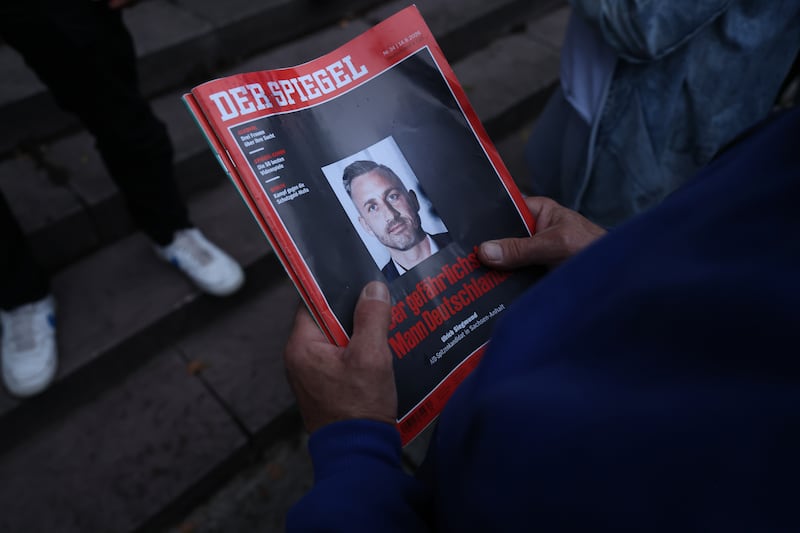
By now the 35-year-old now leans into controversy. When Der Spiegel magazine dubbed him “Germany’s Most Dangerous Man” on last weekend’s front cover, Siegmund posted clips of himself autographing and handing out copies of the magazine on his TikTok channel.
With more than 700,000 followers on that platform alone, Siegmund is now one of Germany’s most-watched politicians. His multiple daily posts, ranging from humorous rants to ironic stunts, have boosted his state’s AfD to similar levels of popular support as neighbouring Thuringia and Saxony.
That success, however, has brought unwelcome attention from Saxony-Anhalt’s state intelligence service. Its designation of Siegmund’s AfD as “secured extreme right”, based on surveillance and content analysis of speeches and policy papers, is contested vigorously by the party and the subject of ongoing legal proceedings.
While his critics see a populist demagogue in the making, Siegmund says his idol is Otto von Bismarck. A portrait of the so-called “iron chancellor” hangs in his Magdeburg office.
[ Derek Scally: AfD on a roll ahead of crucial electionOpens in new window ]
At the Dessau rally he tells the crowd his favourite Bismarck line: “In the long term, an idea that is right cannot be lied out of existence.” He doesn’t relate how Bismarck made that remark in an 1882 Reichstag debate over a state tobacco monopoly. For this beer garden crowd, the line has another meaning: with the AfD, their kind of common sense will prevail. And, in a fortnight, Saxony-Anhalt can light a spark in the dark.
This optimistic, can-do framing is clearly a winner with the nodding crowd of about 300 people. Predominantly male, there are muscular middle-aged men with tribal tattoos and T-shirts with slogans like “Alphafighter”; alongside them are groups of younger men with sharp haircuts and alert eyes. Scattered among them are older retired couples in pastel shades and sensible shoes. What attracts them to the AfD and Ulrich Siegmund?
“I like him, he works hard and tells it like it is,” says Meta, a 72-year-old Dessau native.
Dieter, a 52-year-old carpenter sitting beside her, says the AfD is popular for its promises to crack down on migration and make Germany “focus on helping ourselves and not try to save the world”.
“Two shots are fired in Syria and suddenly they’re all here,” he says. ““The AfD isn’t far-right here, it’s mainstream. I’m not far right. Well, maybe just a bit.”
In Dessau, Siegmund doesn’t dwell on detail, apart from his popular promise, in power, to cancel the statutory licence fee and tear up the state contract with MDR, a local public broadcaster the AfD views as irredeemably biased. That is an opening shot with potentially huge consequences for Germany’s equivalent of RTÉ.
Other campaign promises for Saxony-Anhalt, home to many of Germany’s lowest earners and one of the highest jobless rates, are promises to prioritise investment in local businesses and pay out bonuses of up to €4,000 for parents of new babies – provided at least one parent is a German citizen.
Critics accuse the party of making populist, racist and spendthrift promises, but Siegmund’s fans in Dessau couldn’t care less.
Their cheers of “Uli! Uli!” indicate Germany’s most prominent scent specialist has, in politics, retained his discerning nose for what works with the masses.
“From the people, for the people,” shouts Siegmund in the Dessau beer garden. “That is the perspective we never want to lose.”


