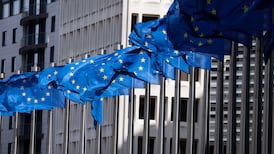

This time last year, Friedrich Merz made history twice over – just by showing up for work. On May 6th, 2025 Merz planned to be, at 69, the oldest person ever elected German federal chancellor.
On his big day, however, Merz fell 18 votes short of a Bundestag majority and became the first German leader in history to collect the chancellery keys on the second try.
One year on, Merz has set a third record: just 15 per cent of Germans have a positive opinion of his work, the lowest-ever rating for a chancellor.
The polling agency found voters’ problem is not the Berlin coalition of Christian Democratic Union (CDU) and Social Democratic Party (SPD) but “solely the person of Friedrich Merz”.
READ MORE


In a frank interview with this week’s Der Spiegel, Merz suggested to his fellow Germans: it’s not just me, it’s also you.
The chancellor berated those who view democratic politics through an “instant gratification” lens and refuse to accept a painful truth: after 80 years of peace and 36 years as a united country, modern Germany’s “prosperity illusion will not hold”.
“We are experiencing a profound upheaval. Not an open war in the middle of Europe but the impact is probably no less great,” he said. “We have yet to adapt to this, but that has yet to succeed because many want to maintain what they have and defend themselves against any change.”
Europe’s largest economy has not grown substantially since the pandemic, its industrial engine room is in trouble and the reform agenda Merz promised a year ago has mostly yet to materialise or make its effects felt.
The Iran war has knocked on the head hopes of a German economic recovery this year, and with a positive knock-on effect for Europe. A spike in company insolvencies, meanwhile, has pushed Germany’s jobless rate back above the crucial three million mark.
After berating voters, though, Merz was equally hard on his own government, rating it “below 50” on a scale proposed by Der Spiegel of one to 100.
Regular public squabbles among his ministers do little to build public confidence, he conceded, while his own CDU voters have extra reasons to remain furious with him.
He won the February 2025 snap election on a tax-cut-and-austerity ticket but then, even before taking office, backed a €500 billion borrowing package for infrastructure and a blank cheque for military investment.
Despite all that extra cash, Berlin still needed to back record extra borrowing for the 2027 budget.
This has revived CDU voter complaints that Merz is bending over backwards to please its SPD coalition partner, struggling on just 12 per cent in polls.
Not that anyone in the SPD is feeling flattered. They fear real voter backlash from cutbacks in healthcare and pension packages due in parliament before the summer break.
Beyond a challenging political to-do list, a common thread in talk about Merz is whether his temperament is suited to secure – and communicate – political compromise as a good and necessary thing.
“It’s a huge problem that he is such an impulsive person, it’s no way to lead the chancellery,” said Matthias Miersch, SPD Bundestag floor leader, last week.
CDU allies of Merz did not race to contradict that observation, with one senior adviser conceding that a main part of their job is to prevent Merz in public “repeating the last thing he has heard” on any issue.
Merz is aware of the criticisms and, in December, fired a close adviser. But many say the key complaints – poor political communication, even worse political co-ordination – remain fundamentally unchanged.
Ahead of the first anniversary, other Merz aides have fanned out to spin the coalition’s achievements. After 20 years of infrastructure neglect, Germany has launched its largest-ever investment programme. The coalition has pruned social welfare entitlements back to more sustainable levels and, after weeks of arguments, temporary fuel tax cuts kicked in to lower petrol prices to below €2 a litre.
Efforts to reverse armed forces neglect are struggling, they admit, but procurement and recruitment are at least back on the agenda.
Above all, Merz aides say they have defused a political time bomb by flattening the inward migration curve, though measures taken still face legal challenge and possible rollback.
Looking beyond Germany’s borders, the Merz record is equally mixed. German voters see no progress on ending the war in Ukraine nor any Berlin contribution towards a Middle East peace deal.
Ahead of Israeli elections, Merz has, as chancellor, cooled significantly towards prime minister Binyamin Netanyahu and retired Germany’s controversial “reason of state” rhetoric – though still supplies arms.
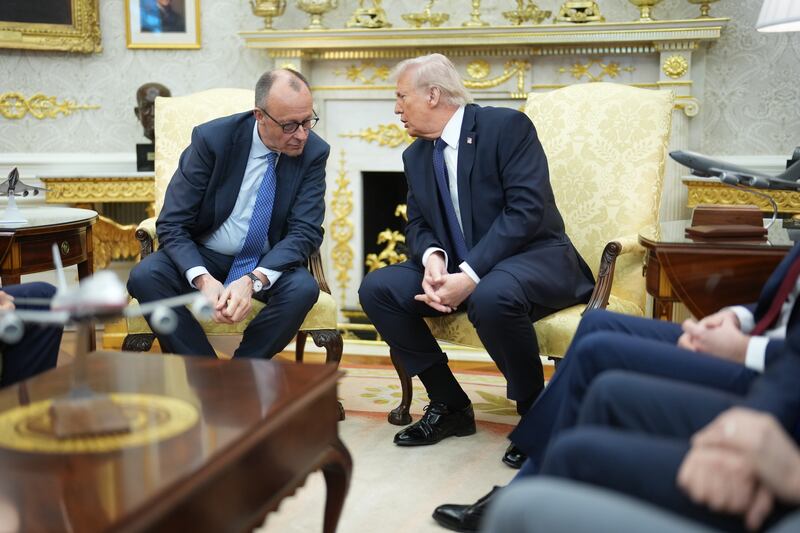
In the Oval Office, the chancellor held his tongue when Donald Trump slagged off his UK and Spanish colleagues, but Merz has been making up since by suggesting Iran had “humiliated” the US in talks to end a war Washington began “with clearly no strategic plan”.
In a television interview on Sunday, Merz insisted there was “no connection” between his remark and an announcement Trump would not just cancel a Biden-era plan to station US Tomahawk missiles in Germany, he was withdrawing 5,000 troops from Germany, too.
“There’s been talk for some time of their withdrawal,” said Merz, while the Tomahawk cancellation was no surprise “as they don’t have enough now themselves”.
Whether Iran blowback or in domestic spats, Merz insists his plain-speaking is not the problem but how modern political discourse encounters a “hypernervous public that is easily triggered”.
A year before French voters choose a new – possibly far-right – president, Franco-German relations are more work than progress.
Amid an unresolved row with Paris over a joint European fighter jet, German officials say Trump’s sabre-rattling has hardened the chancellor’s resolve to join a common European nuclear deterrent under French leadership. In Der Spiegel, the chancellor promised to do “everything we need for a secure Europe”
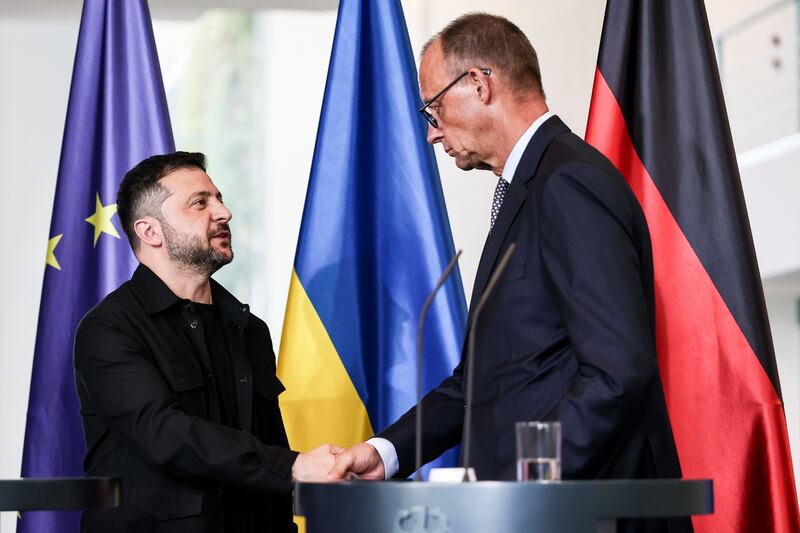
“We want to be able to defend ourselves so we don’t have to. Europe’s diplomatic strength will only have an effect if we can underpin it with military capabilities,” he said. “Frederick the Great put it well: diplomacy without weapons is like music without instruments.”
And what would the philosopher king say about politics without results?
For political analyst Wolfgang Schroeder, of the University of Kassel, the main problem Merz faces is leading a coalition that is “quarrelling hopelessly, with no plan”.
“No one knows what the next step is, the government is driving by sight and that makes people jittery,” said Schroeder. “Merz has the worst ratings of any chancellor but at present there is no real alternative.”
The Alternative for Germany (AfD) would beg to differ. After taking office last year, Merz’s CDU surged to 33 per cent in polls and squeezed the AfD to 18 per cent.
A year on, the far-right party is Germany’s most popular political force on 28 per cent, four points ahead of the CDU.
The AfD is poised to take power in at least one eastern German federal state in September elections. That creates a real prospect of the far right as a constant disruptive force in the Bundesrat upper legislative chamber.
One year in office, with three yet to go, the real window for political action is closing fast for Merz. Many analysts believe decisions taken – or postponed – in the weeks until the Bundestag summer break will decide the government’s fate.
For now, political scientist Schroeder predicts Merz will battle on: “His coalition will continue on its wobbly way, offering little to please the public in the way of good governance.”