Field marshal Burkhard Münnich, the German who led the army of Russian Tsarina Anna, went on a frenzy of boatbuilding in the winter of 1737.
With the help of his then Cossack allies, Münnich built 400 shallow-bottomed sloops in just one winter on the largest island in the Dnipro river, Khortytsia. He used the boats as troop carriers in Russia’s war against Ottoman Turkey.
The following year, vice admiral Naum Senyavin, who had studied shipbuilding in Holland with Tsar Peter the Great, built 30 brigantines for the Dnipro flotilla. The brigantines were sturdier than the open-air sloops. Each carried four canon and 50 crew.
Fast forward to 2026. Russia and Ukraine are engaged in a frenzy of drone production as they fight over the very territories which Russia colonised in the latter part of the 18th century. Russia exploited ship-making technology from 18th century England, France, Holland and Italy. Vladimir Putin manufactures Iranian-designed Shahed drones, which he calls Geran-2s, and has received up to 12 million artillery shells, more than 100 missiles and 16,000 troops from North Korea.
READ MORE


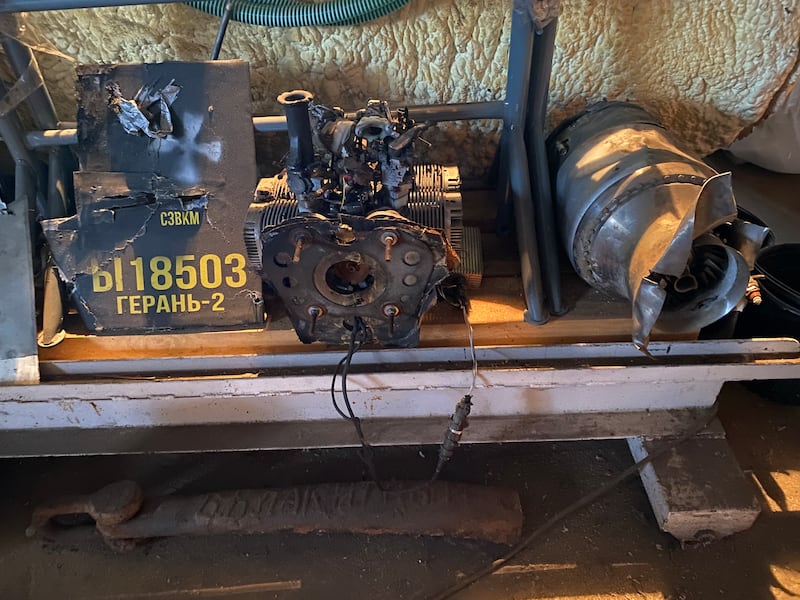
A corrugated steel hangar deep within the meadows and woods of the Khortytsia National Reserve (KNR) houses boats and artefacts retrieved from the Dnipro by the KNR’s archaeologists. Chief archaeologist Dmytro Kobaliia shows me debris from the Shahed drone which recently exploded 70m from the hangar.
“This is just a big metal garage,” Kobaliia says of the warehouse. “Our boats are as fragile as oil paintings. This is not a good place for them.”
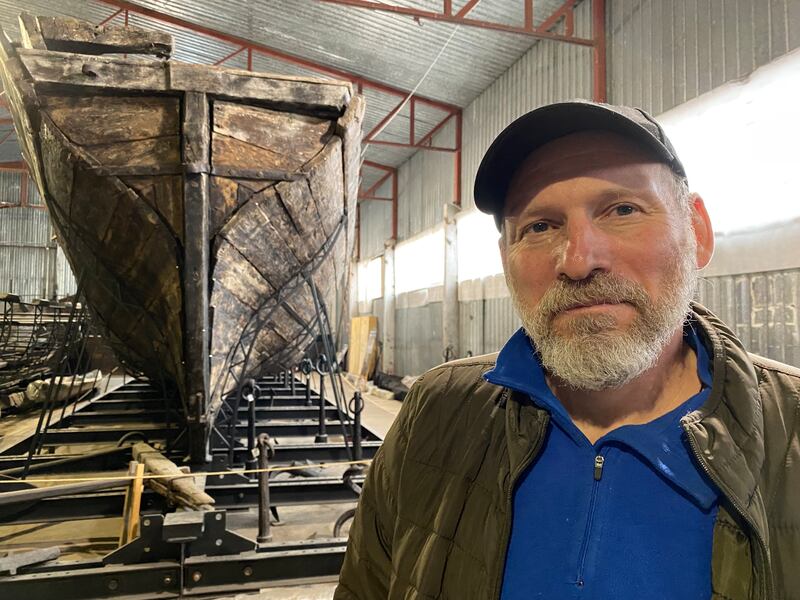
The large boats housed in the hangar – two sloops and a brigantine from the 18th century war and a 19th century baydak barge used for commerce – were already threatened by age, humidity and the drastic temperature swings of the Ukrainian steppe. Russia’s 2022 full-scale invasion poses the greatest threat of all.
Kobaliia (54), has spent 27 years studying Dnipro shipwrecks. He volunteered for the Ukrainian army on February 24th, 2022, and fought for two and a half years, firing mortars in Donetsk. Discharged because of his wife’s illness and a malformed hand, he returned to Khortytsia Island and set about trying to save the boats.
Most of the boats are vestiges of the 1736-1739 Russo-Turkish war. Russia and Turkey fought 12 wars between 1568 and 1918, one of the longest-running feuds in European history.
Münnich’s boatbuilding binge occurred 284 years after the Turkish sack of Constantinople. Russia had adopted Orthodox Christianity from Byzantium. Putin’s ideologues call Moscow the third Rome – Constantinople having been the second. The tsars of the 18th and 19th centuries dreamed of conquering Istanbul as a sort of revanchist Byzantium, much as Putin dreams of restoring Imperial Russia.
Münnich wanted a Black Sea shoreline as a pathway from Russia to the Mediterranean and trade with Europe. His goal of conquering what is present-day southeastern Ukraine and the Crimean Peninsula would be achieved by Catherine the Great a quarter century later. Catherine called the conquered lands Novorossiya or New Russia.
“Russia has this strange compulsion to collect lands,” says Kobaliia. “I always say this planet is too small for Russia.”
As Trump and Putin have learned, wars rarely unfold as planned. The Russo-Turkish war was interrupted by an outbreak of plague. Münnich did not have enough men to man his flotilla, let alone drive the Ottomans out of Crimea. He burned half his boats at Ochakiv, on the Black Sea. The rest limped back to Khortytsia where Russians and Cossacks built a military base, dismantling some boats for timber. The plague dead were so numerous in the winter of 1738-1739 that they had to be buried in mass graves. The brigantine-builder vice admiral Senyavin was among the plague victims.
The Dnipro shipwrecks lay largely undisturbed for the following two centuries. Pacifist Mennonites who fled Prussia and established a colony on Khortytsia in 1785 recorded seeing skeletons of ships on the beaches.
[ The hidden Jewish history at the heart of a Kyiv paintingOpens in new window ]
Between 1920 until 1960, the Soviet Union built a series of hydroelectric dams along the Dnipro. The Kakhovka dam, constructed downstream from Zaporizhzhia in the early 1950s, raised the water level of the Dnipro by five metres and covered the remaining shipwrecks. Under the influence of French oceanographer Jacques Cousteau, the Soviets embraced underwater exploration in the 1960s. Archaeologists studied the historic, sunken boats by scuba diving.
Russia blew up the Kakhovka dam in June 2023, flooding much of southeastern Ukraine and lowering the water level so that 18th century shipwrecks were exposed. “We found a lot of remains and details of ships on land,” says Kobaliia. “Time is very short to save archaeological wet wood. If you put any wooden object in water for centuries, when you take it out you have very little time to conserve it or put it back in the water. Wood dries out and disintegrates.”
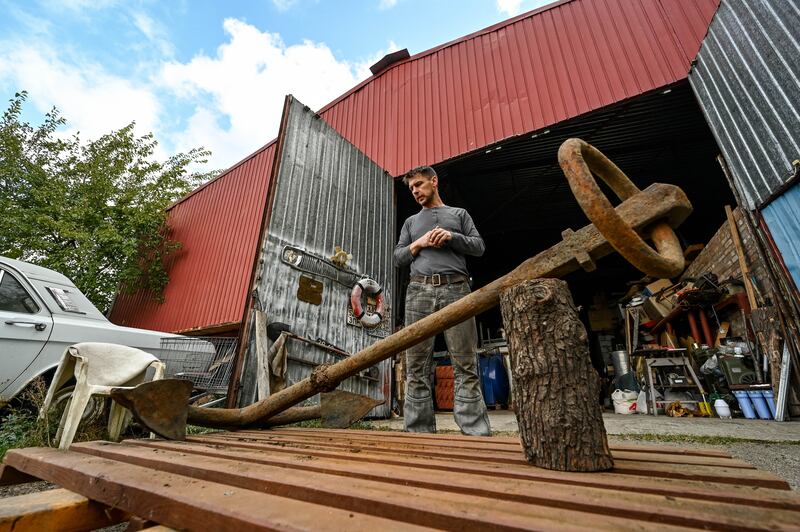
Kobaliia appealed to his old friend Fred Hocker, head of research at the Swedish National Maritime and Transport Museums, which include the Vasa Museum in Stockholm. Hocker visited Khortytsia. The two men organised an international archaeologists’ expedition to rescue the newly exposed boats.
The team of archaeologists worked last August, building a cofferdam to re-immerse one wreck, partially dismantling another and towing it a short distance upstream to a conservation facility.
While the team were in Zaporizhzhia, the Russians destroyed the bus station, a hospital, a supermarket and several apartment buildings in the city, Hocker wrote in the winter 2025-2026 edition of Sea History. “We were not spared on the ride home,” Hocker recounted. “Drones and missiles rained down on Ukraine during the night, and on two occasions hit train stations fewer than ten minutes after we passed through them.”
Now Kobaliia is determined to save his four prize ships, the sloops, brigantine and baydak I saw in the hangar on the Khortytsia reserve. Kobaliia and his friend Lars Amréus, director general of the Swedish National Heritage Board and an adviser to Swedish king Carl XVI Gustaf, have drawn up a plan to transport two boats 560km (347 miles) to Kyiv, the other two 2,434km to Karlskrona, the site of Sweden’s largest naval base and the headquarters of the Swedish Coast Guard.

[ The mystery of Ukraine’s Caravaggio: the second Taking of Christ?Opens in new window ]
Carl XVI Gustaf supports the plan to devote the equivalent of €1.2 million in Swedish krona to the project. He is the direct descendant of king Charles XII, whose military alliance with the Ukrainian Cossack hero Ivan Mazepa was defeated by Peter the Great in 1709. Putin styles himself as the modern-day incarnation of Peter.
Partially dismantling and transporting the boats on giant lorries through a war zone is a pharaonic undertaking, but Kobaliia will not rest until the boats are in safe keeping. The UN cultural organisation Unesco is expected to finalise its participation in coming days.
Kobaliia hopes the Russians will not target the boats. “They are cultural, not military objects. I hope that whatever small brain they have in their heads will tell them not to attack.”
Peter the Great helped design the brigantine for Russia’s 1700-1721 Great Northern War against Sweden. It is a small irony of the Khortytsia boat saga that a ship designed to fight Sweden may now be sent there to protect it from Russia.