It was 2am when the phone woke Oleksandr Titarchuk. Within minutes, he was in his car, racing to his workplace: the Chernobyl nuclear power plant.
When Titarchuk, the site’s chief engineer, arrived that morning just over a year ago, he found firefighters and rescue workers already busy.
Looming over them was the giant steel structure that covered the remnants of the world’s worst nuclear crash. All Titarchuk could think about was the emergency message that woke him: the structure had been hit by an attack drone.
The explosion ripped through the outer shell of the steel arch. Built less than a decade ago, the structure was supposed to safely encase the “sarcophagus”– the concrete tomb hastily erected in 1986 around Reactor 4 after it exploded, sending a radioactive cloud over Europe.
READ MORE


Titarchuk takes pride in keeping a cool head. He was relieved to find that no one was injured. But the situation was bad.
Several hundred worked in shifts, climbing to great heights in winter temperatures that fell below -10 degrees. Each one carried a dosimeter to keep track of radiation; when it exceeded the permitted level, they rotated out.
Thermal vision drones helping to monitor the blaze showed it smouldering until March 3rd – a full 17 days after the drone struck.
The arch was built to keep the damaged nuclear site from threatening the world again for at least another century. Now it was compromised, open to the elements, and prone to corrosion.
Inside the now-damaged arch – which is large enough to house the Statue of Liberty – sits the unstable concrete “sarcophagus”, and within that hundreds of tonnes of fuel-containing masses and vast amounts of radioactive dust, including uranium and transuranic elements, the substances that come after uranium in the periodic table. Without significant repairs to the arch, officials warn, corrosion will set in within four years.

“If the [concrete] shelter collapses, a radioactive cloud will rise,” says Serhii Tarakanov, the plant’s general director.
Ukraine’s financially strapped government has taken the first steps to repair the hole made by the drone. But the European Bank for Reconstruction and Development (EBRD) says it will need about €500 million to make the site safe again.
The call for donations, and the 40th anniversary of the 1986 disaster next month, highlight a lingering danger at one of the world’s most vulnerable nuclear sites.
They come at a time of severe international discord. War is raging in Ukraine – including near its nuclear facilities. The Middle East is ablaze. And in the White House is Donald Trump, an ultra-sceptic of multilateral projects.
“As 1986 taught us, radiation does not recognise borders,” Tarakanov says. “The wind will carry these transuranic elements across Europe.”
“This isn’t a ‘Ukrainian problem’,” he added. “It is a continental threat that is being ignored.”
‘Safe confinement’
When the €1.5 billion “New Safe Confinement” (NSC) – the arch’s official name – was built in 2019, it was designed with multiple layers to shelter the “sarcophagus” beneath, and resist moisture, radiation, heat and even a Class 3 tornado.

It was meant to buy Ukraine, and the world, time to find a lasting solution for the remains of the reactor that lies beneath it, and the radioactive materials around it.
Built in two parts, it was slid into place using rails and hydraulic jacks. The NSC’s designers expected it to last a century. What international donors failed to anticipate was a major war – much less the drone strike in February 2025.
Chernobyl is in Ukraine’s north, near the Belarus border, along an air corridor frequented by Russian missiles and drones, including those aiming at Kyiv. Ukrainian officials say last year’s strike was carried out by an Iranian-designed Shahed attack drone – and claim it was intentional. Volodymyr Zelenskiy, Ukraine’s president, said the drone was flying at an ultra-low altitude of 85m, probably to avoid radar detection.
The site became an active military zone in the first weeks after Russia’s full-scale invasion in 2022. Troops seized the facility and camped in the exclusion zone, kicking up radioactive dust as they moved through the highly contaminated “Red Forest” surrounding the plant.
The war once again reminded the world that containing Chernobyl’s nuclear threat is a never-ending struggle.

The arch’s metal frame is 108m high and nearly three times the weight of the Eiffel Tower. Two cranes hang from its roof, built to continue the painstaking work of dismantling the most unstable parts of the “sarcophagus” – officially known by Chernobyl staff as the “Shelter Object” – built after the disaster in 1986. The cranes are operated remotely from a control room to minimise human intervention in what is still a high-radiation environment.
Among the remains of Unit 4 is the damaged reactor and some 5,000 tonnes of sand, lead and boric acid dropped from helicopters after the disaster. The EBRD says the unit still houses 190 tonnes of uranium dioxide fuel. The reactor’s lower reaches contain “lava-like, fuel-containing masses”, with melted steel and concrete in various locations.
Damage
Last year’s drone strike did not cause radioactive leaks into the atmosphere, officials say. But damage to the arch’s outer cladding and the holes drilled by emergency workers have compromised the NSC’s ventilation system.
Since the structure is made of metal, the ventilation system was designed to limit corrosion by maintaining relative humidity below 40 per cent in the “annular space” – the technical term for the ring-shaped gap between two concentric structures. This part of the arch was also designed to maintain a stable pressure differential, acting as an additional barrier to stop radioactive releases.
Without repairs to the ventilation system, “corrosion will set in” on the arch by the end of this decade, said Balthasar Lindauer, the head of the EBRD’s nuclear safety department.
[ Depressed by the news? Be a ‘happy warrior’ – and other tips to raise hopeOpens in new window ]
Nuclear officials say the NSC has lost several core functions, including the ability to contain the radioactive substances and provide a controlled environment within which to dismantle the “sarcophagus” – the main reason it was built.
“Without a sealed shell, the whole system fails,” said Tarakanov, the plant’s director. “There is now an open link between the interior and the outside world. This means we can no longer keep humidity within the required limits.”
Chernobyl’s management completed emergency repairs on the NSC in early October, covering the main breach with a protective shield before the onset of winter rain and snow.
But officials acknowledge the metal sheet does little more than keep water out. Simon Evans, an EBRD nuclear safety expert who managed the fund that built the NSC, describes it as a “glorified tarpaulin”.
Phase two, Tarakanov said, will be interim repairs costing €5 million to €10 million, which Ukraine is raising from donors. Tarakanov said much of that work – sealing all the small punctures and restoring part of the membrane – should be done this year.
Phase three will aim to fully restore the NSC’s functions: “an exceptionally daunting task”, Tarakanov said, since the membrane that burned away was embedded within a so-called “sandwich” structure.
“Given the intense radiation fields directly above the destroyed reactor, this presents a formidable technical challenge,” Tarakanov says.
‘Sarcophagus’
The Chernobyl “sarcophagus” was built in about 200 days in 1986, under gruelling conditions. Vast radiation fields made standard building codes impossible to follow, and the result was never structurally stable. Plant officials say a nearby missile strike could trigger its collapse, causing radioactive dust to rise and exit via the unsealed arch to the atmosphere.
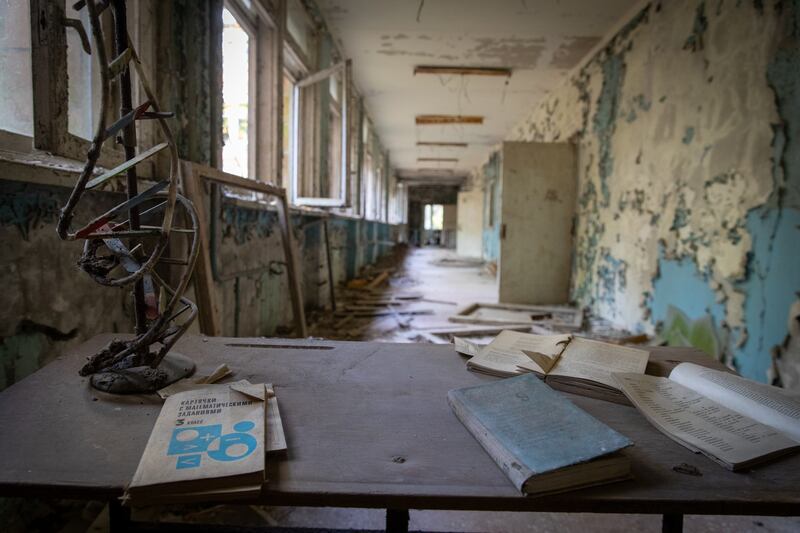
Thousands of men were drafted from across the then-Soviet Union to help clear debris from the explosion and entomb Reactor 4. When clearing the roof, they donned lead-lined aprons and respirators and were given strict time limits to limit their exposure to gamma radiation, according to Adam Higginbotham’s book Midnight in Chernobyl. The “shelter object” was designed to last 20 years, but has now been standing for 40.
At the time of the drone strike, plant officials had prepared a plan for the “early deconstruction” of unstable components in the sarcophagus. But with the NSC compromised, officials paused the dismantling of the remains of the plant.
“You can’t continue while you don’t have that level of confinement which is required,” says Rafael Mariano Grossi, director general of the International Atomic Energy Agency (IAEA).
“The structure of the building is not compromised,” Grossi said. “What is compromised are all the ancillary systems – and the level of confinement is affected.”
Ukrainian nuclear officials have warned that combat operations could cause another incident.

“Nearly every day and night, we witness hostile missiles and drones flying over the Chernobyl exclusion zone,” says Tarakanov. Drones and missiles can fail, be “blinded by electronic warfare systems or just veer off course”, he adds, while there is also the possibility of an intentional hit: “The fallout from that would be catastrophic.”
“A missile or heavy drone landing near the arch creates a seismic impact,” he says. “No engineer on earth can guarantee that the shelter will not collapse from such a shock.”
[ We face a real danger that the nuclear arms race might be about to resumeOpens in new window ]
The site is also home to the world’s largest spent fuel repository and “enormous volumes of liquid radioactive waste,” he adds. “A strike on any of these facilities – intentional or accidental – could trigger a nuclear catastrophe of global proportions.”
Ukraine has also called – with limited success – for more international pressure on Russia for its war of aggression in the vicinity of nuclear sites.
In May 2023 Grossi, the IAEA chief, told the UN Security Council that both sides should follow five principles to ensure safety at the Zaporizhzhia nuclear power plant, which Russia has occupied and is operating.
“The principles boil down to two things,” says Grossi. “Don’t shoot at a nuclear power plant, and don’t make a nuclear power plant a military base to project force to the other side.” No binding solution has been adopted, however.
“The true lesson of Chernobyl was never just about engineering or physics – it was about the collective moral responsibility of our species to protect the world from its own inventions,” Tarakanov says.
“If we allow a man-made war to shatter a man-made safety shield, we are admitting that while we have learned how to harness the atom, we have failed to learn how to govern ourselves.”
Funding
The International Chernobyl Cooperation Account – which co-ordinates work on nuclear safety, security and decommissioning within the Chernobyl exclusion zone – has more than €70 million in its coffers, according to the EBRD. But Arvid Tuerkner, the bank’s managing director for Ukraine and Moldova, estimates the cost of the project will be “north of €500 million”.
While the arch prevents the release of contaminating dust into the environment, it does not block gamma radiation, which reaches anyone working above it.
[ Forty years after Chernobyl, we are again on a nuclear knife-edgeOpens in new window ]
“At the top of the arch, you would get your maximum dose [of 20 millisieverts per year] in 11 hours,” says Evans. “That drives complexity and it drives cost.”
EBRD officials describe international support for Chernobyl to date as the “largest ever global collaboration on nuclear safety”, but says this has been put in “fundamental jeopardy” by Russia’s drone strike.
In one sign of how much things have changed since the arch was built in 2019, Moscow was among its initial donors.
Countries “recognised they needed to support Ukraine ... and agreed to put in place funding to provide a long-term solution,” says Evans.
The hope, he adds, is that “the international community will come together again”. – Copyright The Financial Times Limited 2026