Part of a town in Sicily is teetering on a cliff’s edge, days after a landslide cut a wide chasm that destroyed buildings and threatened to swallow more, including structures in the historic city centre.
The landslide in the town of Niscemi happened on Sunday, triggered in part by intense rain from Cyclone Harry, one of the most damaging storms in the Mediterranean in decades. On Wednesday, rain continued to fall and the hillside was still crumbling, heightening the danger to buildings and infrastructure near the edge.
More than 1,500 people had been evacuated from neighbourhoods along the chasm, which stretched for about 4km. Houses and apartment buildings were perched precariously at the edge, and aerial footage showed underground pipes and cables dangling from exposed foundations. A silver-grey sedan was partly suspended over the abyss.
“We are in a movie, in a horror film, it’s still all up in the air,” said Stefania Di Giovanni, who lives a kilometre from the edge. She said she did not know when she would be able to return to the restaurant she owns in Niscemi’s historic centre.
READ MORE


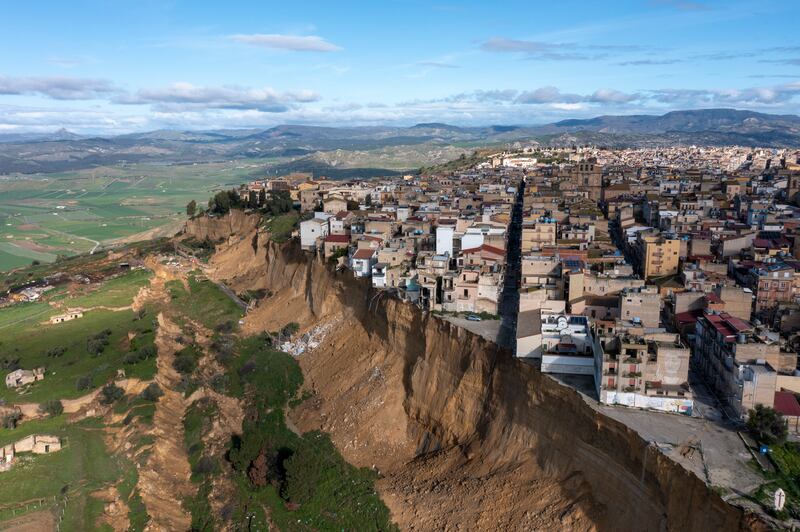
Niscemi is one of the towns hit worst by Cyclone Harry, which brought heavy rain and flooding to Sicily and Italy’s southern coast. Italy’s prime minister, Giorgia Meloni, who visited Niscemi on Wednesday, called the situation there “particularly complex” and said she was “determined to provide immediate responses”.
Her government has declared a national emergency across Sicily, Sardinia and Calabria, all areas affected by the cyclone, and has set aside €100 million for the disaster response.
Fabio Ciciliano, the head of Italy’s National Civil Protection Service, said the crumbling hillside in Niscemi was preventing emergency workers from approaching the scene. He said it was hard to calculate the extent of the damage or say when, if ever, people could return to their imperilled homes.
“At the moment, it’s very hard to imagine the future” of the town and the surrounding area, he said by telephone after surveying the area in a helicopter.
“The only thing we can do now is wait,” he said.

Parts of Niscemi’s historic centre and nearby businesses are at risk, the authorities have said. Frida Rooftop Bar on the old town square has a view of the seaside town of Gela and the ocean beyond, its draw since it opened in 2020, but it is now on the fault line, said Gaetano Parisi, whose family owns the establishment.
“We built this dream five years ago, but at the moment, we don’t know if this dream will continue to exist,” Parisi said.
Luigi Virone, a doctor at the local hospital who grew up in Niscemi, owns one of the town’s oldest houses. Built in 1693, it is now a pub, in a terraced part of the historic centre with Baroque-era homes, which many fear will not survive the disaster.
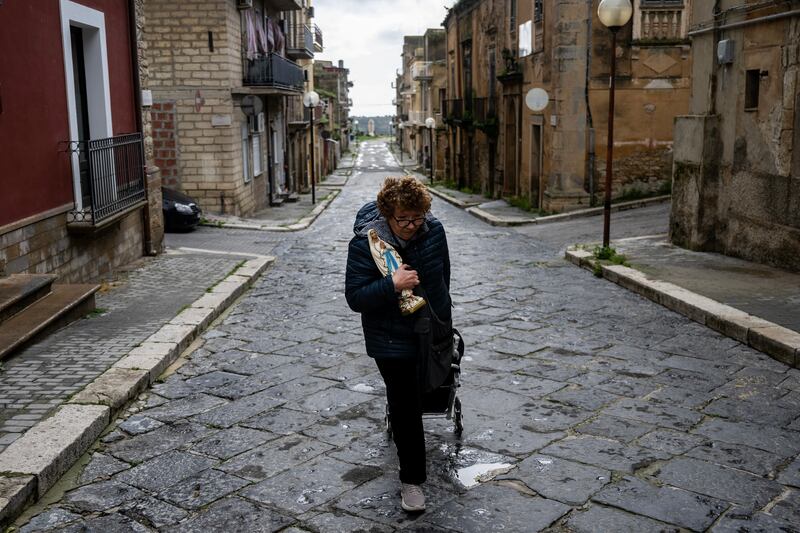
Virone said he tried to visit the area on Sunday, just after the landslide, and found a stricken neighbourhood as people were forced to evacuate. “Disbelieving and lost faces, eyes welling with tears, frightened children carrying precious items,” he wrote in a message. “Others didn’t even have time to grab clothes to wear the next day.”
He said he felt “helpless, frustrated, and small compared to the force of nature.”
Cyclone Harry was unprecedented, at least in human memory, said Giulio Betti, a climatologist and meteorologist with the National Research Council, citing the intensity of the storm, which swept through an extended area.
Niscemi, a town of about 25,000 built on a sloping plateau, has a centuries-old history of landslides and may have to reconsider how it builds, said Giuseppe Collura, a geologist with the Sicily Italian Society of Environmental Geology.
The same area struck by the landslide was hit by one in 1997 that affected several buildings, requiring that they be demolished, he said.
“There was a high probability that these events would, in short, be repeated over time in these areas,” Collura said. Niscemi was struck by a landslide earlier this month, Italian authorities said; Collura said the one that followed on Sunday was “a second step”, part of the same geological development.

Giuseppe Cafà, a parish priest in Niscemi, said the week had felt apocalyptic, with many residents wondering how they will rebuild or plan a life. Some fear being isolated for weeks or months as the state repairs the roads. With some schools closed because of damage, many parents wonder where their children will finish the year.
Though most of Niscemi is not directly threatened by the disaster, the imperilled historic centre, the town’s oldest neighbourhood, is its heart, Cafà said.
“It’s as if we were losing our roots,” he said.
– This article originally appeared in The New York Times.


