
The Trump administration has indicated to Ukraine that US security guarantees are contingent on Kyiv first agreeing a peace deal that would likely involve ceding the Donbas region to Russia, according to eight people familiar with talks.
Washington has also suggested it would promise Ukraine more weaponry to bolster its peacetime army if – as the price of peace with Russia – it agreed to withdraw its forces from the parts of the eastern region it controls, two of the people said.
Volodymyr Zelenskiy, Ukraine’s president, had hoped to sign documents on security guarantees and a postwar “prosperity plan” with the US as early as this month, giving Kyiv leverage in future talks with Moscow.
But Washington is now signalling the US security commitments depend on reaching an accommodation with Russia. Ukrainian and European officials described the US stance as an attempt to strong-arm Kyiv into making painful territorial concessions Moscow has demanded in any deal.
READ MORE


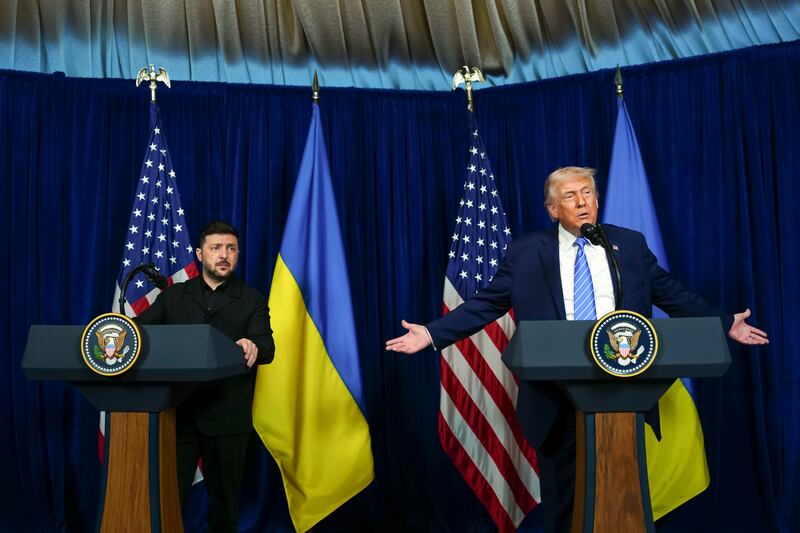
The US has yet to give its final approval to either agreement even though Mr Zelenskiy said the texts of the security guarantees, which he discussed with US president Donald Trump at Davos last week, were “100 per cent ready”.
A senior Ukrainian official said it was increasingly unclear whether the US would commit. “They stop each time the security guarantees can be signed,” the official said.
Following Mr Trump’s meeting with Mr Zelenskiy in Washington last month, US officials said the offer of American security guarantees “will not be on the table forever”, without elaborating.
Ukraine wants to confirm the US security guarantees before it gives up any land. The US, however, believes Kyiv must give up the Donbas for the war to end and is doing little to pressure Russian leader Vladimir Putin to abandon one of his most hardline – and persistent – demands, the people said.
In response to questions about conditions attached to the security guarantees, Anna Kelly, the deputy White House press secretary, said: “This is totally false – the US’s only role in the peacemaking process is to bring both sides together to make a deal.”
“It’s a shame that the Financial Times is letting malicious actors lie anonymously in order to muck up the peace process, which is in a great place after this weekend’s historic trilateral meeting in Abu Dhabi,” she added.
A person familiar with the US position said Washington was “not trying to force any territorial concessions upon Ukraine”. “The US has said that security guarantees depend on both sides agreeing to a peace deal, but the contents of the peace deal are up to Russia and Ukraine.”
Mr Zelenskiy on Friday said he and Mr Trump had “finalised” bilateral US-Ukraine security guarantees while in Davos. The matter of territory remained undecided as Kyiv entered the first three-way talks with Washington and Moscow held at the weekend in Abu Dhabi.
Mr Zelenskiy’s presidential office did not respond to a request for comment. But the senior official in Kyiv said the Americans “use the guarantees ... to push Ukraine” towards concessions they believe can get “Russia to the table”.
The official said a crucial reason for the prosperity agreement for Ukraine remaining unsigned is that Zelenskiy and Trump agreed in Davos that the document needed more work.
Composed of the Donetsk and Luhansk provinces, the Donbas has been a bulwark against Russia’s invading forces since 2014. The 50km (31 miles) defensive line containing the cities of Kramatorsk, Slovyansk, Druzhkivka and Kostyantynivka is often referred to as a “fortress belt”.
Conceding it has been a red line for Mr Zelenskiy and a majority of Ukrainians, according to polling earlier this month.
The US is pushing Ukraine to withdraw troops from the Donbas region to create a “free economic zone”.
Initially, Washington said it wanted a “demilitarised zone” that would be internationally recognised as Russian territory. Moscow has said it would agree to deploy its national guard and police to the demilitarised zone instead of its armed forces.
But after pushback from Kyiv and its European partners, Mr Trump eventually compromised with Mr Zelenskiy, agreeing a neutral force could oversee the area.
Mr Zelenskiy has come around to supporting the idea of a “free economic zone” but only if it remains internationally recognised as Ukraine’s, and Russian forces withdraw an equal distance from it.
The proposed US commitments include a pledge that guarantees will “mirror” Article 5, Nato’s self-defence clause, and a promise of a co-ordinated military response in the case of a sustained attack, two people familiar with the matter said. But they risk being too vague to satisfy Kyiv yet also too broad for Russia, one of the people added.
The Kremlin insists it will not end its war unless Ukraine unilaterally and completely withdraws from the Donbas region. “There is enormous pressure being put on the Ukrainians right now,” said one of the people.
Should Russia be given the Donbas as part of a peace deal, or capture it by force, Ukrainian officials and military analysts say it would give Moscow’s forces a launch pad to attack deeper inside Ukraine.
Speaking at a Ukraine-themed event in Davos on Thursday morning, Trump’s special envoy Steve Witkoff said there had been significant progress in the peace negotiations with the Ukrainians. “I think we’ve got it down to one issue ... and that means it’s solvable,” he added, in a reference that Mr Zelenskiy later said was to the Donbas territory.
Mr Witkoff said on X that the talks in Abu Dhabi “were very constructive, and plans were made to continue conversations next week” in the Emirati capital.
Mr Zelenskiy on Monday confirmed a second three-way meeting later this week but said “further diplomatic work” remained on “complex political matters that remain unresolved”.
– Copyright The Financial Times Limited 2026


