

With allies like this, who needs enemies?
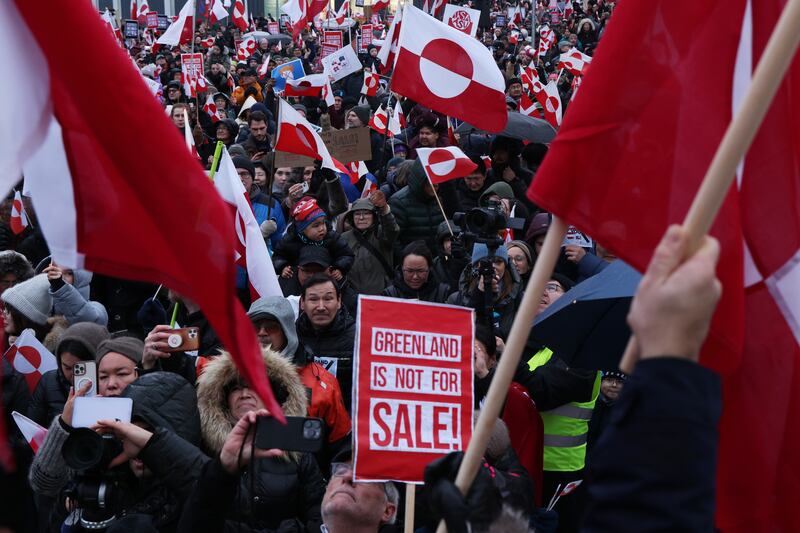
US president Donald Trump’s bullish efforts to “buy” Greenland are, he claims, motivated by his desire to protect the western hemisphere from the security threat posed by China and Russia. Yet, at the weekend he became the sole architect of an act of diplomatic cannibalism on Nato. Xi Jinping and Vladimir Putin must be really enjoying watching the American and European alliance eat itself. The US president is determined to gain an island, even at the cost of losing the world.
Ireland, which is not a member of Nato, is of course not included in the eight countries which are now being threatened with 10 per cent and possibly even 25 per cent tariffs on goods exported to the US. Those countries were specifically chosen by Trump in retaliation to a comparatively small Nato military exercise carried out in Greenland last week. Ironically, some within Europe had thought the exercise might appease Trump – who had been loudly complaining that he felt Nato’s security presence in the Arctic was little more than a couple of dogsleds. Instead “Mister Tariffs”, as he christened himself on Truth Social, perceived it as a slight.
But by Sunday morning, it was quite clear that the 27 member states of the European Union saw this new act of unprecedented transatlantic acrimony as one that is as much about EU-US trade as it is about relations within Nato.
READ MORE


The Irish Government did not hesitate to rush to express solidarity with its EU colleagues. Minister for Foreign Affairs Helen McEntee framed Trump’s jaw-dropping announcement as one that threatens the basic principles of international law and sovereignty – an issue that Ireland is more than entitled to express a position on given its UN membership. Once again, Ireland’s military neutrality was exposed as being distinctly different from political neutrality as McEntee said that “Denmark and Greenland of course have the sovereign right to arrange military exercises with their partners, on their own territory”.
Tánaiste and Minister for Finance Simon Harris had only just returned this weekend from a trade visit to California, a trip which he had described as “no accident” – pointing out Ireland’s “mutually beneficial” trading relationship with the US. Yet he was forced on Sunday morning to all but accuse Trump of undermining the work that had gone into the Turnberry trade deal – an EU-US agreement which was negotiated to neuter the previous threat of trade war that had been started on 1600 Pennsylvania Avenue.
That deal had been due to be ratified by the European Parliament by the end of this month. Already, some of the biggest parties in the EU have made it clear that they will now postpone that important sign-off. Prominent EU leaders including French president Emmanuel Macron also proposed that the bloc use what’s known as its “trade bazooka” on the US – the never-before-triggered Anti-Coercion Instrument (ACI), which is available to the EU if and when it feels it is being blackmailed by trade rivals. “Blackmail” is exactly the word that was used towards the US by the Danish and Swedish prime ministers at the weekend.
But the Taoiseach was more reluctant to rush towards punitive measures. Micheál Martin said he felt it was “premature” to be talking on Sunday about triggering the ACI, which could give the EU the power to punish US companies with restrictions on trade and investments, as well as sanctions on intellectual property rights. Martin was also talking down the prospect of the EU not honouring the Turnberry deal – but added that it of course retained the right to retaliate against the US if it pressed ahead with its tariffs threat.
The pace at which the US president is bringing us the latest instalments in the episodic drama of his relentless attempts to increase the global real estate of the United States is quite fast. The benefit for the Taoiseach is that, if dialogue does prevail, there is some hope that this global political drama will have reached a peaceful conclusion long before Martin steps foot in the gold-gilded Oval Office on St Patrick’s Day. We have been here before with Trump and, as Martin pointed out on Sunday, a lot of the threats made on so-called “Liberation Day” never came to pass.
[ Diplomatic standoff awaits as US senators fly to Denmark for Greenland talksOpens in new window ]
On the other hand, it won’t have escaped the attention of Irish officials that Cyprus, which currently holds the EU presidency, was responsible for convening an emergency meeting of EU ambassadors on Sunday. How would Ireland manage a similar deterioration in transatlantic relations during its EU presidency, which starts in July?
Though it has been relegated to a political subplot for the moment, it is worth considering if another threat to Europe’s existing trading relationships could cast Ireland’s opposition to Mercusor in a new and even less-flattering light. The European Commission believes that American protectionism is one of the greatest arguments for the South American trade deal.
We may also now need to consider if, post-Venezuela, the US president is someone whose hair-trigger threats need to be taken more seriously. There are other ways for an emboldened Trump to wreak havoc on global economies. In his book on the 1929 stock market crash, Andrew Ross Sorkin suggests that the failings of the fledgling Federal Reserve in the late 1920s were because it was too close to US politicians. A more politically minded Fed is exactly what Trump wants when he installs a new and presumably more deferential chair in May.
All of which puts Ireland, which is loyal to Europe, in the position of being an opponent of the US rather than an economic ally. This could prove to be both uncomfortable and uncharted terrain.


