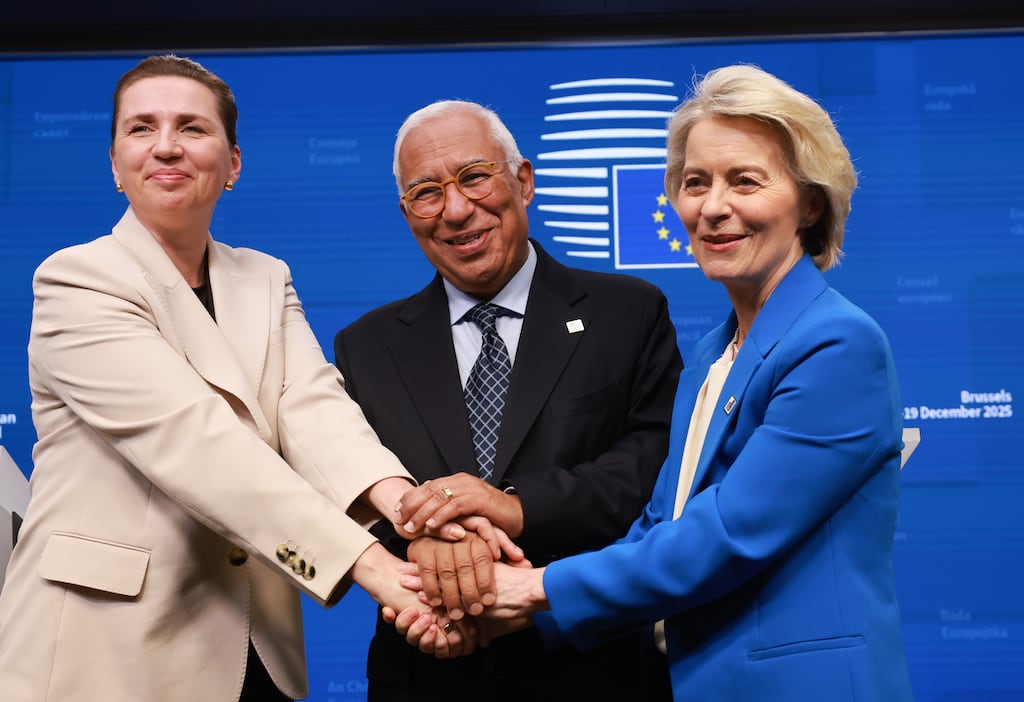
The leaders of the European Union have agreed to jointly borrow €90 billion to give to Ukraine, after a plan to finance a similar sized loan using sanctioned Russian state assets foundered during a late-night summit in Brussels.
The EU will borrow the money as a bloc to make sure Ukraine does not run out of cash for another two years, while the war heads towards its fifth year and peace talks continue.
The union’s 27 national leaders spent hours at what was seen as a make-or-break summit to agree a substantial package of financial aid which has been welcomed by Ukraine’s president, Volodymyr Zelenskiy.
The original plan was to turn to a large pile of Russian central bank assets, “frozen” in European financial institutions by economic sanctions since the early weeks of the war, to extend a lifeline loan to Ukraine.
READ MORE


The legally complex and politically contentious plan to use €210 billion of Russian state cash to back up a loan failed to convince key objectors, such as Belgium, where most of the assets are held.
The summit instead agreed that the EU would borrow €90 billion itself against the union’s budget, breaking a taboo for Berlin and other frugal capitals that have traditionally opposed taking on shared debt.
The summit broke up in the early hours of Friday morning, after a day of backroom negotiations and intense debate between national leaders.
There were credible fears that Ukraine would begin to run short of money in the spring of next year, risking a potential collapse on the battlefield and necessitating help from Kyiv’s European allies.
In a post on X, Mr Zelenskiy said the “significant” investment would “truly strengthen our resilience”.
“It is important that Russian assets remain immobilised and that Ukraine has received a financial security guarantee for the coming years,” he said.
“Thank you for the result and for unity. Together, we are defending the future of our continent.”
Belgium had opposed the original asset-backed loan, due to fears it would be the target of retaliation from Moscow, because the vast majority of the funds are in Euroclear, a Belgian securities depository that houses government bonds.
The frozen asset loan would have needed other EU states to provide guarantees, worth upwards of €200 billion, to jointly cover Belgium’s exposure to any fallout.
Belgium’s hard-right prime minister, Bart De Wever, continued to insist that his fellow EU leaders commit to “uncapped” financial guarantees.
Several governments said it would be legally impossible to offer unlimited guarantees, which would need to be approved by national parliaments.
Leaders pivoted to a “plan B”, which will see the EU borrow €90 billion itself. It was a deal that Belgium could sign up to, and Hungary’s far-right leader, Viktor Orban, opted not to block.
Mr Orban and two other populist leaders, Slovakia’s Robert Fico and new Czech Republic prime minister Andrej Babis, did not object to the EU loan, on the condition they would not be required to contribute towards any related costs borne by the union’s budget.
Mr Orban, seen as the most pro-Kremlin of EU leaders, has previously held up aid for Ukraine. His government had earlier ruled out support for the union taking on joint debt to fund a loan for Kyiv.

The Hungarian leader shifted position and decided not to veto the EU loan at the summit. The U-turn was viewed as Mr Orban preventing Europe from moving on the Russian funds. Mr Orban told other leaders they could move ahead with an EU loan as long as Hungary would not face any costs.
Moscow hopes Washington will put pressure on the EU to lift its regime of economic sanctions on Russia, unfreezing its assets, as a condition of a future truce settlement between Russia and Ukraine.
Speaking after the summit ended, Mr De Wever said the joint loan was a more straightforward plan that meant the union was sailing in “chartered waters”.
A statement agreed by leaders outlined Ukraine would only be expected to repay the loan when Russia paid out compensation to Kyiv for the damage caused by its invasion.
European Commission president Ursula von der Leyen said the decision addressed Ukraine’s “pressing” need for funds for the coming two years.


