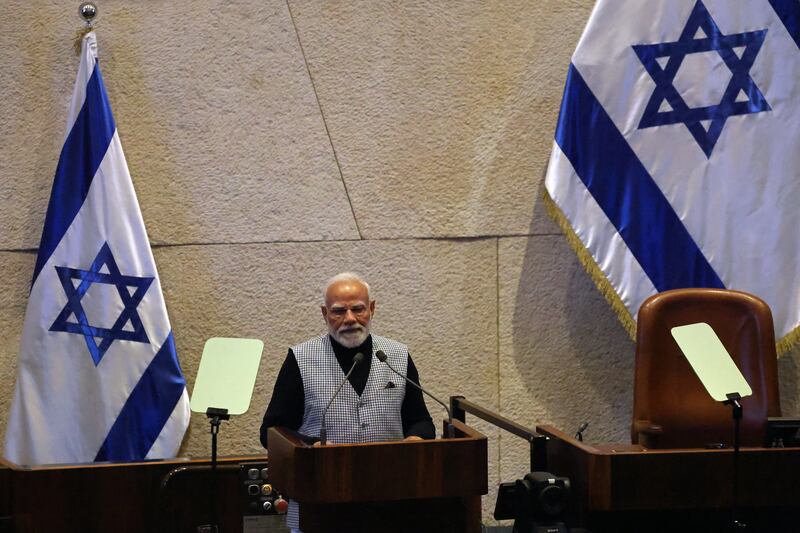
Indian prime minister Narendra Modi began a two-day visit to Israel on Wednesday.
Modi said he discussed a range of issues with Israeli prime minister Binyamin Netanyahu aimed at “deepening and strengthening relations between our countries”.
“India supports Israel because it understands that Israel serves as a protective wall from barbarism,” Netanyahu said, referencing the spread of “radical Islam” in the Middle East.
Opposition lawmakers walked out of the Knesset plenum during the welcoming speech by speaker Amir Ohana in protest against the fact that he had not invited Israel’s supreme court justice to the event. They also boycotted Netanyahu’s address, but returned to hear Modi’s speech.
READ MORE


Bilateral ties have steadily strengthened since Modi’s watershed visit to Israel in 2017 and India has become an important market for Israeli weapons systems. The trip will include agreements to deepen security, economic and diplomatic co-operation.
Additional agreements will cover agriculture, innovation and academic co-operation, and the two countries are also negotiating a free-trade agreement.
Historically India, when a leading member of the non-aligned movement, was critical of Israel while backing Palestinian rights. But that changed after the two countries established full diplomatic relations in 1992 amid the Israeli-Palestinian peace process.
Today, New Delhi is seeking a more balanced approach. Despite the close bilateral ties, in September India backed the United Nations-backed New York declaration calling for swift and concrete steps toward a two-state solution to the Israeli-Palestinian conflict. Last week, India was one of the more than 100 countries condemning Israel’s recent moves to expand its control in the West Bank and advance a de facto annexation.
The two countries share concerns over Turkey’s regional role, including its support for Pakistan and Bangladesh, and its activities in the Horn of Africa.
Netanyahu sees India as a vital partner in his vision of a “hexagon of alliances” in and around the Middle East, which also include moderate Arab states, African countries, Mediterranean states such as Greece and Cyprus, and Asian partners.
The India–Middle East–Europe Economic Corridor (IMEC), backed by Washington, envisions rail links connecting India to Europe via the United Arab Emirates, Saudi Arabia, Jordan and Israel.
The goal, according to Israeli officials, is to strengthen a moderate axis in the region amid concerns about a Muslim Brotherhood-aligned bloc led by Turkey and fears that Saudi Arabia could draw closer to it.
However, the current tension between Saudi Arabia and the Emirates and the lack of progress towards normalisation between Saudi Arabia and Israel have put the IMEC project on hold.