
“As a children’s author, I find it quite hard to be writing children’s books these days,” says Chris Haughton, national children’s laureate 2026-2029.
“More than 20,000 innocent children now have been killed. I’m sick of what I’ve been seeing.”
Haughton, an Irish children’s book author and illustrator who is based in London, may appear to be an unlikely terror suspect.
Yet, since his arrest at a mass demonstration for holding a sign that stated “I support Palestine Action”, he is awaiting trial for supporting a designated terror group in the UK.
READ MORE


The Irish illustrator is among more than 4,000 people, including more than two dozen Irish people, arrested on terror-related charges in the UK for declaring their support for Palestine Action.
“There’s 4,000 of us that have been arrested now,” he says. “It’s absurd.”
Sinéad Ni Shiacáis, an Irish woman who travelled to London to take part in protests, was arrested on the same day as Haughton.
“The day I went over I was extremely nervous, I’m just an ordinary person,” she said. “When I went over to the UK I was very very nervous, because the UK I felt was becoming more extreme.”
“For me Palestine Action are just ordinary everyday people that can see the source of the problem – International law is being broken. And they have the audacity to scapegoat us and call us a terrorist.”
More people have been arrested in the last year for supporting Palestine Action than were detained during a single year at the peak of the Troubles, an analysis by The Irish Times has found.
Irish people now constitute the largest number of non-British-national terror-related arrests in the past year.
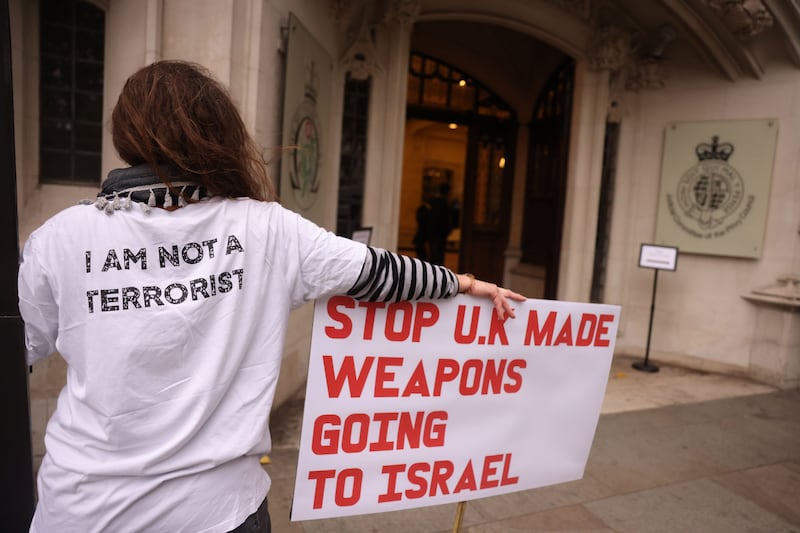
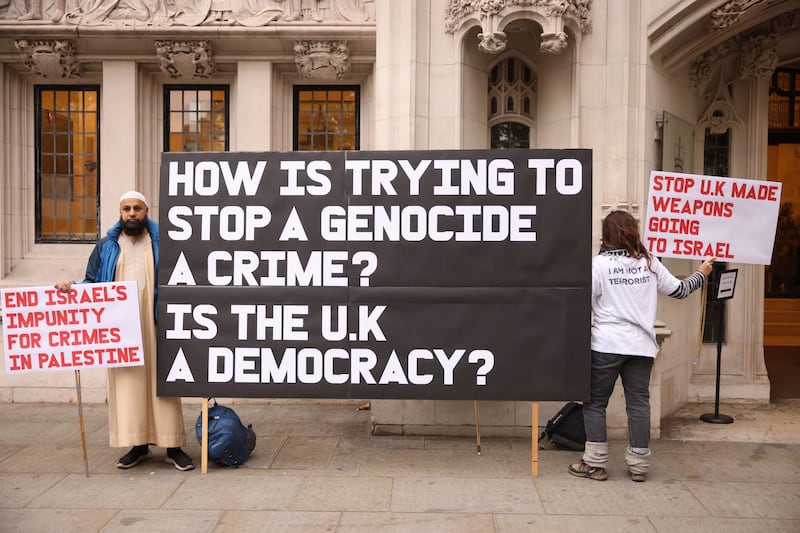
The UK supreme court began hearing a challenge to the proscription of Palestine Action on November 4th. A high court judicial review in February found the ban was unlawful, but this judgment was overturned by the Court of Appeal in June.
Under the legislation, to date more than 4,000 arrests have resulted in thousands awaiting trial and potential prison sentences.
The figures are continually rising given the now regular occurrence of Palestine Action protests, where mass arrests take place for holding signs of support – including a further 300 people arrested outside the US embassy last weekend.

With 3,630 people arrested in the first year since Palestine Action was proscribed under British terror law, UK terror-related arrests are higher than all annual recorded arrests during the Troubles.
Under the Operation of the Prevention of Terrorism in Northern Ireland, the Prevention of Terrorism (Temporary Provisions) Act came into force on November 29th, 1974. It provided the police with powers to arrest suspected terrorists and detain them for 48 hours.
The highest number of detentions for all proscribed groups in Northern Ireland was 1,795 in 1992, according to data recorded between 1974 and 1998, collated by the Northern Ireland Statistics & Research Agency and published to the Northern Irish Conflict Archive on the Internet (CAIN).
The definition of arrests does not apply to those detained under internment, as interned individuals were never formally arrested. Yet even considering internment figures – estimated at 1,981 detained over the four years of internment between August 9th, 1971, to December 5th, 1975, according to CAIN director Martin Melaugh’s research – these numbers are lower than the numbers arrested in the last year for supporting Palestine Action.
Aside from the IRA, Palestine Action arrests now outnumber all UK terror-related arrests made in the 15 years after the 9/11 al-Qaeda attacks on the United States.
According to UK terror arrest figures published by the Home Office, Ireland now appears, once again, to the biggest exporter of “terror” to the UK, with 28 of those arrested identifying as Irish – more than any other nationality outside of Britain in the year ending June 2026.
As a result, arrests linked to support for Palestine Action have altered the typical demographic profile of a terror suspect in the UK.
The typical terror suspect in the UK is now a white woman in her 50s.
For the first time in the past year, Home Office data now shows the majority of people charged with terror-related activity are female. The proportion of white people arrested has also doubled, with 59 being the average age of a person arrested for being a Palestine Action supporter.
Changing definitions
Palestine Action was originally proscribed as a terror organisation on July 5th, 2025, primarily after a series of “direct action” incidents that allegedly involved vandalism of Israeli-owned Elbit Systems drones factories in the UK.
The alleged vandalism was designed to disrupt Israel’s defence industry in response to the Israeli military’s actions in Gaza.
On October 7th, 2023, Hamas, the armed Palestinian group in Gaza, led an attack on southern Israel in which about 1,200 people were killed and 251 others were taken hostage. Since then Israel’s attacks on Gaza have killed more than 70,000 people, according to Gaza’s health ministry.
The International Association of Genocide Scholars has stated that Israel’s actions in Gaza amount to genocide. South Africa launched proceedings against Israel before the International Court of Justice in 2023, alleging that Israel’s military actions in Gaza constituted a genocide against the Palestinian people, but a ruling is not expected for several years.
Elbit Systems UK Limited denies that it supplies weapons or military equipment to the Israel Defense Forces or the Israeli ministry of defence.
In one incident in August 2025, activists destroyed drones and computers, causing an estimated £1 million (€1.2 million) in damage to the Filton Elbit Systems factory, before clashing with security and police. One officer was struck with a sledgehammer, fracturing their spine.
Palestine Action members are also alleged to have broken into the RAF Brize Norton airbases in Oxfordshire on June 20th, 2025, and graffitied two planes.
Palestine Action says planes from Brize Norton fly regularly to the RAF Akrotiri airbase in Cyprus and onwards over Gaza for secretive surveillance operations.
[ Albanese urges Ireland to ‘show spine’ on Palestine during EU presidencyOpens in new window ]
“Its activity has increased in frequency and severity since the start of 2024 and its methods have become more aggressive, with its members demonstrating a willingness to use violence,” the explanatory memorandum prepared by the Home Office and laid before the UK parliament states.
Jonathan Hall, an independent barrister who was appointed by the Home Secretary as the UK’s fourth Independent Reviewer of Terrorism Legislation, advised the UK government on its decision.
He told The Irish Times it was the “first time” property damage was used as the primary basis for proscription.
“If you think Palestine Action is a protest group who paint a few jets red, of course you wouldn’t call them a terrorist group,” says Hall.
“But the government has assessed the facts to be that Palestine Action is a very big organisation which runs clandestine cells, and these cells have got targets which involve causing really serious damage to property worth hundreds of millions of pounds.
“The definition of terrorism in the UK extends to serious damage to property as long as it’s being done to intimidate a section of the public.
“It could be security guards, it could be Jews. Or to try to influence the government ... for example, so it doesn’t supply arms to Israel or doesn’t allow Israeli weapons manufacturers to operate in the UK.
“You actually might even cause more damage for society’s ability to control those people that have given up on democracy and who say because they believe there is a genocide they can do whatever it takes to stop it.”
Hall says the British public should voice their dissent only through democratic non-violent means.
This is a classic example of counterproductive counterterrorism. This has actually increased the prominence of Palestine Action
— Alan Greene
Proscribing Palestine Action criminalised support, the invitation of support, or membership for the group.
“There are 100 groups that support Palestine and there is one group amongst them that is being explicit about its use of violence in that,” says Clionadh Raleigh, director of the Armed Conflict Led Event Database, which examines terrorism and conflict around the world.
“And so, when you want to give that group money and stand on the corner with that particular placard, you are saying, ‘I support this group’ – there will be consequences.
“What I think is most egregious is people want consequence-free really extreme political statements.”
However, arguing in the supreme court on Wednesday, Raza Husain, a lawyer for the group, stated, “Palestine Action never advocated for violence against the person.”
He told the court on Wednesday that only three of its 385 actions over five years met the legal definition of terrorism, and only because they involved property damage.
Indeed, proscribing Palestine Action as a terror group primarily based on property damage presents a marked change in the interpretation of UK terror legislation.
Under the Terrorism Act 2000, which was brought into effect after the Troubles to prepare for future terror threats, it was legislated that property damage could be used to justify proscription, based on lessons from IRA car bombings.
“The British government was quite quick to say this would be a heavy power only used in exceptional circumstances,” says Conor Crummey, a lecturer in the School of Law and Criminology at Maynooth University.
“They said we can rely on the Home Secretary to use that discretionary power responsibly and courts can step in to ensure it is used in line with human rights.”
Alan Greene, a professor of constitutional law and human rights at the University of Birmingham, says a selective application of the law now undermined the UK’s terror legislation itself when criminal law for incidents of vandalism could have sufficed.
“The restraint that had been traditionally there to stop this overexpansion and overapplication of terror laws is now gone,” he says, arguing that the laws were now prohibiting British citizens’ freedom to protest and express dissent.
“It seems to be a general authoritarian shift in the UK.
“I think it’s being abused to pursue certain political objectives while at the same time ignoring other threats and harms that could equally be dealt with through the same counter-terrorism approach.”
The same rules, Greene says, could be used to proscribe environmental groups such as Extinction Rebellion, Just Stop Oil, or far-right groups who engage in property damage at immigration centres or against RNLI lifeboats.
Similar to the sign-holders, republican and loyalist groups who display support for proscribed groups with flags and murals in Northern Ireland also risk arrest.
Greene says proscribing Palestine Action and triggering an extreme number of arrests has not only undermined terror legislation in the British public’s eyes, but also distracted from very real terror threats.
“This is a classic example of counterproductive counterterrorism,” he says. “This has actually increased the prominence of Palestine Action.
“Police resources are being directed toward dealing with these protests rather than other very real threats toward the Jewish community and British society on a whole.”
On October 14th, the Home Office put the UK’s terrorism threat level at severe, meaning an attack is considered highly likely in the next six months.
On October 22nd, the British government launched a campaign for every Briton to prepare 72 hours of supplies – including bottled water and tinned food – in anticipation of climate and technological risks, and threats from hostile states.
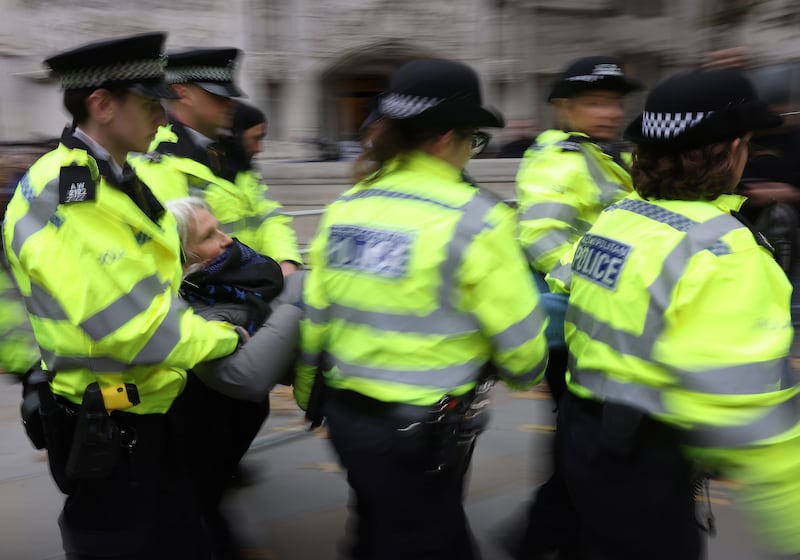
As the supreme court weighs its decision, with an outcome expected in January, a further two dozen protesters were arrested outside the court on Wednesday.
Haughton continues to await trial alongside thousands of those arrested, but remains undeterred.
“Holding a placard makes a mockery of the proscription,” he says.
He has pledged to donate proceeds from his children’s books to Sally Rooney, the Irish author who recently had her books removed from sale in the UK over her own commitment to donate their proceeds to Palestine Action.
“To be quite honest, I think it’s a badge of honour at this point,” he says.