

Before news of the shock resignation of MetroLink boss Seán Sweeney hit the headlines earlier this month, State public transport agency Transport Infrastructure Ireland (TII) moved to reassure international investors the multibillion rail project was still on track.
“We would have regular engagement with all of the major market participants and we did call each and every one of them in advance of the announcement so that there were no surprises,” says TII chief executive Lorcan O’Connor.
“The message was ‘we recommit to the publicly stated, procurement milestones that we’ve already made’ and I think that was very reassuring to the market.
“While they all expressed disappointment at a personal level to see Seán leaving the project, they equally would have recognised that this is a 10-year project and there will be a number of project directors during that time.”
READ MORE


The 67-year-old New Zealander on April 2nd announced he was stepping down from the €550,000-a-year job for family reasons after less than two years in the role.
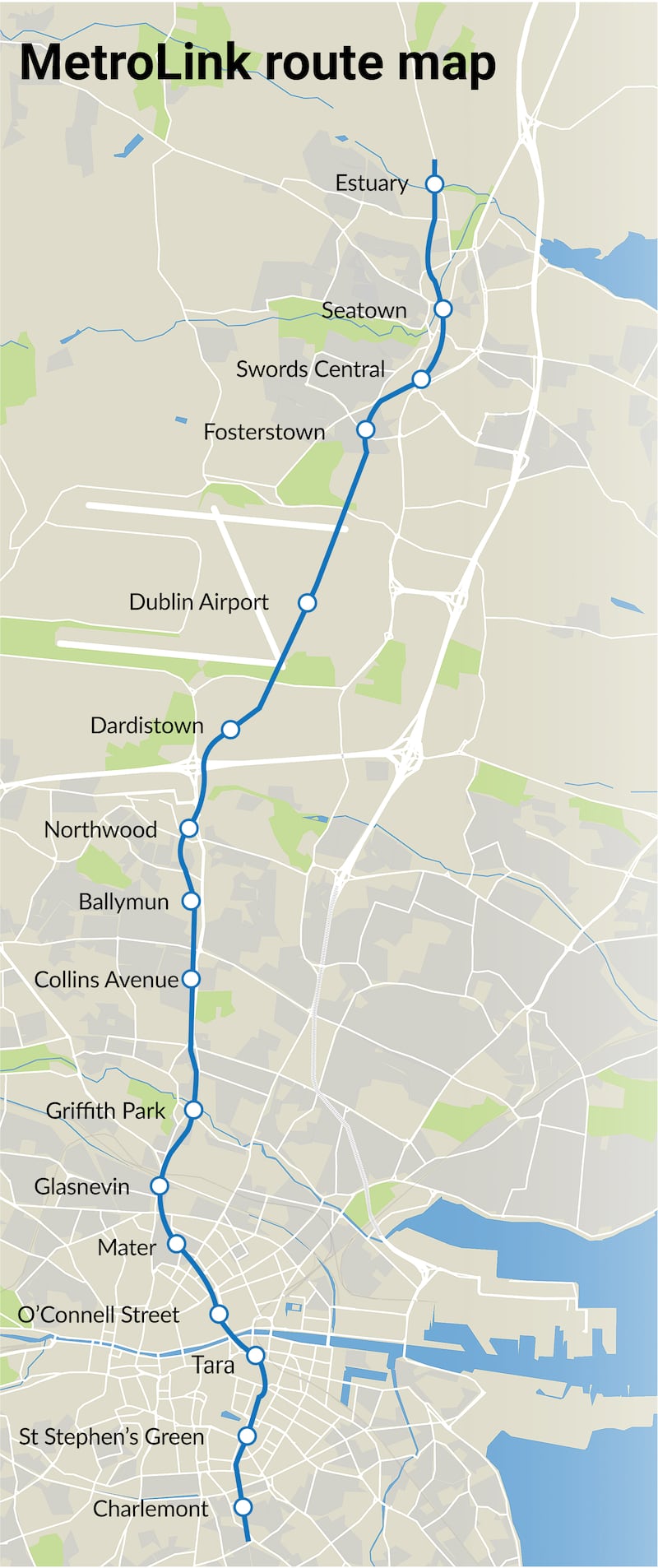
Had Sweeney stayed the course he could have been pushing 80 by the time services started running on the 19km line from Swords in north Dublin to Charlemont on the southside of the city, serving Dublin Airport and city centre.
It was never a guarantee, or even a likelihood he would still be at the helm then, but the timing of his departure is less than ideal.
MetroLink has reached a crucial juncture and any uncertainty that could result in jitters among prospective bidders is something TII would be eager to avoid.
Until now, TII has been gauging market appetite for the project, starting with an international roadshow hitting major European cities last autumn and in February issuing “pre-qualification questionnaires” (PQQs), seeking expressions of interest from firms that want to be shortlisted to bid for the tunnelling and station-building elements of the line.
Now it is crunch time.
[ MetroLink chief’s shock resignation could spook construction marketOpens in new window ]
To move from expressions of interest to seeking bids to build MetroLink, TII must get Government approval for its new cost estimates for the line.
At the end of March, just days before Sweeney’s announcement, TII submitted its business case, with updated costs, to the National Transport Authority (NTA), which will be presented to the Government for decision before the Dáil breaks for the summer in July.
These are the first cost projections since before the MetroLink application was submitted to An Bord Pleanála (since replaced by An Coimisiún Pleanála) back in 2022.
Back then €9.5 billion was the midpoint of a “credible” cost range of between €7.16 billion and €12.25 billion.
However, a review of that business case, undertaken by the Department of Public Expenditure’s major projects advisory group, said the cost forecasts should have allowed for “unknown unknown” risks, which would put the potential upper limit of costs at more than €23 billion.
It’s no secret that costs will have increased significantly beyond the 2022 midrange, O’Connor says.
“There’s clearly going to be an increase in costs given the inflation that has taken place over the last years,” he says.
“But you can’t look at costs without looking at benefits and for me, that’s the key linkage. Do the benefits still significantly outweigh the costs? The likelihood is that they will, by a large extent.”

On the specifics of how big the increase in costs will be, he says that it “wouldn’t be appropriate for me at this stage, prior to the business case going to and being considered by Government, to comment on the specifics”.
An indication of just how much higher those costs could be might be found in the contract notices or PQQs issued in February, which had a maximum value of €7.9 billion, though TII said it expected bids to be “considerably less” than this figure.
Those tunnelling contracts are just one element of the project. The other big component is the operation of MetroLink over a 25-year period, a contract that will also include the fit-out of the stations and provision of trains.
This PQQ is to be advertised by the end of this month, at which point the “maximum contract value” for both big elements, the building and the operation of MetroLink, will be known.
These two sets of contracts cover the major infrastructural elements of MetroLink, but there are more. Contracts for enabling works, including moving underground utilities out of the way of the tunnel, have been advertised with a combined maximum value of €680 million.
O’Connor stresses all these contract values are “maximums” and not what TII expects to be sought by bidders.
“What’s required in procurement documentation is to give an indication of the top line expectation of what those costs might be. You would expect then through competitive tension you would come at quite a different number to that,” he says.
Separately, there are the property acquisition costs. The €30 million to buy homes from the residents of Dartmouth Square in Ranelagh, Dublin 6, which ended their legal challenge to MetroLink last Christmas, gained huge attention, but it is just a fraction of the money that will have to be spent on acquiring land needed for the project, estimated to be in the region of €500 million.
Although, unlike many of the sums sunk into MetroLink, property acquisitions – both sites and buildings – have the potential to recoup some cash.
“The bulk of those properties would be available to the market again in the future,” O’Connor says, “so I think from a taxpayer’s perspective, there’s certainly a return there.”
Then there’s money that has been spent to date – €360 million to the end of last year, largely on bringing the project through the planning and procurement stages, as well as staff costs and initial property acquisition.
It is tempting to tot up all these figures, which, if the operational contract had similar values to the tunnelling contract, could potentially hit €18 billion.
However, until the business case making its way towards Government is published, these sums remain in the realm of speculation.

Similarly, the timelines for completion of the line cannot be known until contracts are signed with builders. The first of these contracts, for the enabling works, will, if sanction is secured by the Dáil recess, be signed by the end of this year, O’Connor says, with the diversion of utilities, which will involve digging up roads, starting next year.
The tunnelling contracts would be awarded by the end of next year, which would allow construction to start by 2028. The timeline for the completion of full construction will depend on the bids selected but is expected to be about eight years.
Meanwhile the search is on, internationally again, for Sweeney’s replacement, who, O’Connor hopes, will be selected by the end of the summer.
“For a project such as this, it is a specific skill set that we’ll be looking for. We will be looking internationally, but that’s not to exclude anyone in Ireland that might be appropriate,” he says.
This may not necessarily be someone who has developed a metro previously, he says, but will be someone experienced in delivering large infrastructure projects.
“By the time this new person arrives, you’re very close to the construction phase. So there are different skill sets that you will be looking for,” he says.
“So I wouldn’t be confining it to metro experience, but big infrastructure experience that would be key.”


