There’s a recipe for winning when not playing well. It’s a tricky one, and head chef Leo Cullen will know that the ingredients will not come together every time.
Firstly, a large dollop of discipline was called for – Leinster troubled referee Pierre Brousset with just nine penalty offences, and avoided a card of any colour. Then, they kept their opponents scoreless for the entire second half. Finally, they maximised whatever rub of the green came along.
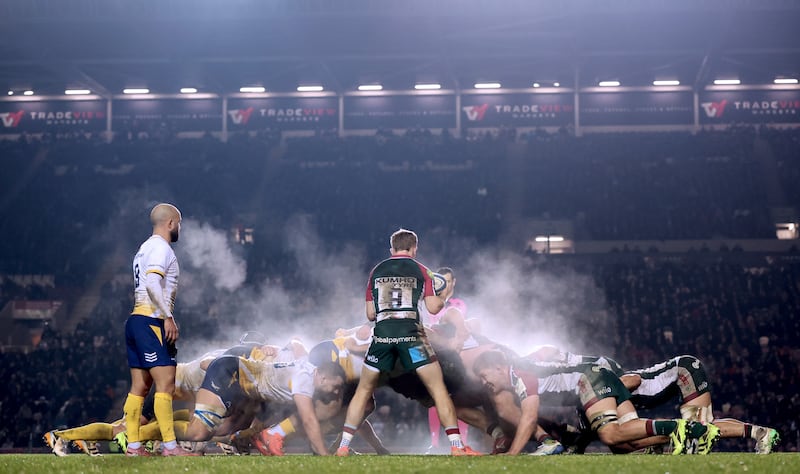
That rub appeared to happen when Leicester’s scrumhalf Tom Whitley chucked the ball towards the backrow of his scrum. Whitley then went to the back of the scrum to collect it, but the ball never arrived. Pinball-style it rebounded and came out the tunnel; when that happens it has to be thrown in again. But Brousset must have seen things differently and his whistle remained silent. A grateful Jamison Gibson-Park played to it, and with Whitley missing he scampered in for a vital try.
Earlier we saw a spectacular opening try by Leicester’s Adam Radwan, who foot-controlled a loose ball magnificently for all of 70m. But, and there is a big question mark here, why was the ball running loose in the first place? Tommy Reffell’s tackle on Robbie Henshaw, which caused the Leinster centre to spill the ball, looked to be a definite no-arms dangerous hit into the shin of the Leinster centre.
READ MORE




It was a penalty to Leinster which didn’t come, despite the apparent presence of all four match officials.
Jack Conan’s afternoon lasted barely a couple of minutes, nearly losing his head as he slipped into a tackle by Freddie Steward. It was accidental, and the referee correctly did not sanction Steward.
Astonishingly, Conan was allowed to pack down in the subsequent scrum before he was taken off, even though it was crystal clear that Leinster should have removed him straight away. Any delay, no matter how small, in removing a player who has received such a heavy hit to their brain is not acceptable.
The match stats will show that Munster scored five tries against a very depleted Gloucester, coming away from Páirc Uí Chaoimh with a winning bonus point. So all is well ... but actually it isn’t.
For a large chunk of the match Munster offered very little to get excited about, and three of those tries came in the last quarter as Leicester’s gallant but inexperienced challenge fell away. Against a fully locked and loaded opposition that level of performance will not translate to a victory, and the candid coach is fully aware of it.
In charge of the encounter was Welsh referee Ben Breakspear, a new kid on the block. I hadn’t seen him before, but liked his performance. Let’s just whisper it for the moment, but it was a good outing, and he may well be a much needed emerging talent.
Of course both teams will have queries for him, and for the EPCR referee manager, Tony Spreadbury. But Breakspear did show good game understanding, allied to an instinctive feel for what was going on. These are things which no referee coach can instil – you either have it or you do not. Currently, too many officials are in the latter category.

“Access” is a relatively new term in rugby’s lexicon. It certainly was an oft-ordered dish of the day delivered by referees during the November test matches. It is designed to tell players that they must not block kick-chasers from accessing their team-mate who is catching the ball.
Some prominent players and coaches are not happy. The arguments are that “access” is leading to more box kicking, more knock-ons, more stoppages, and thus less ball-in-play time. While that appears to be true, and it’s impossible not to have sympathy with those views, they cannot be reasons to allow players to obstruct an opponent who is chasing the ball, or attempting to make a tackle.
While “access” as a word is relatively novel, shielding or blocking kick-chasers amounts to just good old fashioned obstruction. The current interpretation is not a law change, it has been in the book for aeons. So, appeals for World Rugby to rescind it will fall on deaf ears. Such a change would require major law surgery around obstruction, and, you can bet, would be packed with plenty of unwelcome, unintended consequences.
Nevertheless, the number of box kicks is a massive concern for the game, and for its appeal. Mostly, these kicks come from slow breakdown ball, and that’s where the law makers must start to speed things up. The elongated caterpillar rucks need to be banned, post-haste.
Once the ball has been won, no other player should be allowed to join it. When they do, it might be as much as 10 seconds before the ball emerges, and it is inevitably going to be kicked. Whereas fast ruck ball, of two to three seconds, is what provides dynamic running play. Referees are supposed to call “use it” more quickly. It has slipped, and must now be re-enforced, and the same goes for penalising sealing off the ball after a tackle.
Access also means that the catcher is very exposed. Not just to a competing jumper, but also to being tackled, and very hard too. If he has little chance of competing in the air, the chaser will wait until the moment the catcher lands, when he becomes fair game to be legally smashed.