With Jon Rahm winning on the DP World Tour again last week in Abu Dhabi, it felt like nature was healing in the golf world after a wild four-year period that shook the foundations of the professional game.
The Spaniard had been LIV Golf’s most prized catch, one of the top players in the world, who was not a flash in the pan, over the hill or an anti-establishment figure, but one of the most respected players on both sides of the Atlantic.
When he moved to LIV in late 2023, it was the closest it felt to the balance of power shifting to the enterprise backed by billions of dollars from Saudi Arabia’s Public Investment Fund. Rahm had said only a few months previously: “I laugh when people rumour me with LIV Golf. I never liked the format.” Another time he said: “Shotgun three days to me is not a golf tournament, no cut. It’s that simple.” He also said that receiving $400 million (€352 million) would not change his life. Rahm would eventually take a deal in that price range.
If Rahm could go to LIV after literally declaring his fealty to the PGA Tour, then what was stopping any player taking the cash? Would golf fans flock to watch Rahm over the established tours?
READ MORE


The answer was a resounding “no”. Rahm failed to move the needle despite his consistent excellence on the tour. Having called the format unappealing, Rahm would help influence LIV to later move to 72 holes, and with it went one of its calling cards (LIV being Roman numerals for 54).
Saudi Arabia’s sportswashing project had got off to a spotty start, with the biggest name to sign up initially, Phil Mickelson, calling the rulers “scary mother***kers”.
“We know they killed [Washington Post reporter Jamal] Khashoggi and have a horrible record on human rights,” he told journalist Alan Shipnuck. “They execute people over there for being gay. Knowing all of this, why would I ever consider it? Because this is a once-in-a-lifetime opportunity to reshape how the PGA Tour operates.”
The crux of Mickelson’s grievance was that the PGA Tour was “sitting on multiple billions of dollars worth of NFTs (non-fungible tokens)”. In 2022, the much hyped Bored Ape Yacht Club collection of NFTs, where digital pictures of cartoon apes were endorsed by celebrities, was worth $4 billion. Today, its value has declined 96 per cent. It is easy to draw parallels with NFTs and LIV Golf.

The first LIV event in June 2022 at Centurion Club in London began with typical bluster about revolutionising golf and included the likes of Mickelson, Dustin Johnson and Irish golfer Graeme McDowell. It told the world that a golfer who shoots an almost impossible score of 54 will receive a prize of $54 million. Teams such as the “Crushers”, the “Cleeks” and the “Fireballs” were supposedly going to become billion-dollar entities.
But the tour could not get away from the Saudi ownership hanging over it. McDowell had tried his best for his new employers by saying he was “proud to help them” on their journey to “get to where they want to be”. He later regretted the comments, saying he should have just said it was “good for his bank account”.
That first tournament also brought up one of the great golf press conference questions to Lee Westwood and Ian Poulter. “Lee and Ian, is there anywhere in the world you wouldn’t play? If Vladimir Putin had a tournament, would you play that?”
Westwood, who has always freely admitted he joined the tour for financial reasons, said: “You’re just asking us to answer a hypothetical question, which we can’t answer a question on that.” Poulter said he would not comment on “speculation”.
Brooks Koepka and other Major winners would join as the Ryder Cup was put into disarray when Henrik Stenson joined LIV despite being threatened with losing the captaincy – although giving it to Luke Donald turned out to be a blessing in disguise for Europe.
There was no bigger story in golf in 2022, so much so that after a thrilling final round of the Open Championship at St Andrews, when Australian Cameron Smith came from behind to beat Rory McIlroy, the main headline from the winner’s press conference was about LIV speculation. “I just won the British Open, and you’re asking about that. I think that’s pretty ... not that good,” Smith said. A month later he had joined LIV.
While Smith struggled to replicate his form on LIV, the tour managed to carve out an Australian niche for itself in what was one of the few success stories from the tour, no doubt helped by Greg Norman being chief executive.
The event in Adelaide was a sell-out each year in a golf-starved region grateful to see some of the world’s best players show up, the exhibition vibe going down a treat as they promised the “biggest party in golf”.
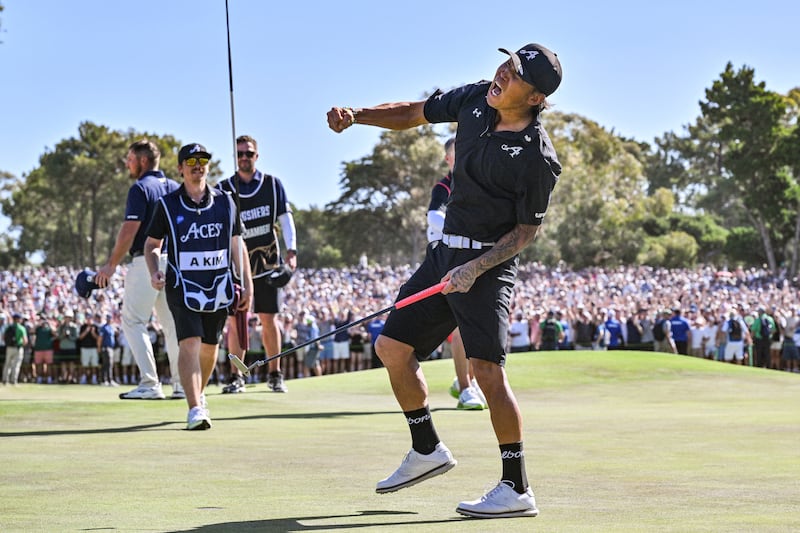
Norman’s presence was divisive though, especially when he was not on the best terms with the PGA Tour’s stars Tiger Woods and McIlroy, and his proclamations added fuel to the fire. Norman’s defence of Saudi Arabia’s human rights record was “look, we’ve all made mistakes”.
With tensions high, McIlroy, who had been thrust into being the PGA Tour’s main spokesman among the active players, said the following after winning the Canadian Open: “This is a day I’ll remember for a long, long time. Twenty-first PGA Tour win, one more than someone else – that gave me a little extra incentive today, and happy to get it done.” That someone else being Norman.
LIV perhaps should have doubled down on the international aspect of their schedule. Hosting events on US soil provoked the PGA Tour, making them a direct competitor, and it banned all LIV players from their tour.
The PGA Tour’s Jay Monahan took a hostile stance to his competitor, invoking links between Saudi Arabia and the September 11th terrorist attacks, saying: “I would ask any player that has left or any player that would ever consider leaving, have you ever had to apologise for being a member of the PGA Tour?”
The cut-through in the US compared with Australia and South Africa was minimal. Only 89,000 watched LIV’s individual finale in Chicago in 2024. In one of the more embarrassing moments for LIV’s viewing figures, a rerun of an old PGA Tour event on CBS in April 2025 had 15 times more views than LIV’s Mexico event that was on live.
Despite the limited interest in LIV’s format, there were fears that the sheer financial weight of the Saudi Arabian backing would see it become the dominant tour, particularly after stories began breaking of a surprising merger in the summer of 2023. But talks about finalising a framework never went anywhere and seemed more focused on avoiding lawsuits against each other.
Once the PGA Tour got additional outside funding from the Strategic Sports Group, it further distanced itself from the merger. The PGA Tour was able to increase the purses of its tournaments to keep its members satisfied and saw its viewing figures increase, helped by the dominant form of Scottie Scheffler and the brilliance of McIlroy.

After Rahm, LIV found it harder to attract top PGA Tour players. Tom McKibbin became the second Irish player on the tour after he joined Rahm’s LIV team Legion XIII alongside Tyrrell Hatton. Both tours did their own thing, like boxing with its different titled crowns, with the Majors having extra intrigue as the only time all the top players came together.
Moving to LIV seemed to benefit Bryson DeChambeau’s career, the limited schedule giving him the time to expand his YouTube empire and he beat his rival McIlroy to the US Open in 2024 in dramatic circumstances. DeChambeau became their trump card but more preferred to watch him on YouTube than on LIV.
LIV trucked on with its incredible purses, it even got world ranking points and mainstream broadcasters after a long struggle. But ultimately, the broader public just did not care.
With $20 million purses and ageing players on contracts worth several millions, as the years went by, it just couldn’t pick up significant traction.
“I think it was the running of it more than anything. I think the way the business was structured, there was too much waste, really,” Westwood said.
Saudi Arabia found that no budget is unlimited. In the extravagant opening year, LIV paid for even the caddies to fly in first class and stay in luxury hotels. They trimmed that expense in 2023.
Scott O’Neil, who replaced Norman as CEO in January 2025, tried to make the business “sustainable” but the damage was already done and it was the beginning of the end when Saudi’s PIF withdrew funding in April. Alarm bells sounded when vendors were not being paid and the LIV Michigan event was cancelled. Last week it was announced that it would be liquidated.
After $5 billion spent, what is LIV’s legacy? It made a lot of already rich golfers richer, although not quite by as much as they were promised, as Rahm gave up $100 million of his contract just to ensure he escaped back to the DP World Tour. Talor Gooch is certainly happy he joined, earning $72,800,839 despite never having a Major top 10. That is more money than three-time Major and 34-time PGA Tour winner Vijay Singh won in 30 years on tour.
It divided a sport that did not need division and failed to add to the golfing ecosystem for the average golf fan. Shotgun starts are not likely to be adopted by any major tour, with team events to stay mostly limited to the Ryder Cup and its equivalent events.
“Golf, but louder” was LIV’s slogan. But after its demise many in golf will be glad for some peace and quiet.