Workers should not have to pay more than half their income above a certain threshold in taxes to the State except in “exceptional circumstances”, the Minister for Justice Jim O’Callaghan has said.
Workers who earn more than €44,000 a year typically pay a marginal rate of 52 per cent for any income earned over that amount when income tax, the universal social charge and PRSI are taken into account.
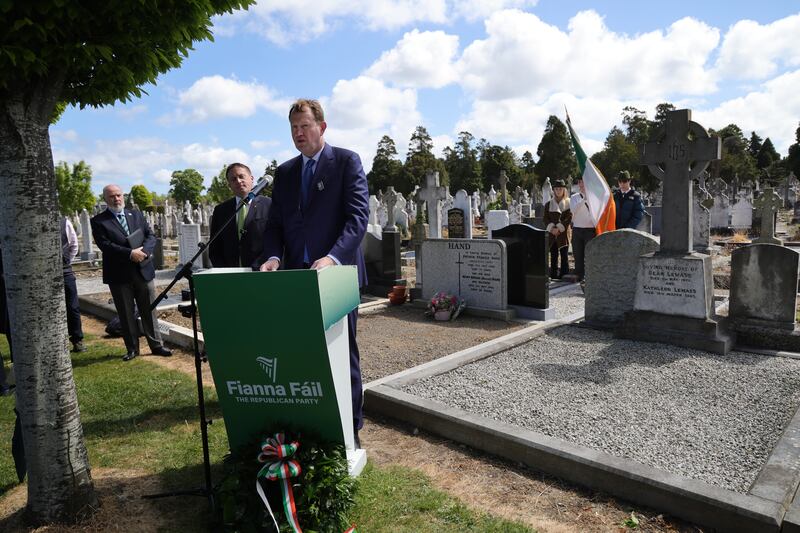
Speaking at the annual Seán Lemass commemoration in Deansgrange Cemetery, O’Callaghan said the marginal rate of tax in the State is “imprudent, demoralising and contrary to the public good.

“This is particularly the case where ordinary middle-income workers find themselves taxed at the highest levels by simply working over and above their usual hours.
READ MORE


“We need to make sure that we as a Government and a state do not penalise work, that we do not overtax success and that it should always pay to work.”
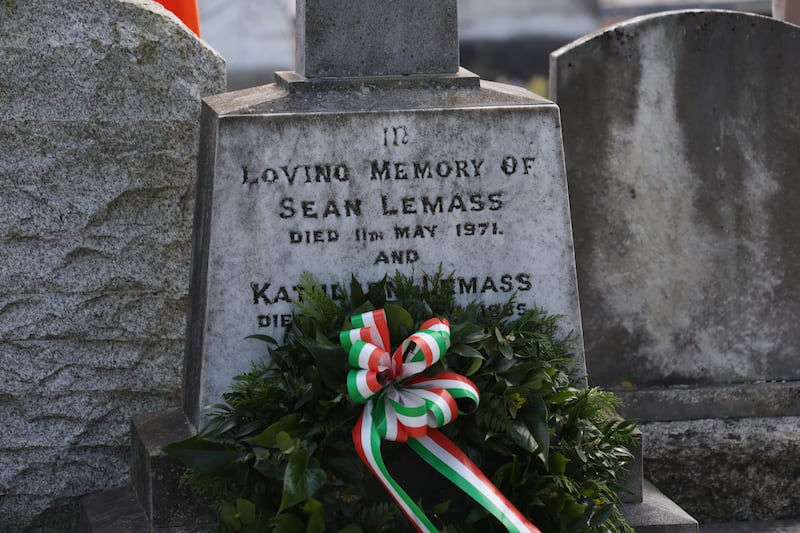
O’Callaghan delivered the oration beside the graveside of Lemass, one of the founders of Fianna Fáil and taoiseach for seven years, who died 55 years ago this week.
The exceptional circumstances would be a “fiscal emergency” where the State needed to increase the marginal rate of taxation to bridge a funding gap.
O’Callaghan suggested that Lemass’s legacy was “more than survival for the Irish worker”.
He added: “He pioneered the ‘National Wage Agreements’ seeking a social partnership where labour and capital moved in tandem. He believed that if the economy grew, the workers’ pocket must feel it first.
“He believed in the idea that the first duty of a government is to ensure the economic conditions support the population in a reasonable standard of comfort.
“To Lemass, a patriot was anyone who provided a job, and a successful state was one where a man or woman could raise a family with dignity on Irish soil. There are lessons from this approach in how we govern today.”
Afterwards O’Callaghan said he was not the Minister for Finance nor the Minister for Public Expenditure, but he, along with many other Government colleagues, “would like to see proposals coming forward in the budget that would benefit the working people in the country.
“And rather than identify specifics, I am going to leave that to Minister (for Finance) Simon Harris and the Minister (for Public Expenditure) Jack Chambers to come forward with proposals.
“Fortunately, we are also providing opportunities for backbench TDs, certainly in Fianna Fáil. I know very many backbench TDs who want to have their say in terms of the budgetary process and that’s going to start in the next week or so.”
When asked if he was prepared to co-operate with the stipulation by Chambers that all government departments should cut their funding by 0.5 per cent, he said he hoped that his department would not get squeezed.
“Obviously, there will be budgetary discussions coming up in the next few months as well. And I will try to ensure that I can get as much money as possible for the Department of Justice,” he said.
“I’m obviously constrained by the budgetary process as well. I obviously can’t get as much resources as I would want, but I would ensure that I fight to get as much as I need”.
O’Callaghan also praised Lemass for his approach to Northern Ireland, stating that his historic meeting with the Northern premier Terence O’Neill was a “gesture that broke decades of icy silence.
“Lemass believed that if the two parts of the island worked together on trade, electricity, and tourism, the political barriers would eventually become secondary to common interest. He sought a “unity of hearts” rather than just a unity of territory."
He said the fact that meetings between the Government of Ireland and the North-South Ministerial Council were now commonplace was a testament to Lemass’s vision.