Madison Twamley, a third-year University College Dublin student from strongly unionist Newtownards, Co Down, spent her first St Patrick’s Day in Dublin two years ago enjoyably socialising with college friends.
Photographs were taken in great number, as they always are, with all of the usual festival backdrops that feature on social media around “Paddy’s Day”, filled with Tricolours, shamrocks, leprechauns.
For Twamley, however, such photographs posed an issue. “My parents are always really careful how they talk about my time here in Dublin,” says the politics, philosophy and economics student.
“Obviously I was covered in the Tricolour, because it’s St Patrick’s Day in Dublin, and they’re like, ‘Don’t put that on your social media, we can’t have our friends seeing that’.”
READ MORE


Twamley is one of a number of UCD students who spoke to The Irish Times around the St Patrick’s Day festival to discuss issues of identity, relations and understanding between North and South, and the constitutional question.
Like most students, they believe that the opinions they hold on such issues are ignored, misunderstood, neglected or subjected to simplistic judgments by older generations.
For 22-year-old Tom Carolan, an economics and politics student from Ranelagh in Dublin, unification is “not going to be happening anytime soon”. “There’s a lot of work to be done,” he says.
“If a border poll was held tomorrow – or within the next 10 years – it would fail, in the North, not in the South. In the South, I think it would pass, no matter when you’d hold it, even if people have a lot of reservations.
“Ultimately in the South, there’d be enough of an emotional vote from people for it to win. Whereas in the North, obviously a lot more factors would come into play, but I don’t think it would pass.”
For Carolan, the issue is time. “I think we probably will see a united Ireland in my lifetime, but I don’t think it will happen in the next 20 years. If you rushed it and a border poll passed with 51 per cent in the North, it would be a bad foundation for a united Ireland.”
He says he places himself in “the John Hume school of politics: that we are not a divided nation, but a divided people”.
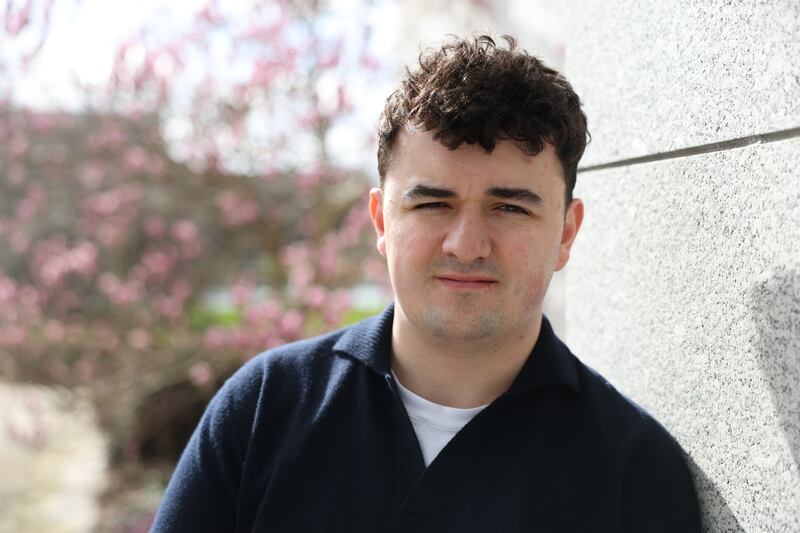
For Twamley, unification is a long way off, if it happens at all. “Maybe when I’m 99,” she says. A greater number of people in Northern Ireland are applying for Irish passports “but for many, that’s just about getting a shorter queue at the airport.
“I don’t actually have a valid British passport. I have my driver’s licence, which is technically a British ID,” she says.
Twamley is doubtful about the level of interest people in the South have on the issue. With a Presbyterian father from east Belfast and an American mother who came to Northern Ireland in 1997 and stayed, she grew up “in a mixed community, which was very important.
“People [in the South] don’t quite realise whenever I tell them I’m from Northern Ireland. They say, ‘I’ve been to Belfast, and that’s lovely.’ I’m like, ‘No, I don’t think you quite understand. Where I live, they flag the British flag everywhere’.
“There are at least five bonfires in my town alone. Growing up, I did not see a single person carrying a hurl. Not a sign of one. I didn’t know what the county colours were until I came here. There were so many things I didn’t know about.”

Twamley says she has learned a lot more about the South since coming to Dublin, but she is conscious of the gaps. “I have never been to a GAA match, three years in.
“It wasn’t easy to get into it, because all the Irish people knew each other already before they came to UCD.”
The success of the Belfast rap band Kneecap has done much to spur the resurgence in popularity of the Irish language, although the students say they are uncomfortable when the language is used as a tool to divide, not unite.
For Carolan, the popularity of the band is based to some extent on a desire for youthful rebellion. “But it does say something deeper. Some people enjoy the balaclava [worn by band member DJ Próvaí], and have a good time at a concert, but some buy into what Kneecap say a lot more,” he says.
“I think there’s a little bit of romanticisation in our generation. No one in my generation lived through the Troubles.
“Young people in the North now are the peace generation, so I think there’s a bit of forgetfulness there. But I do think that Kneecap would speak to a lot of people in our generation.”
For Jack Basquille the resurgence in the popularity of the Irish language is a joy for someone who grew up in an Irish-speaking household “in Dún Laoghaire, which is not exactly Connemara”.
Though a fan of Kneecap, Basquille, a 22-year-old final-year politics and Irish student, harbours doubts about the way some of its messaging lands. “Sometimes, Irish is seen as a political tool, which I’m not a huge fan of. I think it diminishes it.”
The conversation about unity must consider that there will be “a massive minority” who will either oppose it or fear its consequences, he says.
“The assumption a lot of people have, I think, of a united Ireland is that Northern Ireland and the unionist minority would just amalgamate and assimilate. That’s an ignorant thing to think, I feel, and probably quite dangerous.
“That’ll be years and years away, and take so much compromise. I don’t know if the Irish people are able for that, or if either community [is] able for that. There’s so much difference and people are so headstrong about this stuff.”

Often, the attitudes of young people are set against Electric Picnic videos of thousands of young people joining in with The Wolfe Tones on the “Ooh, Aah, up the ‘Ra” chorus of Celtic Symphony.
For Carolan, such moments can be over-interpreted, but also reveal something deeper: “You’ll hear lads after GAA matches singing that stuff. It’s so part of the Irish culture.
“Younger generations were less exposed to it. They see the photos of the IRA, the Armalite, the balaclava, and all that, and it seen as kind of cool, but the Troubles never affected a lot of people singing.”
For Twamley, the differences in songs and cultural references highlights the gap that exists between North and South. “I had never heard The Fields of Athenry until I was on a bus into town one night that was packed with first-year students.
“They started, and then they threw in the chorus of ‘Ooh, Aah, up the ‘Ra’. It was a very strange experience, I have to say. Initially, it was a little bit frightening, because the IRA is very serious. I don’t know why people joke about it.”
Unlike most southerners of his generation, Basquille went to the North “maybe five times last year, not more than that”, where he and friends “rocked up in Belfast with our GAA bags, most of us speaking Irish, to play American football, which is massive up there”, he says.
“We got into a black taxi, expecting that we would be taken to some AstroTurf pitch, but, instead, we ended up in an estate adorned with UVF flags and King Billy murals where we played on the green in a housing estate.”
Preparations for “the Twelfth” were everywhere in Wedderburn Park in Finaghy, with “a massive pile” of pallets for a bonfire stacked on one side. One of the group worried about whether they should cover up their O’Neills kit bags.
“We spoke in Irish. They couldn’t care less. It didn’t bother them at all.”