
Foraging is in our DNA and, while it may have become hidden from many of us, buried under a few thousand years of agriculture, it is always ready to emerge if we allow it. For me, it appeared when I became fascinated with wild mushrooms in my teens, and slowly taught myself which to eat and which to avoid.
If fungi foraging is at the deep end of finding tasty things from the wild, then coastal foraging is the shallow end – there are no troublingly poisonous seaweeds in Irish waters, and succulent coastal plants tend to be as distinctive as they are nourishing. If you are new to the world of wild food, then the shore is a great place to gather tasty food with confidence.
“When the tide is out, the table is set” is a saying originating from the First Nations of the Pacific Northwest coast of Alaska and Canada, but it applies equally to most coastal regions. Ireland is particularly blessed with a groaning maritime table that surpasses even the richest riverbanks or most fecund forests in both its diversity of edible species and the nutritional potential of what grows there.
Our hunter-gatherer ancestors knew this well, choosing to spend large portions of their year by the sea. Preserved piles of discarded shells many metres deep (known to archaeologists as shell middens) show us that seasonal gorging and preservation of shellfish such as mussels and oysters was commonplace. The shell middens at Cullenamore gave their home county of Sligo its name: Sligeach means “the shelly place”.
READ MORE


Yet these remains tell only a small part of the story: in northern climes the coast was the only place where large nutrient-rich wild vegetables were abundant and easily harvested, but their consumption left no trace. Many of the vegetables that we now cultivate still grow free and wild in coastal habitats. Sea beet, for example, is a wild ancestor of sugar beet, beetroot and chard and is common all around the Irish coast.
Cultivation hasn’t always improved on the flavour or nutritional value of wild plants, but merely made them easier to grow in straight lines or away from the sea. I once rescued some sea beet plants that had been unceremoniously dumped on the coast road by a storm and planted them in my garden. They took well enough to their new domestic setting and sprouted the following year, but their leaves – so glossy and succulent in their coastal home – were sad, flimsy and tasteless by comparison. Meanwhile, the storm-tossed wild colonies grew back even stronger, and I continued to thin them rather than harvest the domesticated weaklings in my garden.
Other succulent coastal plants are less familiar, but equally nourishing.
Take sea sandwort for example – a diminutive little plant that forms dense carpets just above the high spring tide line on rocky, shingly and sandy beaches. Closer inspection reveals thousands of juicy little shoots, miracles of resilience and ingenuity, able to withstand regular immersion by the sea, coastal exposure and the ever-changing nature of their coastal home. With their perfect double symmetry, they are also rather beautiful and play an important role in stabilising sand and shingle, allowing other coastal plants to colonise the foreshore. The shoots can be thinned out with a knife, causing minimal inconvenience to the plant, leaving you with a crisp and juicy harvest that, after thorough rinsing to divest it of sand, can be steamed and eaten like mangetout, tossed in salads or stir-fries, pickled or even used as a glamorous garnish in a G & T. A word of caution though – enjoy them in spring as their mild flavour turns bitter as they flower in summer.
Seaweeds – which include the ancestors of all our terrestrial plants – are an even richer and more reliable source of nutrition, but suffer from a bit of an image problem around the North Atlantic. Disliked as a stinky, slip-hazard on the beach, or for its slithery groping of swimmers, even its name – seaweed – dismisses it as a nuisance. Part of the problem is that most casual coast users only experience seaweed when it is either washed up dead, or lying asleep waiting for the sea’s return. We probably wouldn’t feel so fond of our meadows and forests if they laid prostrate and impenetrable every time we visited them.

Marine forests are just as complex, pretty and diverse as those made by their plant descendants on dry land. From tiny moss-like growths on rocks through a complex understorey to a broad treelike canopy, seaweeds are food, home and nursery to a wealth of aquatic animals. They are also good at sucking up carbon dioxide, and help dissipate the destructive action of waves.
Foraging is a wonderful and rewarding way of entering into a wider appreciation of this world. The very act of searching for seaweeds nourishes our souls as much as our bodies by leading us to one of the last accessible truly wide places – the intertidal zone, where beauty and treasure cling to every rock.

Modern use of seaweed in northern Europe tends to be restricted to its Celtic fringes and the west coast of Ireland is the only place where I’ve seen seaweed (most often dried dulse/duileasc) sold next to everyday staples. More recently it has found new interest from high-end chefs, inspired by Japanese cuisine, its versatility and downright deliciousness.
Like all good foods, the gastronomy of seaweeds is a direct product of their natural habitat. Slippery compounds help them slide through crashing waves without being smashed to pieces. Two of these compounds are of particular interest to humans: glutamates give seaweeds their prized deeply savoury umami properties, so beloved in Japanese cuisine, while alginates can be used to thicken and set recipes, slow down digestion (which helps us to better absorb our food), or as skin moisturiser.
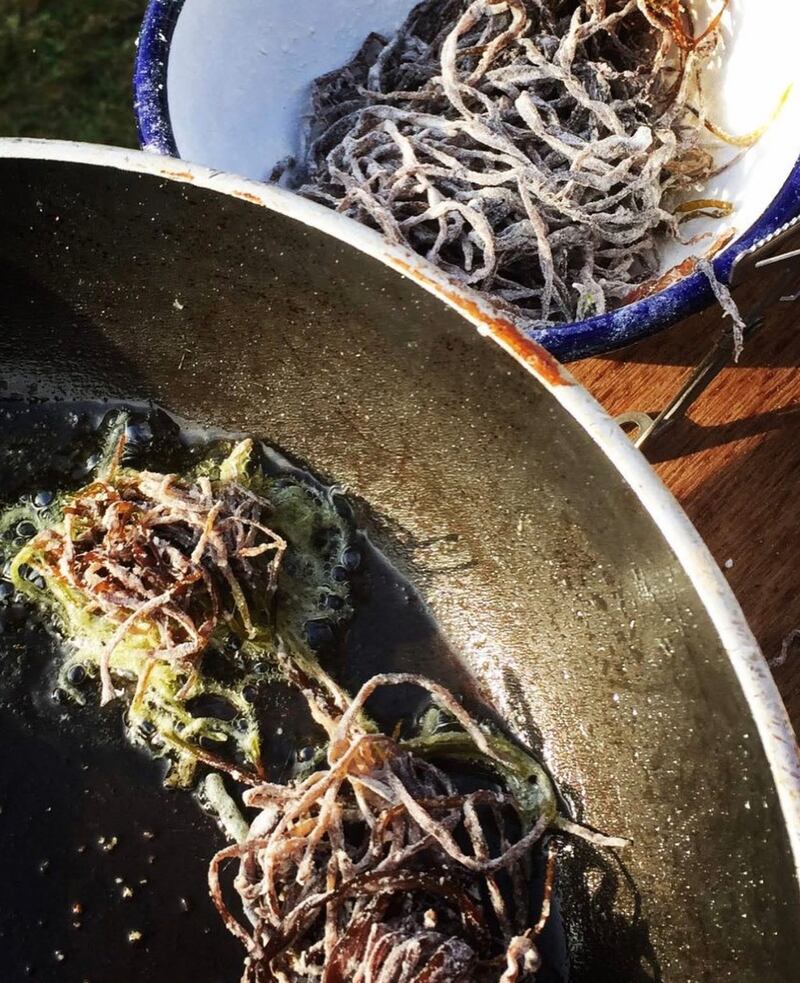
Ireland still has a few traditional seaweed bath houses and I was lucky to visit Kilcullen Seaweed Baths at Enniscrone, Co Sligo with my wife and mother-in-law a few years back. As well as the moisturising qualities, many of the rich cocktail of minerals (most notably iodine) contained in seaweeds (primarily serrated wrack was used) are absorbed through the skin, and plenty of people swear by it. Certainly my companionsemerged glowing and enthusiastic, but I confess, as someone who prioritises my stomach over my looks, I was more excited by the copious amounts of super-delicious Dumont’s tubular weed growing in thick rosettes on the nearby shore. This is one of a number of smaller seaweeds that deter grazing aquatic molluscs by producing compounds with incredible truffle-like flavours that leave gourmets chortling with joy. As with many seaweeds, a leap of faith is required, as it looks like no more than straggly brown bootlaces in sheltered rock pools. But the merest nibble never fails to leave folk on my seaweed forays gobsmacked by its complex, truffly, savoury aromatics, raw or cooked (see recipe below).

Many seaweeds are nutritional powerhouses, capturing and concentrating minerals from ocean currents. This isn’t to say that they are all worth eating: the challenge for seaweed foragers is in locating the choice species and knowing how to use them. In my book, I cover 25 of the most rewarding and accessible, as well as coastal plants and a dozen common, but not widely appreciated, shellfish.

[ Seagrasses are a precious resource and need protectionOpens in new window ]
No wonder our ancestors spent long parts of their foraging year near the sea – it is the origin of life on earth, and continues to sustain us in innumerable ways. It is one of the last truly wild places on earth that we can access with ease – you are never more than two hours’ drive from the sea in Ireland. Beyond its many gastronomic delights, this is what makes foraging there most magical. By attuning ourselves to it, we can rediscover our place within the natural order of things.
Crispy Fried Sea Noodles

These salty snacks are perfect with a cold beer, perhaps dipped in some pepper dulse mayonnaise, laid on top of laverbread with a pickled cockle or two, or as a flamboyant garnish on a bigger dish.
- Look for Dumont’s tubular weed’s diminutive straggly rosettes of dark brownish branching noodle- or shoelace-like tubular fronds, hollow and somewhat contorted, up to 50cm (20in) long, but usually less. Snip or carefully pull them, leaving at least a third behind and rinse briskly in clean seawater.
- Heat enough oil to just cover the base of a shallow frying pan.
- Pat the seaweed dry in a tea towel – it should be moist but not wet.
- Place it in a bowl and sprinkle with a little flour.
- Lightly work it with your fingertips (or better still, chopsticks) until it is evenly coated in flour, adding more flour if necessary. It should be beginning to stick together in clumps, but not a big doughy mess.
- Form the floured seaweed into rough nests, that sit in the palm of your hand.
- Drop the nests into the hot fat and fry until crispy – this will take less than 30 seconds – then flip and fry for a few seconds on the other side. They will turn greenish as they fry.
- Lift out of the oil on to some kitchen roll or a paper towel to absorb any excess oil, then serve and eat, ideally while still warm.
Pickled dulse paste

This is an umami-packed condiment that is great in sandwiches, smeared on burgers, or as an accompaniment to meat, fish, shellfish or vegetables. The same treatment also works for sea lettuce.
- Pack a clean jar with roughly chopped dried dulse (duileasc).
- Top up the jar with mix made of three parts cider vinegar, two parts water, one part sugar – you can include some herbs and spices too if you like.
- Leave for a week in the fridge.
- The dulse will rehydrate into a delicious paste that will keep for months in the fridge.
Mark Williams is a foraging guide and wild food chef based in southwest Scotland, who enjoys Ireland’s bountiful coastlines when visiting his wife’s family who come from Schull, Co Cork. His new book, The Coastal Forager, explores dozens of edible coastal plants, seaweed and shellfish, and how to safely and responsibly harvest and cook them.


