

A simple poster with a stark message was placed around Dublin city centre in the late spring of 1926.
“Volunteers wanted for another effort to break England’s power in Ireland,” it said.
It invited people to a meeting where they could enrol in a new party being founded by Éamon de Valera.
It was to be held in La Scala Theatre, off O’Connell Street, on May 16th.
READ MORE


“Join Fianna Fáil,” it exhorted.
One hundred years later, the place where the party was founded is no longer there, save for a slightly neglected plaque that marks where La Scala used to be.
But Fianna Fáil has made the century, more or less thriving for the first 80 years and then somehow surviving the vagaries it faced – including shouldering the blame for an economic collapse – over the past two decades.
On Tuesday night, it launched an ambitious programme to mark its centenary, culminating with a special ardfheis in the summer. The event was held in the ornate Pillar Room of the Rotunda Hospital, attended by a few hundred party members, including Taoiseach Micheál Martin, Cabinet Ministers, most of the parliamentary party and representatives from all over the country.

The venue was symbolic because in the absence of La Scala, this was the next best thing. It was in this room that the party held its first ard fheis in late 1926.
The night was a simple affair. The chair of the centenary committee, Shane Moynihan, a TD for Dublin Mid West, made a short speech and was followed by Martin.
The Taoiseach’s speech was surprisingly pointed and ideological setting out his interpretations of the party’s republicanism. It’s a view that would not be shared by everybody within the movement.
“After 1923 no party contesting an Irish election while advocating armed conflict won more than 4 per cent of the vote. That is a remarkable fact given the extreme political ideologies of the last century and the efforts of small groups here to promote conflict.
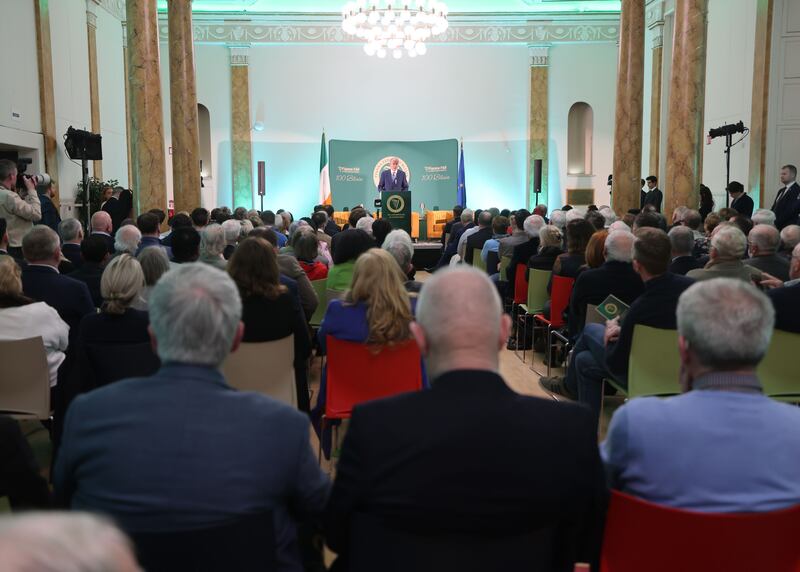
“The new party also rejected the narrow and exclusionary nationalism which was developing rapidly in much of Europe. A strong belief in international law and an inclusive definition of the nation was there from the very beginning,” he argued.
“As I have said on many occasions in the past, if you try to understand Irish politics simply as a continuation of the Civil War then you can’t understand Irish politics.
“It ignores the fact that so many people changed their allegiance and that this State evolved dramatically.”
Talking to the media in advance of the event, he said that the only comparable party in Europe in terms of success and longevity was the Swedish Social Democrats party.
But both parties have suffered political vagaries in recent years and there is less certainty now that one or both can last another 100.


