
The great, progressive and forgiving political career of Seán Lemass is often framed against the torture and murder of his older brother Noel by Free State forces during the Civil War.
But before that tragedy, 110 years ago next week, the Lemass family had suffered another violent loss for which the future taoiseach, then only 16, was directly if accidentally culpable.
On January 28th, 1916, while playing with a loaded revolver in the family kitchen at No 2 Capel Street, Dublin, he shot and killed his younger brother, a 21-month-old toddler named Herbert.
Details are scarce, now as then. But, according to the brief press reports of an inquest held the following day, the infant was being minded by his sister Ciara, while John (as he was still known then) sat in an armchair behind her.
READ MORE



She heard a bang, then saw the child fall, with a fatal wound to the head. Those details aside, reports noted little else but the bland advice of the jury that “something should be done to prevent young boys getting possession of firearms”.
The name Herbert loomed large in the extended Lemass family. For in an extraordinary and poignant coincidence, the baby was not the only one so christened to die violently in 1916.
A first cousin, Lieut Herbert Lemass, was by then a commissioned officer with the Royal Dublin Fusiliers. He was sent to France in June 1916 and killed at the Somme on October 23rd, when still only 19.
The January tragedy must have been well known in republican circles at the time but, to biographers and the public at large, it somehow remained a secret long afterwards. When Eunan O’Halpin, Trinity College Professor of Contemporary Irish History, wrote about it for The Irish Times in 2013, he was the first historian to address the subject.
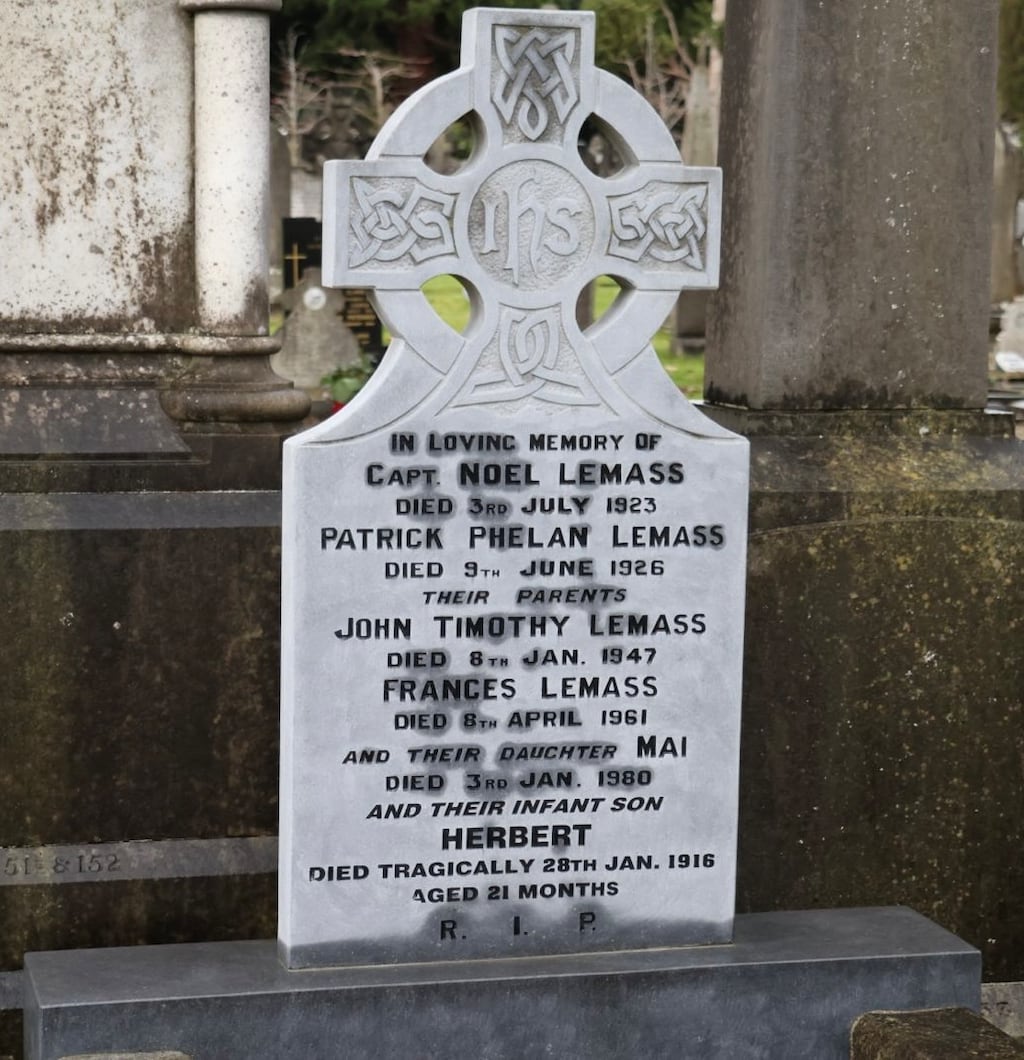
Despite the public inquest, the circumstances of baby Herbert’s death had been hidden in plain sight for almost a century, even from subsequent generations of the family. Seán’s daughter, the late Maureen Haughey, first learned of it from reading Prof O’Halpin’s article. Before then, the child’s name had never been added to the family gravestone in Glasnevin, an omission rectified in 2016. In a video made that year by her son Seán Haughey, Mrs Haughey suggested baby Herbert was “the first casualty of 1916”.
In the tragedy’s immediate aftermath, the older Lemass brothers excused themselves from training with the Irish Volunteers and they were not mobilised for the Rising itself, although they took part anyway.
On the 50th anniversary of the Rising in 1966, by then taoiseach, Seán Lemass recalled how he and Noel had gone for a walk in the Dublin Mountains that Easter Monday and on their return met an “agitated and depressed” Eoin MacNeill, who informed them of the events unfolding in the city.
Determined to get involved, they first went to Jacob’s factory but could not contact those inside through the barricaded windows. Next day, they tried the Four Courts, to be told their unit was in Ringsend. But en route there, they met a friend at the GPO, where they were invited in and given arms.
From then on, they were part of the fighting in the post office and later the fraught evacuation. Noting that “many people” had claimed to have carried the wounded James Connolly from the building, Lemass explained: “In fact, the process was so slow, and so frequently interrupted, that almost everyone in the GPO helped in it at some stage.” So did he, until ordered elsewhere.
Lemass recalled too the moment Seán MacDermott told Volunteers of the decision to surrender: “He spoke briefly but very movingly and many of those present were weeping.”
In his forthcoming book Seán Lemass: The Lost Memoir, to be published in March, my colleague Ronan McGreevy echoes attempts by other historians to explain how the family’s dark past influenced the politician.
“The realisation that he had killed his own infant brother, albeit accidentally, must have had a traumatic impact on Seán. His biographer Bryce Evans has speculated that Lemass’s ceaseless endeavour in the service of the country may have been partially driven by this particular tragedy.
“It arguably imbued Lemass with a restless desire to atone – not in an overtly Catholic sense but in service to the nation. In the revolutionary period, this meant taking up arms in pursuit of the republican ideal. In the postrevolutionary period, it would take the form of a workaholic commitment to national regeneration.”
Lemass was noted throughout his political life for refusing to attack opponents for misdeeds or omissions during the Troubles. His clemency extended to those, like his cousin, who had been soldiers in the first World War. Looking back from 1966, he lamented: “In later years it was common – and I was also guilty in this respect – to question the motives of those who joined the new British armies at the outbreak of the war, but it must be said in their honour and in fairness to their memory that they were motivated by the highest purpose.”


