

A quarter of the way through the 21st century, the horror and guilt inspired by two world wars appear to have vanished. Despite ample evidence to the contrary, the leaders of Russia, Israel and the United States apparently believe war is an effective method of statecraft.
The Swedish Uppsala Conflict Data Program confirmed last month that states were involved in 65 conflicts in 2025, the highest number since statistics were first gathered in 1946. Conflict claimed nearly 250,000 lives in 2025 alone.
“The West took a holiday from war and now it’s coming back,” Shashank Joshi, outgoing defence editor, now Washington bureau chief, of the Economist said on The Intelligence podcast.
The drone revolution fostered in the Ukraine war has enabled underdogs Ukraine and Iran to hold their own against far more powerful aggressors. Compared with earlier 21st century wars in Afghanistan and Iraq, “the Iran war looks far more like the Russia-Ukraine war, with its proliferation of inexpensive, one-way attack drones, rapid advancements in surveillance and targeting, huge use of munitions and the expansion of the battlefield well beyond traditional military targets”, former US defence secretary Lloyd Austin wrote in The New York Times in April.
READ MORE


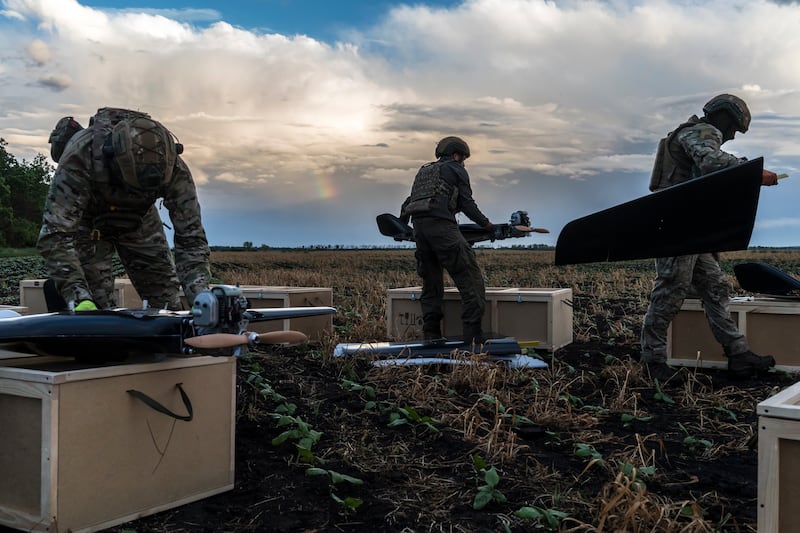
Ukraine pioneered the use of large numbers of cheap game drones to achieve transparency on the battlefield. Air superiority no longer provides cover for ground operations. Troops and armour cannot mass without being attacked by drones equipped with high explosives. Russia has replicated the strategy, resulting in a “kill zone” 30km wide that in effect freezes front lines in eastern Ukraine.
The frontline stalemate has led Russia to heighten its assault on Ukrainian cities, attacking across the country with a mix of hundreds of Shahed-type single-use drones and dozens of traditional ballistic missiles on a near nightly basis.
“Let the robots fight” is a Ukrainian motto, signifying that human lives are too precious to risk in combat. Twenty per cent of Ukraine’s armed forces engaged in drone warfare account for 80 per cent of Russian fatalities.
Ukraine increasingly uses ground drones – robots – to evacuate civilians and wounded soldiers from the battlefield and to deliver supplies. The defence ministry in April released a video of Russian troops surrendering to a ground drone.
Ukraine has virtually no navy, but it has sunk nearly a third of Russia’s Black Sea fleet mostly using sea drones. In June 2025, Operation Spiderweb used $100,000-worth of drones to destroy up to $10 billion-worth of Russian military aircraft.
Ukrainians and Russians both developed fibre-optic drones, which emit no signal, to evade each other’s electronic countermeasures. Drones are advancing rapidly in speed, range, lethality and the use of artificial intelligence.
Iran provided thousands of delta-shaped Shahed drones to Russia for use against Ukraine. The Islamic Republic now uses Shaheds to attack Israel, the US’s Arab allies and US bases in the Middle East.
Drones are no more lethal than classic artillery shells. “It’s the intimacy of it that horrifies us,” says Joshi. Drone pilots often see the faces of those they are about to kill from the relative safety of bunkers. Russian FPV (first-person view) pilots pursue civilians through the streets of the frontline cities of Kherson and Kharkiv in “human safaris”.
Drone-feed snuff videos circulate widely on social media, from both Ukrainian and Russian sources. Joshi recounts how a video used by the Pentagon for training shows a Russian soldier gesturing to an approaching Ukrainian drone to kill a soldier in a nearby trench, not him. The drone pauses, drops a grenade on the second soldier, decapitating him, then returns to kill the first soldier.
[ Why Ukraine is targeting Russia’s answer to AmazonOpens in new window ]
Vladimir Putin is reportedly terrified that a drone with facial recognition technology – like the AI tools used by Israel to assassinate Iranian leaders – may be used to kill him. In the hope of evading the fate of Ayatollah Ali Khamenei, Putin shut down CCTV cameras and the internet, banned aides from using smartphones or taking public transport, and lives mostly in bunkers.
Tension between proponents of old-fashioned warfare and the high-tech digital killing fields came to a head in the conflict between Ukraine’s outgoing commander-in-chief, Oleksandr Syrskyi, and the outgoing defence minister, Mykhailo Fedorov.
Syrskyi (60) graduated from Soviet military academy and served in the Soviet army. Opponents accused him of “trying to fight a large Soviet army with a smaller Soviet army”. Like the Russians, Syrskyi was willing to sacrifice soldiers for minimal tactical gains, earning the unenviable sobriquet “butcher of Bakhmut”.
Fedorov, a 35-year-old civilian tech whizz, clashed with Syrskyi over the emphasis on drone warfare. It was Fedorov who brought Ukraine to the most optimistic juncture in years, by waging long-range drone campaigns that took the war to Moscow and St Petersburg, paralysed Russian-occupied Crimea and led to petrol shortages in the country described as ‘a petrol station with nukes’.
Volodymyr Zelenskiy initially sided with Syrskyi, sacking the wildly popular Fedorov on July 15th. Bowing to street protests, he this week fired Syrskyi, replacing him with Gen Mykhailo Drapatyi (43), an ally of Fedorov and a member of the new generation who never fought in the Soviet army.
Unabashed plunder on a monumental scale – be it Ukraine’s rare earth minerals, Venezuela’s oil wealth or the investment potential of “Trump Gaza” – is also characteristic of war in our century. Russia, Israel and the US destroy schools, hospitals and civilian housing with impunity. Israel continues to kill large numbers of Palestinians despite a ceasefire, amid shocking international indifference.
“What we are seeing today sets an extraordinary precedent,” Israeli-American historian and university professor Omer Bartov wrote in The New York Times this week. “If the plans that are currently being elaborated for Gaza go forward, genocide may come to be seen by some nations as the legitimate and lucrative extension of politics by other means.”


