
The United States-Israeli military strikes on Iran over the weekend demonstrate a clear violation of two of the most basic principles of international law: respect for sovereignty and prohibition of the use of force in international relations.
The US has justified the action as a pre-emptive strike against a regime it argued posed a threat to international security.
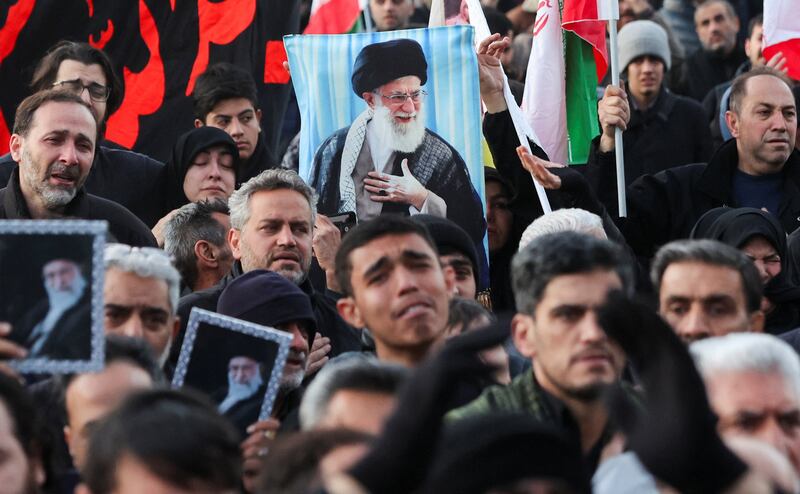
While there is little doubt the Iranian regime led by Ayatollah Ali Khamenei, who was killed in US-Israeli air strikes at the weekend, has been a brutal dictatorship that persecutes its own people, the threat Iran posed to the wider world was hardly imminent, even in recent weeks of escalating tensions.
Rather, with this illegal and dangerous bombing, it is the US that is destabilising regional and world security – while avowedly peacemaking states such as Ireland stand idly by.
READ MORE


The Irish Government has been busy urging parties to the conflict to exercise restraint, with Taoiseach Micheál Martin recognising the “potential that exists for escalation and wider conflict in the region”, but also adding that the Middle East has “not been safe for quite a long time, and Iran must take a significant degree of responsibility for that”.
Responding to the situation, he pushed for a diplomatic resolution, pointing to the principles of the United Nations Charter and international law that should apply in this situation. On Tuesday, he called for a “de-escalation” of the conflict and a “return to the negotiating table”.
Minister for Foreign Affairs Helen McEntee framed Ireland’s position in equally carefully chosen diplomatic language: expressing “concern” over the escalating situation; “dismay” at the Iranian military response and “urging” a negotiated resolution to the crisis. Asked on Sunday whether she believed the US-Israeli war was illegal, McEntee opted for a watery characterisation of it as an “extremely, extremely difficult situation”.
In an interview with The Irish Times today, she did not respond directly to a question about whether the Government condemned the action, but she said there should have been US congressional approval and a United Nations mandate.
“That hasn’t happened here. We have been very clear. We don’t think it has been the right approach.”
[ This is a serious blow to the Iranian regime – but it is unlikely to be immediately fatal ]
However, expressing dismay, muted criticism and vague assertions about the importance of international law – and even reminding everyone of the principles at stake – in the face of an illegal unilateral military intervention is not enough.
These principles must be defended by European leaders against transgression, even by the US.
There is no doubt Ireland is caught in a difficult position. On the one hand is our rhetorical commitment to protection of international law and human rights; on the other we turn a blind eye to the continued flow of US troops and equipment through Shannon.
Inevitably, this has once again become a flashpoint for the debate about Irish neutrality. While the Government can insist on a distinction between Ireland’s military and its political neutrality, the continued use of Shannon as a staging point for US military manoeuvres in the Middle East points to the inherent contradictions in this stance.
Ireland’s complicity in facilitating American military actions for decades has become increasingly untenable. Rather than standing by as US president Donald Trump desecrates the principles of the UN Charter that the Irish Government claims to defend, it is time for Ireland to stand up for our values.
The ceremonial handover of the bowl of shamrock at the White House to mark St Patrick’s Day this month does not have to be an empty performance. If the Government is serious about the recourse to diplomacy, and the importance of the UN, this is the time to use our limited influence to stop pandering to Trump’s mercurial regime.
The Taoiseach should clearly condemn this illegal military action and criticise the US for its violation of international law and the undermining of the UN Charter as its actions destabilise the whole international system.
Ireland’s obsequiousness when it comes to the US is of course rooted in the belief that our multinational tax base would be damaged by the Government taking a more forthright position on key issues of international relations.
But US multinationals will not flee the country just because the Irish Government stands up for the principles of global order. What has always made Irish internationalism powerful is the principled role of right over might that we have embodied in the international system since our independence.
There are other arguments in favour of speaking out. Beyond the political costs, the practical stakes for Ireland in this rapidly escalating conflict are also considerable.
Iran’s military response has spread the conflict around the gulf region and now involves at least seven states. Across these territories are more than 20,000 Irish citizens, many of whom may face being stranded abroad for an indefinite period until commercial airspace in the region reopens.
Renewed Israeli attacks against Hizbullah in Lebanon have escalated the risk to the 358 Irish soldiers stationed at Camp Shamrock as part of the UN peacekeeping mission.
This range of practical and political dimensions should be reflected in a far more forthright response from the Government.
The international language of diplomacy used by Martin and McEntee skirts around these humanitarian concerns and instead puts our relationship with the US at the centre of the Government’s focus.
But Trump’s actions against Iran and his contempt for the UN and the rules-based order reflect a new narrative of power that represents a direct attack on the international system.
This is made more dangerous by the apathy and silence of countries such as Ireland who do not act to defend a global order based on rules and principles designed to prevent illegal use of force.
As a small state, Ireland depends on other countries’ respect for international law to maintain our position and protect our sovereignty.
But failure to defend the system – when it is the system itself that is under such sustained attack – is the first strike against the agency of smaller powers.
There is no sense in proclaiming the words of the UN Charter, unless we also defend them when transgressions occur.
To avoid accusations of complicity and complacency in a war that has the potential to devastate the Middle East, it’s time we put down the bowl of shamrock and stand up for the basic principles with which we have ordered the world.
Alanna O’Malley is professor of global governance and wealth at Erasmus University, Rotterdam


