
Hidden in the Wicklow hills stands the Mottee Stone. It’s purported to be a tourist landmark, with legend suggesting Fionn MacCumhaill hurled the stone from the top of Lugnaquilla Mountain. That was back when Laois had quality hurlers.
It is said that the five counties surrounding Wicklow can be viewed from the rock on a clear day.
The stone sits atop a hill in deepest Wicklow, not far from the meeting of the waters. But you follow Google Maps to its location at your peril. One route is a back road. The other is a failed attempt at a rally stage that turns into an off-road track. In the Sat-Nav lottery, we were sent one way, our visiting friends in a rental VW Polo sent another.
Our route started out on the usual single-lane country trek. However, it quickly progresses to swap the two metres of tarmac for a dust track. This soon becomes a rocky path that would pose a challenge for a quad bike. Even walkers would need to watch their ankles on the jagged rocks.
READ MORE


After several sump-challenging rocky potholes, we reached the top, where our friends were waiting in their Polo. Thankfully, they had taken the other route up, for the Polo would still be sitting on a hill in Wicklow leaking engine oil if they had followed us. I’m amazed that tourists hadn’t already left a trail of wrecked rental cars on the trail.
Two lessons we learned from our trip to Motte Stone: Never unquestioningly trust our Sat-Nav masters; and the Jeep Avenger 4xe is more than a charming little town toy.
This Jeep’s got character. And that’s something to be lauded in the age of comatose-inducing, cookie-cutter cars.
Sure, it’s flawed. The back seats are relatively cramped, and the powertrain can be a bit gruff.
But for all that, there’s something earnest and eager about the Avenger that we used to find in quirky models like the old Fiat Panda 4x4. You can’t get little off-roaders as easily as in the past, and models like the Suzuki Jimny barely hit the Irish market before being sold. Clearly, there is an appetite out there for small cars with off-road credibility and not just marketing spin and plastic cladding.
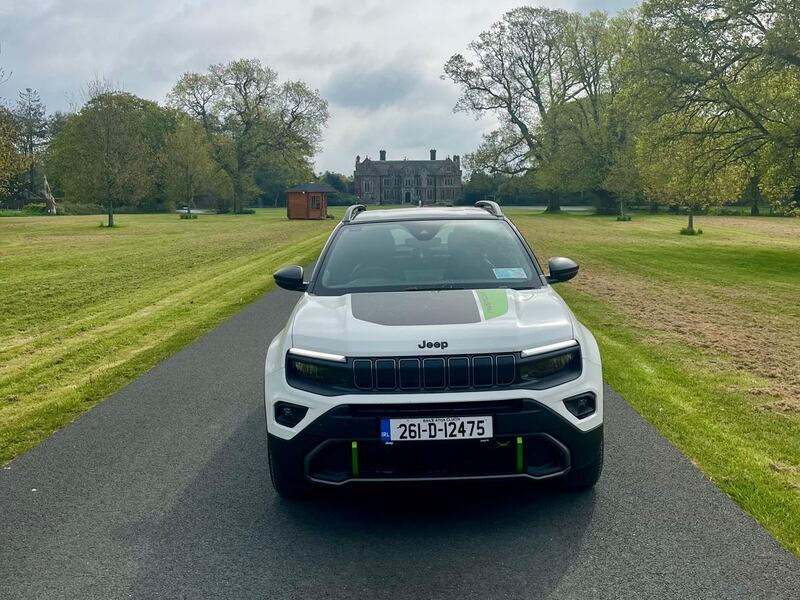
The Avenger comes in three flavours. Initially flagged as an electric-only baby crossover, the Stellantis-owned brand quickly added a small 1.2-litre petrol engine, an automatic version and then this four-wheel-drive derivative.
The Stellantis parentage was key. This car might carry the US moniker, but it was entirely styled, engineered and constructed outside the US. Better not tell Mr Trump.
And while it carries the Jeep signature seven-slot grille, its lineage can be traced to the Opel Corsa, with which it shares a platform.
That platform, as is the modus operandi of car giants these days, is the foundation for many of the small cars on forecourts these days, from the Peugeot 208 to the Alfa Romeo Junior.
It has won plaudits, the top of which was the prestigious Car of the Year for Europe award in 2023. That award, judged by European motoring journalists focused on the needs of European car buyers, was a major coup for a brand that has always been niche, even if its name is so generic that it is the generic designation for SUVs and crossovers used by gardaí, Revenue and even the voice of the motor trade here, the Society of the Irish Motor Industry.
It was built in Poland at the well-regarded Tychy factory, which in the past turned out Fiat 500s and Pandas and has won industry plaudits for the quality of its production. So, it comes from good stock.
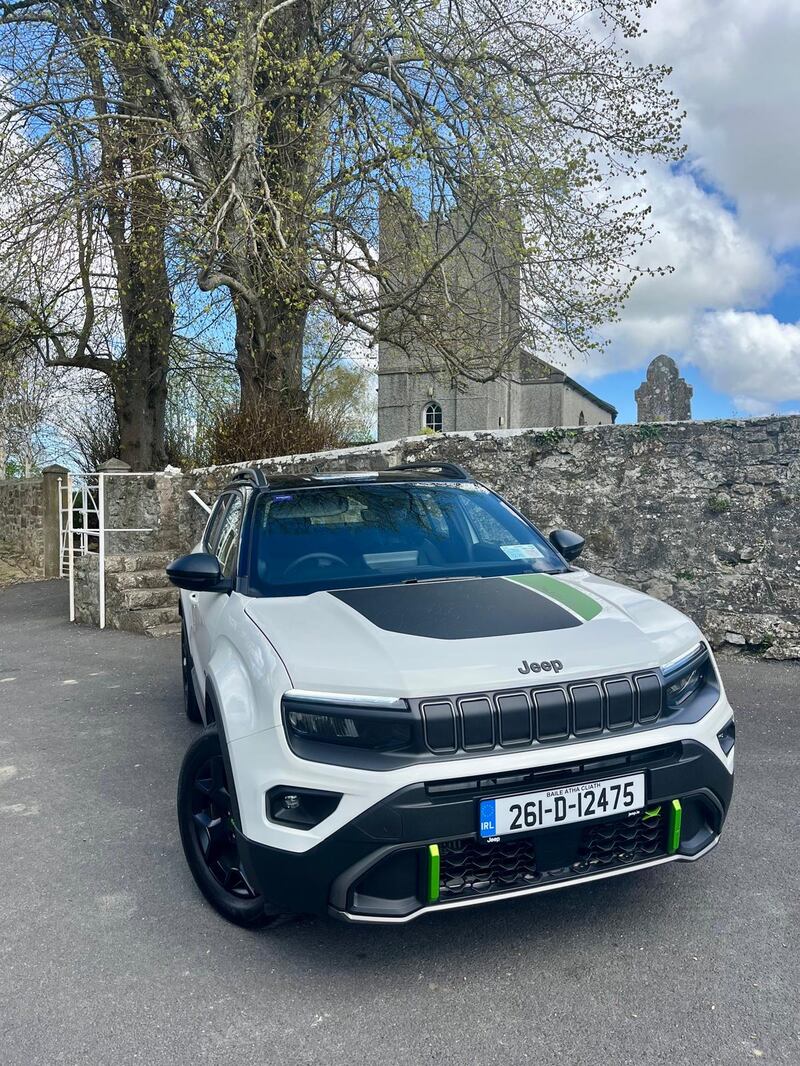
To live up to the Jeep brand, the regular Avenger delivered 200mm of ground clearance, but being a front-wheel-drive format, it tended to do a little bit of crossover cosplay. That’s where this version delivers more off-road mettle, with an extra 10mm of suspension lift to deliver more cushioning and off-road capabilities.
On the road, the Avenger feels sure-footed, and the steering is smooth and friction-free, even if the ride quality can be a little firm for general town driving. Its small car roots can be spotted in the limited travel of the suspension, even with the extra suspension lift.
The 4xe is powered by a 1.2-litre three-cylinder engine that isn’t exactly pacy – with a 0-100km/h time of 9.5 seconds – but it is economical, thanks to a mild hybrid set-up, comprising a 48-volt system, a little 0.9kWh battery pack and two 28hp (21kW) electric motors. One is integrated into the six-speed automatic gearbox to help power the front axle and the second is mounted on the rear axle to drive the rear wheels.
That doesn’t sound like much, but it’s peppy in the way we like small cars to be, though it can sound too gruff and strained when you need to push it on during motorway drives.
The four-wheel-drive set-up switches to front-wheel drive at over 30km/h, but you can still toggle the modes to keep it on up to 90km/h, using the rear electric motor to power the back wheels.
Jeep claims an official WLTP fuel economy figure of 5.4 L/100km (52mpg), and we did manage to hit that target on a few town and M50 drives. Overall, we managed to average 6.5 L/100km (44mpg).
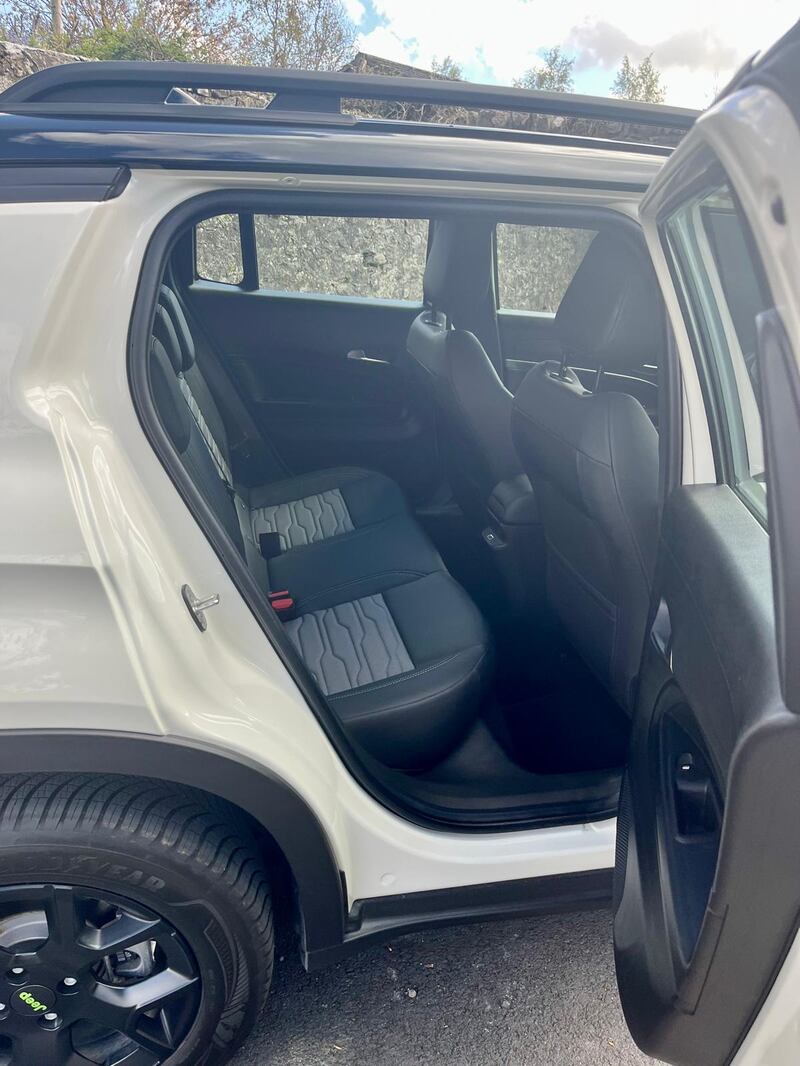
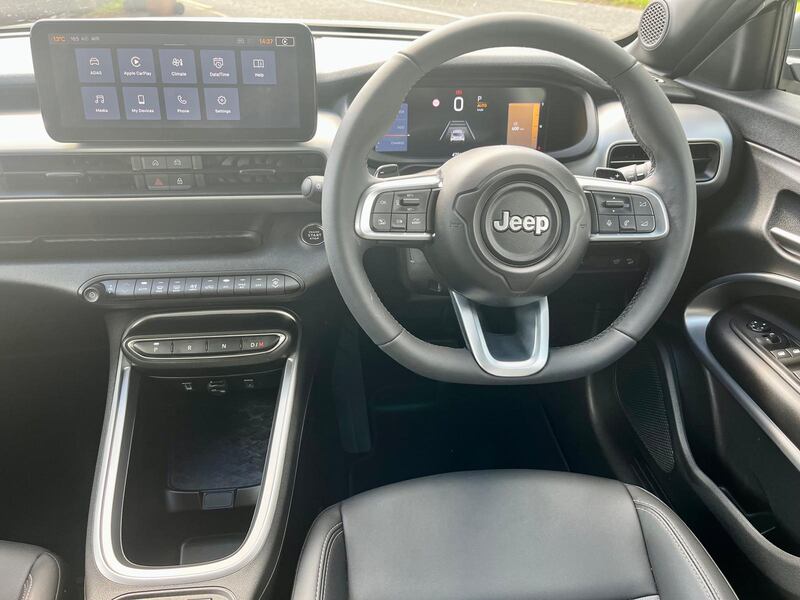
Inside, the Avenger can’t help feeling a little cramped. To deliver that chunky exterior styling, Jeep’s designers had to limit the amount of glass on the sides and back, so the relatively low roofline and high windowsill can’t help but leave the cabin feeling a little confined.
Hard black plastic trim abounds as well, which might, in theory, make the car feel more rugged and ready for the rough and tumble of life off-road, but seriously dents any sense of quality or premium appeal that Jeep might like to play upon. There are a lot of rivals in this class with considerably plusher cabins.
There are decent stowage bins in the cabin, but they can’t make up for the limited legroom in the back or the 380-litre boot, which is average rather than stellar for a car in this class.
Yet we can forgive a lot of those issues because of its charm. Even if you don’t really relate to the Jeep brand, you quickly appreciate the character of this car, in much the same way we fell for plucky little off-roaders in the past, like the Fiat Panda 4x4 or any number of small Japanese 4x4s. These cars prove you don’t need a six-figure behemoth to get across the bog road or up the mountain pass.
Yet the one mountain the Avenger can’t master is price. At €39,995, it’s simply too expensive to be considered in the same category as the affordable and charming Panda 4x4s of old.
[ Hyundai Ioniq 6 shows how to build a better EV – but buyers aren’t convincedOpens in new window ]
Yes, it has modern tech and safety systems that would have seemed space-age on the old Fiat off-roader, but it was far more affordable. This price point pits the Avenger up against the new Dacia Bigster 4x4, and that’s a battle the Jeep simply can’t win.
The Bigster is significantly bigger inside and out, and boasts a conventional all-wheel drive system that’s simply more robust.
Jeep’s heritage carries some weight into the fight, it’s got a stronger exterior design and is handier to drive around town, but it’s still far more niche among everyday Irish consumers. Strangely, while its bosses may consider it quasi-premium, on Irish forecourts Dacia has probably a stronger fan base among those who are looking for something a bit rugged and aware of the value of a euro.
With the expected price tag of €40,000, that’s going to make the Avenger 4xe a hard sell, even with all its charm.
Lowdown: Jeep Avenger 4xe mild hybrid Upland
Power: 1.2-litre three-cylinder petrol engine supported by a 48-volt mild hybrid set-up and two electric motors.
CO2 emission Combined (g/km): 122
Fuel Consumption Combined (l/100km): 5.4
0-100km/h: 9.5 seconds
Price: €39,995
Our rating: 3/5
Verdict: Plenty of character and credible off-road capability, but price tag will limit its ability to climb the sales charts.


