
There’s a term that seems to sum up our world these days: Cognitive dissonance.
It’s how Maga supporters can support growing US involvement in wars abroad having vehemently opposed foreign conflicts. It’s how Ireland can laud its booming independent sovereign economy while depending on a handful of foreign companies to pay its bills.
And it’s how EV buyers can obsess over battery output and range, then buy a three-tonne SUV with the aerodynamics of an elephant.
Eight of the top 10 bestselling EVs on the Irish market right now are some form of crossover SUV. The remaining two are the surprisingly roomy Inster city car and the Ioniq 5, which you could cast as a large hatchback. Note that both of these are from Hyundai.
READ MORE


The fact this Korean brand has tried to buck the cookie-cutter crossover trend is perhaps atonement for cursing us at the turn of the century with its Santa Fe, which proved such a sales success, rivals had little choice but to follow suit.
Recently Hyundai has tried to lead buyers down a different path, the most daring of which has been a return to a saloon format, courtesy of the Ioniq 6. Trouble is, this isn’t your everyday saloon. It’s motoring Marmite.
The Ioniq 6 is the result of a committee engaged in tug of war between aesthetes and engineers. It’s hard to say anyone really won the first round. The car was sleek and efficient, but its oddball looks divided opinion. The media reaction wasn’t helped by early leaks of some stunning design promise of the Hyundai Prophecy Concept.
It promised a modern take on four-door motoring that blended the styling of a Porsche 911 with an Audi TT. Then the Ioniq 6 showed up.
Some loved it, my colleague Neil Briscoe being one. Others loathed it, believing it overworked and overdressed with LEDs. I leaned more towards the latter camp, disappointed it widely missed its concept promise.
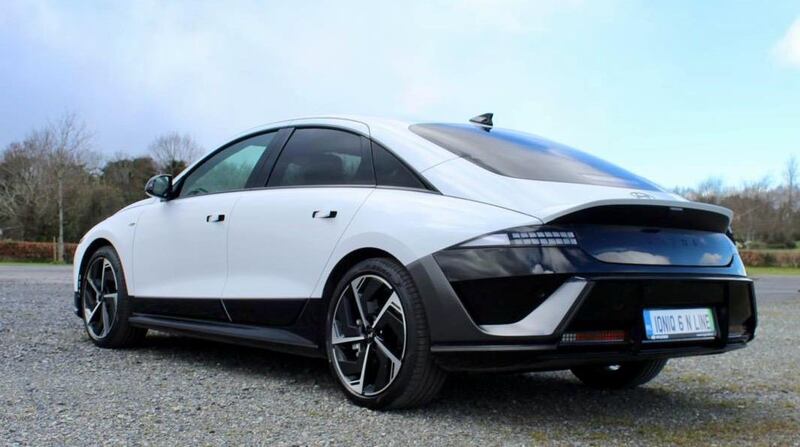
This facelift aims to gently address some of the issues of 2023, while keeping it relevant in a fast-paced EV environment. Styling-wise, it’s still divisive despite the tweaks.
When it comes to efficiency, the Koreans deliver. Little has changed in the underpinnings of the Ioniq 6, which itself was built upon the foundations of the more popular Ioniq 5, its hatchback sibling.
And there’s the rub. With this car what you are getting is a variant of the Ioniq 5 that’s less practical, even if it’s better priced.
Power comes from the same 84kWh battery pack and a 168kW (225hp) electric motor – billed as long-range by Hyundai and the only version available in Ireland.
While on a wet and windy motorway facing into the full force of the weather we recorded consumption figures of 22kWh/100km, our average over 605km was 17.9kWh/100km.
We never reached the promised 624km WLTP range figure, but buyers should get 500km or so from a more normal mix of urban commuting and town driving. Hyundai’s range estimator display on the dash even suggested we could get 635km during the first day of town driving.
To put some context on that expected range, the same N-Line version of the Ioniq 5 has a WLTP estimated range of 515km.
Talk of kWh/100km still bamboozles some motorists, but like all such data points the key is to have some context. What do you normally manage on your regular commutes? And for me 17kWh/100km is a really efficient consumption rate, particularly for a car with this sort of footprint.
That footprint means you get a decent boot and ample legroom in the back, but the price is paid in boot space and versatility, particularly compared to its Ioniq 5 sibling, or indeed many of its rivals. Up front, while you don’t get the SUV visibility, the seating position is quite high and there’s little compromise on that front.
For all its efficiency and spacious saloon attributes, the car really doesn’t stand out in terms of driving experience. It’s a remarkably quiet cabin and delivered a relaxing drive during our long motorway runs, but it’s not engaging. There is a Sport mode, but this car’s natural character is found in either Normal or Eco mode.
Hyundai deserves praise for its braking system and accompanying regeneration set-up. German rivals at VW and even the premium brands could take note of the reassuring grip and responsive feel from the Ioniq’s brake pedal; there’s none of the spongy lacklustre feel you get with many EVs.
The steering is light, so the car is pretty easy to park, though you may be caught out by just how long it is – at nearly five metres. We misjudged the size of a parking space during our first day in the car and turned a parallel parking manoeuvre into a comedy sketch for bemused tourists.

The cabin has been upgraded with new materials, reducing the use of hard black plastics, though there’s still plenty there. As for the tech, it’s standard issue from the Korean brand these days, so it’s a mix of touchscreen controls and a few buttons, mainly sprinkled on the steering wheel.
Compared to the original and even the last Ioniq 5 we drove, this latest iteration has been tweaked and tightened to deliver a level of refinement and reassurance that keeps this car in the running against rivals like the Tesla Model 3, BYD Seal, and even the Polestar 2.
Which brings us to the all-important price. Our N Line version carries a €41,435 price tag, which is €4,560 cheaper than the similarly equipped Ioniq 5. That’s a statement in itself.
And at a time when car prices seem to be only going in one direction, it’s a sizeable drop for the initial launch price back in 2023, when the 77kW version of this car – promising a range up to 614km – landed in showrooms with a price tag of €62,495.
But the new pricing reflects the reality of the EV market, where Tesla has a version of its Model 3 priced at €38,990 and a long-range version claiming up to 750km WLTP for €45,000.
Others in this market include the BYD Seal starting at €46,885, and the excellent VW ID.7 from €55,000. Entry versions offer 470km, but higher-spec models stretch beyond 700km WLTP, underlining just how competitive this segment has become.
Now competitively priced, the Ioniq 6 should have a stronger case to make, even if the styling will still divide the crowd.
Despite seeking an alternative to SUVs, the market simply will not reward its bravery. It’s never going to be a showroom star for Hyundai. Between its launch in 2023 and the end of last year 700 Ioniq 6 were sold in Ireland, compared with more than 2,300 Ioniq 5s.
That’s a big gap to close, and even then, it will not come close to challenging sales of Tucson, which topped 15,000 registrations in that same period. But it’s still a welcome alternative to the SUV crossover surge. This little midlife tweak has helped, but the audience will remain as divided as ever on this car.
Lowdown: Hyundai Ioniq 6 N Line 84kW
Power: 168kW electric motor combined with 84kW battery pack, powering the rear wheels and delivering 350Nm of torque
0-100km/h: 7.4 seconds
Promised range: 624km
Consumption: 17.9 kWh/100km as tested
Price: €41,435 as tested
Our rating: 3/5
Verdict: Controversial styling remains its biggest burden, and despite lower pricing it is likely to remain the right car in the wrong market


