

Six days sailing south of Tahiti lies an island the colonists forgot. A curve of forest clad rock, Rapa Iti, like its fellow Austral islands, is the remnants of an ancient volcano. Wrapping around a sheltering harbour of turquoise waters, Rapa is all jagged mountains, fertile valleys and lush forests. We arrive on a rainswept day to reach the farthest point of an itinerary that has taken us into taro fields and alongside ancient graves. We’ve been welcomed with purifying smoke, dancing and necklaces of shells, and have marvelled at jewel-coloured fish while snorkelling reefs off postcard-perfect pristine beaches. Whales have plunged at our bows, and rare birds have darted above. It has all been extraordinary, but Rapa is something different again.
First settled by Polynesians about 1,000 years ago, the island was already so remote that its own distinct dialect developed. So too did a certain degree of local skirmishing, and the mountaintops are ringed with dramatic fortified settlements. Remote and fortified as the population were, it wasn’t enough to protect the islands from the Europeans, the first of whom were led by the intrepid George Vancouver. He and his crew arrived just before Christmas 1791, bringing disease and booze, twin forces that shattered the population. By the 1800s France had declared Rapa theirs, alongside the other island clusters in these strategic waters.
From Bora Bora to Fakarava, governors were installed, replacing the older social systems, but distant Rapa was somehow left behind; and today, while still a French protectorate, it shares the rare experience of an entirely other system of living. We are on board the Aranui, which is part cruise ship, part cargo ship. Crewed by a team of Polynesians, there is an extra element of excitement as we make our way to Rapa’s dock. Visitors are rare, with permissions for boat landings limited. Many of the crew are greeting friends and family as we are met by small children, curious dogs, and members of the Council of Elders, the To’ohitu.
Drawn from the different clans, they arbitrate and make decisions on behalf of the small population of about 450. Land on Rapa is collectively owned, the fishing catch is shared, and bread is cooked in communal ovens; we sample some, fresh made from coconut flour and slathered with local jam, it is as delicious as it sounds. “Welcome to paradise,” says the mayor with smiling irony as we sit under inadequate canopies buffeted by intermittent squalls. Rapa is so far south, it has a similar climate to Ireland, albeit with tropical overtones. Both apples and coffee grow here.
READ MORE


“You are welcome,” he continues in a powerful oration, only slightly diluted by a more hesitant translator. “We are glad you came, but we don’t need you.” There is a small frisson among some of the passengers, who are predominately French and American, with a smattering of Germans, English, Australians and Italians. After all, who doesn’t feel that unpleasant sense of benevolence, as we spend our tourist dollars and euro, “helping” economies, as we cut a swathe through the world’s fragile paradises?
“We are pleased that you can see how we live,” continues the mayor. “But we do not wish to become like you.” He implies no judgment; he is just stating a fact. After lunch of marinated fish, taro and delicious cakes, cooked by the community, we explore in groups with local guides. I am entranced to see a pair of critically endangered pink-headed Rapa Fruit Doves wheeling overhead - these being pointed out by Lori Beraha, the marine biologist and ornithologist, who is travelling with us and giving talks on board, and it is joyful to share her excitement. Major conservation work is ongoing to restore the natural balance, as habitats have been destroyed by invasive species, and by domestic cats turned feral. Children are educated to primary level on Rapa, before continuing as boarders, usually on Tahiti. This gives them a chance to explore different ways of life. Those who choose to return apply to the council and are given land to build a home.
Rapa may feel like an island out of time, but we have had a time of it getting here. Sailing from Papeete, we met with a storm, during which my duty-free purchase of gold glittered body oil (I had had notions) rolled off its shelf and smashed, making it look as if I had murdered King Midas in my bathroom. The crew were brilliant, and our first landing at Rimatara was all the sweeter for the adventure of getting there.
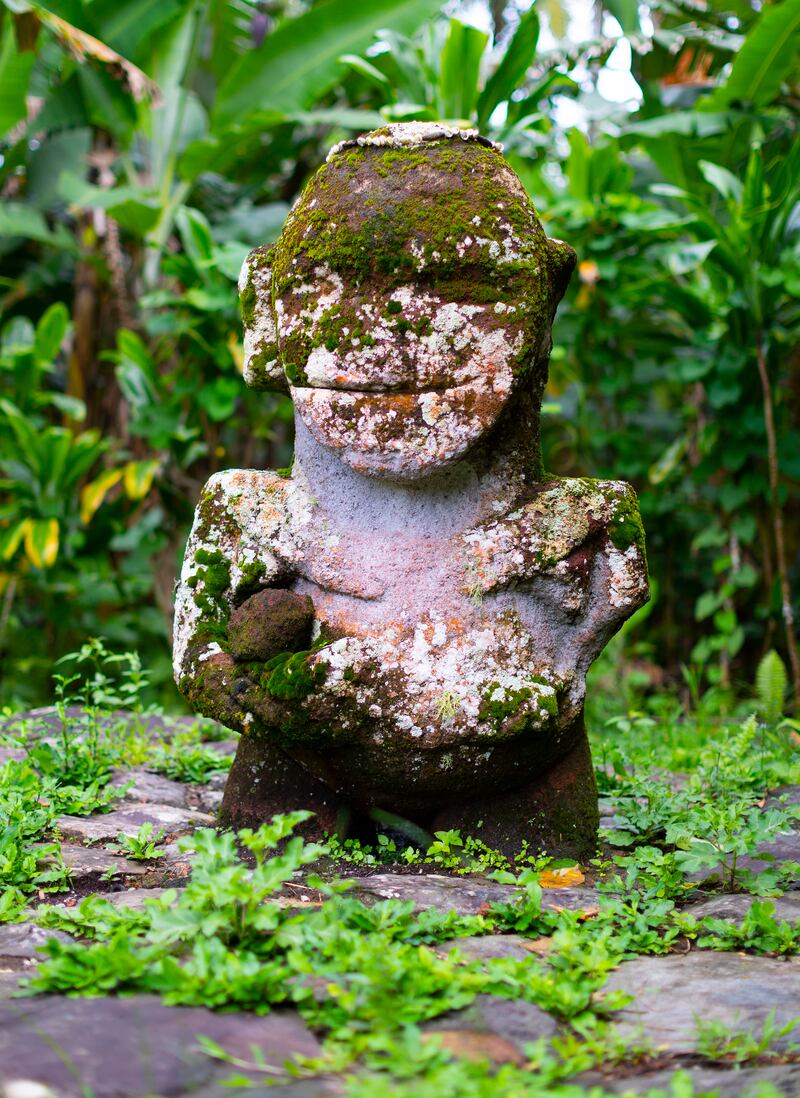
Walking Rimatara’s quiet lanes, Scarlet Lorikeets perch in the ironwood trees, and our guide tells us of the legends of the elders as we explore the marae, one of the sacred enclosures that we will discover, dotting the islands – the most spectacular being on Raiatea. After lunch we head for the beach. “If you don’t feel like walking back, just stop a car,” says our local guide. I do, but wind up having to explain that I need to get to the harbour, and don’t have time to come home with the driver for dinner.
From here we go on to Rurutu. Greeted with garlands of flowers, a man and woman lift heavy rocks in an intriguing welcome ceremony, before we go on to explore extraordinary caves. Local makers show their wares in the community centre, and fellow travellers start to sprout woven hats of various sizes and scales. There are beautiful necklaces of pearls, coral and seeds, and earrings in mother of pearl. I sample the local honey and buy a necklace to treasure. After lunch - a buffet extravaganza at the mayor’s house - I make my way to the local beach, where I alternately swim and bask. Dozing on the white sands, I hear hoof beats and, almost out of nowhere, a horseman gallops by. Later a group of local schoolgirls fail to persuade me to jump into deeper waters, and try – and again fail – to teach me to dance.


“Every day is an adventure,” says Sandra, our guide on Raiatea. “We do not plan because we do not know what will happen.” While the Aranui cruises with cargo to the Marquesa Islands, the Austral itinerary is purely for passengers, and there are just over 100 of us on board. I have loved every moment, but some seem to have, as Richard E Grant gloriously wailed in Withnail & I, “gone on [this] holiday by mistake”. There is a trend in travel for adventure, for small ship cruises that take you off the beaten track, and for travel with local crews and guides. The Aranui has all this in spades, and most of us are delighted with everything. Nonetheless, a vocal coterie seem to believe all this should be somehow homogenised, leavened with European or American ideas of luxury: as if we should be travelling the Australs, but living at the Marriott. Others are happy, and many are soon sporting tattoos by resident tattoo artist (and restaurant manager) Moana.
“We have to make some improvise,” says Spencer, one of the guides, as people complain that an on-board talk is a little late, a landing delayed by tricky seas, or the sign-up sheet for the next extraordinary excursion is at reception rather than in the bar. I start to wonder if they are the types to watch White Lotus and identify with the worst of the characters, or if they are genuinely blind to the experiential gifts being shared. “Fish! I don’t like fish,” says an Italian, as we sail the teeming seas. I make friends with a French couple living in Seattle who once had something to do with Victoria’s Secret, and German who looks like a post-James Bond Sean Connery, and who helped to select his region’s Rose of Tralee.
There is a retired diplomat, who exercises his skills, and a French man who had something to do with the nuclear testing in these waters - although not the explosion on Bikini Atoll that wound up being commemorated as a swimsuit. He lends me his pocket knife to tackle the fruit at a motu picnic on Bora Bora, as frigate birds glide above in the pure blue skies. Motu is the Tahitian word for the sand and coral islets that dot the lagoons, and the Aranui brings us to some of the most beautiful. To get to them, and to some of the islands, such as Rurutu, we need to take the barge.
Let me tell you about the barge! Steered by calm experts, it bobs at a sea-level doorway, sometimes quite dramatically, as one by one we are shepherded aboard. The swells around the islands, and around the Aranui herself, send the craft in different directions, and boarding soon becomes my favourite part of the day, as I revel in the skill of the crew who time the motions of the boats to see us all safely aboard. “Ma belle, n’a pas peur,” says a tattooed Marquesan, and I hardly have the heart to tell him I am not finding it fearsome, but fun.


Excitement aside, sometimes you need the calm so that contentment can catch up to you; as there, at its edges, is happiness. So, while the islands are beautiful, fascinating and astonishing in equal measure, and our days are full of adventure, some of my favourite moments are when we are doing nothing: reading on deck, watching the waves, seeing the crew fishing with lines in the warm night, as the sound of a guitar floats up from a lower deck. There is more music on the evening we sail out of Rapa before turning for home. A group of islanders has gathered to sing us out, and they continue singing, their song hanging on the air, even as we have rounded the harbour curve, disappearing from sight. I will never forget them, or this place where they have chosen another way of living their lives.
Gemma Tipton was a guest of Aranui and Air Tahiti Nui
Getting there

A 13-day Austral Islands cruise travels without cargo and costs from €5,281pps in a standard stateroom. Price includes accommodation, all meals, wine with meals, taxes and excursions. Shared dormitory bunks are €3,785 per person. Austral Island departures in 2026 are on February 14th, March 28th, September 12th and October 24th. aranui.com
Fly from Paris to Tahiti return with Air Tahiti Nui from €1,530 including taxes. The flight includes a short layover in Los Angeles, and you will need a US visa or Esta to complete your journey. airtahitinui.com
Find convenient overnights in Papeete at the Kon Tiki (kontikitahiti.com), with its fancy and vibey rooftop bar, or Hotel Tahiti Nui, which has its own pool, (hoteltahitinui.com), at about €200 per room in each. While in Papeete, take time to explore the local market, a short walk from the marina, where fish, fruit and veg stalls abut pearl and pareo (sarong) vendors. On my itinerary I checked in with the Aranui, and then came back on shore to explore for the couple of hours before sailing.
What to bring
Bring a bottle for the fresh water dispensers on board. Masks, snorkels and flippers are available to borrow, but pack sea shoes and waterproofs: the barges are splashy even if it doesn’t rain. Wifi is available for a limited period each afternoon, but the signal in remoter parts is not equal to everyone trying to log on at once, so it’s much better to lean in to the phone-free adventure. The local currency is Polynesian Francs, and souvenir shopping at the islands’ markets is cash only. Currency exchange is available on board, but you’ll get a better rate at the ATMs in Papeete.


