

“We were delighted to hear that,” says Nigel Flegg, new chief executive of the National Concert Hall (NCH), of Minister for Culture Patrick O’Donovan’s recent remark that money for its long-awaited redevelopment is “not an issue”.
“That was great to hear, and we have a very strong, very positive, relationship with the department.”
The Minister has “expressed that he’s very keen” for national cultural institutions to get on with their proposed revamps, he notes. “We’re taking that as a positive sign.”
Our interview takes place before a report in The Irish Times that O’Donovan was annoyed at the NCH’s handling of a booking from former minister Alan Shatter to host a private event for the Irish branch of an Israeli ambulance charity.
READ MORE


The NCH accepted but then revoked the booking for the fundraising event in its John Field Room on the basis that it does not host political events. After high-level talks, it reinstated it, saying it had “misunderstood” the nature of Magen David Adom Ireland. But a senior Coalition source indicated there had been some Government displeasure at the way in which the NCH had, “of its own volition”, created an issue.
“We continue to have an excellent working relationship with [the Minister],” Flegg writes via follow-up email.
“The decision to proceed with this booking followed careful internal consideration by both management and board, with appropriate oversight and consultation with our Government partners, and in line with our governance policies.”
A good relationship with the Government is important to the NCH right now, as it hopes to finally embark on a multimillion-euro redevelopment that will see its site at Earlsfort Terrace in Dublin “go dark” for a three-year construction period. Although “there’s no set or established timeline”, Flegg’s expectation is that the site will be vacated in 2028, meaning the brand new NCH will, in theory, be ready in 2031.
“I hope to be here for the grand reopening, but I’m only five weeks into the job at the moment, so maybe it’s a little premature,” he says when I meet him in his office in March. Either way, the project is poised to dominate his current five-year term, which began when he succeeded his single-term predecessor, Robert Read, on February 1st.
[The National Symphony Orchestra of Ireland] do need a Dublin base. That is something we have to think about and it’s something we are very much thinking about
— Nigel Flegg
Flegg joined the NCH in 2014 as head of education, community and outreach (later renamed to head of learning and participation). A redevelopment of the site has been in the pipeline for even longer.
In 2005, it unveiled a €100 million plan for a performance centre that included a new 2,000-seat auditorium, the refurbishment of the existing 1,200 seat main hall into a 900-seat venue and a smaller 400-capacity hall. That scheme was derailed by the financial crash. A reworked 2018 plan set out a more modest vision, with €78 million earmarked to pay for it under Project Ireland 2040.
“During Covid we got the preliminary business case over the line,” says Flegg. Still, a pandemic “certainly doesn’t speed things up”, and there was more slippage on anticipated start dates.
Going to tender for a construction company is “something we need to do really during 2026”, he says now.
“That involves the finalisation of the details, the final business case. We’ll be working on that between now and the autumn, with the aim of getting the business case approved.”
The NCH’s classical season is already fully programmed for the 2026-2027 season, but the on-site 2027-2028 season may be truncated thanks to the construction work, during which National Symphony Orchestra Ireland (NSOI) and other ensembles will need to relocate to a new venue, or venues, for rehearsing and performing.

“They do need a Dublin base,” Flegg says of NSOI. “That is something we have to think about and it’s something we are very much thinking about.”
The closure will also be an opportunity to take the orchestra around the country and fulfil the “national” in its remit, he says, describing this as “a sort of musical embrace” that will continue after Earlsfort Terrace reopens.
“I view the redeveloped concert hall as a sort of cultural mother ship with satellites around the country.”
So what will the new mother ship look – and sound – like?
Under the scheme for which the Office of Public Works (OPW) received planning permission in 2024, the capacity of the main auditorium will increase to 1,350 through the addition of a new balcony. Access standards will improve throughout. Backstage, rehearsal, foyer and other performance spaces will be upgraded, it will become possible to use the main hall and historic John Field Room at the same time, and the main stage will be widened and deepened.
“That will enable large visiting orchestras to come and also provide a bit more breathing space for our own orchestra,” Flegg says.
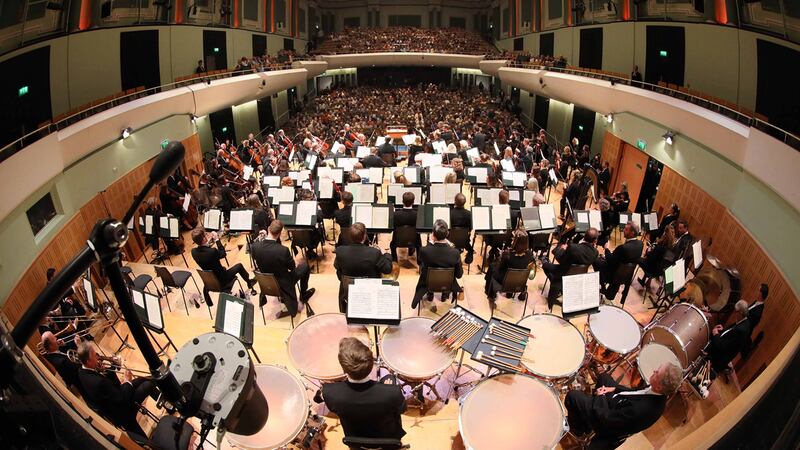
He is “not aware” of any international orchestras that have declined to play at the NCH because of its stage size, but he does remember one orchestra having to reduce its number of players in order to fit.
Acoustic concerns are “always to the forefront”, he says. “We need to make sure the concert hall works for the broad church of music that we put on.”
When I mention reports of a varying acoustic experience between seating areas, Flegg says this “largely comes down to personal preference” and opinion. “Centre-mid in the stalls” is his sweet spot, but some patrons are devoted to particular balcony locations, enjoying their visual aspect.
He hasn’t heard criticism of the acoustics on a consistent basis. “I don’t think we’re fixing the acoustics, if you like, but we would always strive for improvement.”
Two international venues he admires are the Barbican in London, which has “very open, extended foyer spaces where people are just hanging out, maybe having coffee, maybe meeting friends”, and David Geffen Hall in New York. “They had big screens along one wall, so that when the orchestra are playing, they’re broadcasting the concert into the foyer. I was just impressed by the public use of the space.”
This welcoming feel will be “really important” for the redeveloped concert hall. “Something I still hear people occasionally say is that they don’t feel it’s for them. You know: ‘The concert hall isn’t for me.’ We very much want to convert this into a space that is for everybody.”
[ Irish National Opera is showing us how to sing like a pro. Can we pull it off?Opens in new window ]
The foyer is home to a group of high-spirited primary-school children on the morning we meet. In another part of the site, work is under way on a facility that will allow the NCH to both develop its schools offering and expand community music initiatives. This is the €21 million Discover Centre, which is scheduled to be completed next January after a one-year build.
“Fundamentally, investment in culture is investment in people, so when you invest in culture, you are really investing in the people of Ireland,” says Flegg, who wants young children to be empowered to begin a lifelong relationship with music and the NCH through the Discover Centre.
Also ongoing is the recruitment of full-time musicians for NSOI, bringing it up from its depleted level of “about” 60 players to a complement of 79. “Once we get there, we will take stock.”
It is now four years since responsibility for the orchestra and associated choirs transferred from RTÉ after a sustained spell of under-resourcing. Flegg says the NCH has a “very secure” relationship with RTÉ, citing Lyric FM’s Friday night broadcasts, but adds there may be more “opportunities in the future”.
Flegg, who is 55, grew up in Rathgar and now lives in the Dublin suburb with his wife and three teenage children. “My grandfather was a classical singer and my aunt was a professional cellist. Classical music was very much what I grew up on, almost to the exclusion of non-classical music.”
In his teens he “kind of kicked a bit against that” and got into the pop and rock music of the 1980s. When his schoolfriend Tim Boland started a band, Flegg was the trumpet player, but in an early rehearsal he “just had a go at the drums”, inspired by “an all-time idol” of his, Stewart Copeland of The Police. He later went for lessons with jazz drummer Conor Guilfoyle and joined his musical projects as a percussionist, fostering his “particular love” of Afro-Cuban music and Latin-American jazz.
[ Money ‘no issue’ for long awaited revamp of National Concert Hall, says MinisterOpens in new window ]
His life as a percussionist overlapped with a career in education. He was a teacher and later the director of what was then known as Newpark Music Centre in Blackrock, developing Ireland’s first non-classical undergraduate music degree, the BA in Jazz Performance.
Enjoying the NCH’s eclectic variety of music is “one of the terrific things” about his job, he says. “There was a great moment a few weeks ago when I listened to the first half of a classical piano recital, then I went upstairs to one of our experimental electronic gigs and took in about 45 minutes of that before coming back downstairs for the piano encores.”
Beyond music, he’s a keen motorcyclist and volunteers with the emergency medical transport charity Blood Bikes East and a group that trains motorcyclists for advanced tests.
The NCH’s redevelopment may not be full speed ahead just yet, but Flegg expects it will soon get motoring.
“If I look at old notebooks from my own time here, the redevelopment has been a constant right the way through. It is something that has moved slowly but we now feel has the necessary momentum. We’re more confident than we’ve ever been that it will happen.”


