

It is cold outside in the south London enclave of Balham, but not inside the spotless little home of Dubliner Michael Hopkins. It is toasty in his flat today.
He sits contentedly in his comfortable armchair facing the window, his face bathed in the soft light of an early winter’s afternoon. Occasionally he slurps his tea. Now and then a faint smile creases his face as he muses on something or chuckles conspiratorially, recounting fragments of old memories in a thick Dublin accent.
But mostly, he just sits there quietly, entirely at ease and unbothered by conversation elsewhere in the room. Hopkins seems on easy street. And so he should be. It’s not long until he turns 101 years of age, next Wednesday, February 11th.
“The years do go by, don’t they?” he says wistfully, before returning to face the window. There is barely a hint of English intonation in his speech, despite having lived in England for more than 80 years.
READ MORE


With the travails Hopkins has endured – childhood abandonment, the horror of an Irish industrial school, and a period of lonely neglect in London in the winter of his bachelor life – he has earned the right to a comfortable rest now that he’s out the far side of it all.
These past few years, he hasn’t felt as alone any more as he grapples with mild dementia – he is still very lucid, although his memories are fading. Hopkins has no known living relatives, but at least now he has a friend.
Steve Reeves is the cockney stranger more than four decades his junior who stumbled into Hopkins’s life four years ago and utterly transformed it.
Reeves is a street photographer who snapped the dapper Hopkins at a bus stop near both their Balham homes before realising he needed help to live alone. He befriended him and helped Hopkins himself at first.
‘His sight is almost gone. He’s going deaf. But I think he’s happy, he’s resilient. He’s still got this spirit, you know?’
— Steve Reeves on Michael Hopkins
Reeves has a particular interest in photographing older people, whom he says must draw on depths of resilience to surmount challenges they meet in their everyday lives.
“There is no such thing as an ordinary person,” is his photographic motto.
Later, as the burden of helping Hopkins increased, Reeves found him top-notch carers who now lather the old man in the love and attention that he was deprived of all his life.
When you witness them treating him with the sort of tenderness you might reserve for your own father, it is clear that the love they show him is genuine.
“I think he was devoid of human contact and love, and you need that in life to get through,” says Emma Nimmo, his main carer. “It just makes everything better.”
[ London Irish loneliness: ‘In a pub no one would talk to you’Opens in new window ]
A whole online community has now sprung up around this frail old Dub with the killer smile and surfeit of wit. A legion of fans cheers his every little win, even as his life nudges towards its inevitable denouement. Reeves documents parts of his life on Instagram, and Hopkins loves hearing comments from fans, who know him as Michael.

After the tragic beginnings of his life and his brutal, cold upbringing in the Artane Industrial School in Dublin, Hopkins never wants to set foot in an institutional home again. Reeves, now his official advocate, has promised him he will do everything he can to keep him in his flat.
“I think he has some contentment now,” says Reeves. “He had a fall last year, and he never really came back to where he was after that. His sight is almost gone. He’s going deaf. But I think he’s happy, he’s resilient. He’s still got this spirit, you know?”
Hopkins had “such a sh*t start” to life, says Reeves. “He’s going to have a really good end.”
Hordes of strangers now regularly send the Irishman presents such as Guinness socks and cravats. They are usually posted to his local pub, the Nightingale. Forty strangers showed up there for his 100th birthday party last February after Reeves put out a call on Instagram. It was the first big birthday party Hopkins ever had in his life. Videos show him beaming and clapping as he blew out his candles.
Evidence of his centenarian milestone last year is stuck all over the walls of his simple little housing association flat. There are dozens of 100th birthday cards from wellwishers all over Britain and Ireland, strangers who thank him for the joy they say his smile-filled journey, as documented online by Reeves, brings into their lives.
“What a treat it is to be able to send you this birthday card,” wrote Elaine from Leeds. Presumably, she is sharpening her pencil to send him another for his 101st.
Another card, from Patricia, tells Hopkins he is an “amazing, inspirational gentleman”. Yet another tells him to “have a well deserved pint or two – from Louise and your legion of Instagram followers”. There is also a card from Britain’s king Charles and queen Camilla.
The Republic’s then-president, Michael D Higgins, also wrote a warm message to Hopkins last year on the occasion of his 100th birthday. It’s all a far cry from the Dubliner’s earliest interactions with the Irish State when he was effectively orphaned at six years old.
The undulations of Hopkins’s life, his arc from Dublin to London, can be pieced together from detailed stories he told Reeves over the past four years, as recorded by the photographer in video interviews and notes he posted on Instagram (after reading them back to the Irishman first). He has also documented their extraordinary friendship.
[ Diarmaid Ferriter: How the Irish became Britain’s oldest, loneliest ethnic groupOpens in new window ]
I visited Hopkins to speak with him several times in recent weeks. I wanted to check details of his story for The Irish Times, but mostly just to hang out in his charming presence along with the jocular one-time corporate film-maker Reeves, and the carer Nimmo.
“Can you believe you’ll be 101 soon?” Nimmo says to Hopkins on one of my visits.
“You’re as young as you feel,” he says.
“Do you feel young, Michael?”
“No,” he responds bluntly, bursting out laughing.
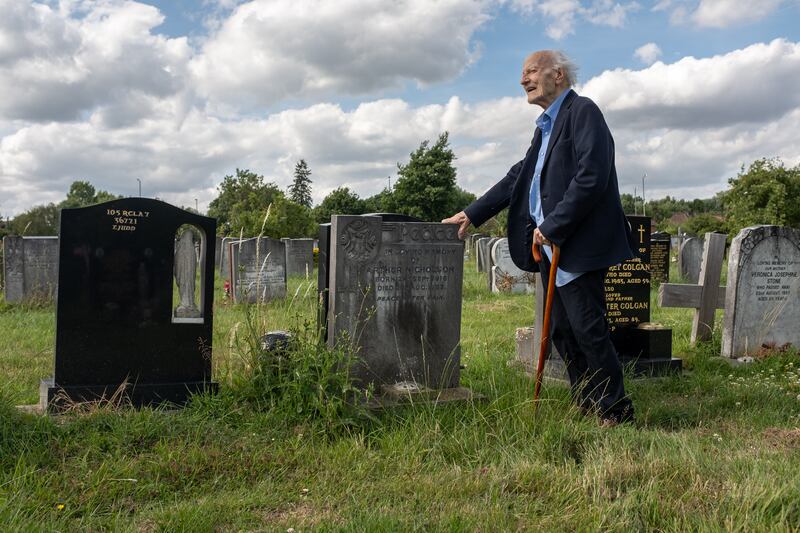
The basic facts of the Irishman’s life can be verified through public documents. Much of what he told Reeves empirically checks out: names, dates, places, records. All told, it is a remarkable tale, and one which Hopkins has freely shared over recent years.
He was born in 1925 in working class Dublin to his beloved mother, Josephine Hopkins (née Power) and father, Owen Hopkins. His older brother Patrick, who later also lived a bachelor life in London, was born two years before. Their sister Maureen was born a few years after.
When you tally the dates from birth and marriage certificates, it is clear that Josephine was already four months pregnant with Patrick when she married in 1923, which would have been severely frowned upon in the staunchly Catholic Ireland of more than a century ago. Hopkins has vaguely alluded to this in conversations with Reeves.
“My Daddy was the villain of the story,” Hopkins says.
He suggests his father, “the old fellah”, drank the money that Josephine earned from selling cakes. Hopkins has also suggested his father was a policeman, although he is named as a “dairyman” on some official documents.
What is not in dispute is the tragic pivot Hopkins’s life took. He says his mother died of tuberculosis in 1931, when he was six. This is verifiably correct – it is officially certified on her death certificate as “acute phthisis”, the Greek for TB. It lists her home address on Oakfield Place, right beside the Clanbrassil Street area where Hopkins says he lived 95 years ago.
‘I wish our mother had lived. Our life would have been totally different. But it looks as though it wasn’t to be’
— Michael Hopkins
Official records show she was buried at Mount Jerome cemetery. Hopkins told Reeves he could remember visiting her in her final weeks in a “home for the dying” overlooking the cemetery. Her death cert shows she died in what is now known as Harold’s Cross Hospice, which is indeed next door to Mount Jerome.
“I’ll be in there soon,” she used to say to her son as she looked out at the headstones.
Hopkins says his father was violent to his mother before she became ill, and that Josephine’s mother, his beloved grandmother Annie Power, defended her. Owen Hopkins left the family and moved to Manchester to “open a chipper”.
When his wife died in 1931, Owen abandoned his children and they were made wards of court. Annie was too impoverished to take them, living in a single room. The children were split up – Maureen was sent to Belfast, the two boys to live with nuns in Kilkenny.
“The old fellah didn’t want us,” Hopkins says. “They put Paddy and me in the dorm, and when I woke up in the morning, I saw my mama sitting at the end of the bed. I told Paddy and he said there was nobody there.”
As the boys neared their teenage years, they were sent to live in Artane, which earned notoriety as a den of abuse of vulnerable boys by Christian Brothers. Hopkins told Reeves they had a terrible time there, but that Paddy got the worst of it. Hopkins later got compensation for physical abuse, which now pays for his domiciliary care.
He trained as a tailor in Artane, but after he got out, his grandmother died and he found himself homeless and jobless. He moved to Belfast to work for the RAF towards the end of the second World War, before later moving to the south of England, and then London to work as “wash up” in hotels and then as a military uniform tailor.
Paddy moved first to Manchester to work with their father before later joining Michael in London, where he worked as a lift engineer. Scarred by their institutional experiences in Artane, the brothers never had relationships with women and lived together quietly in London. Paddy never spoke of what happened to him in the industrial school.
“I found it very hard to cope, and so did Paddy, I suppose,” says Hopkins in one of Reeves’s videos. He says they sometimes “took to the pub” to cope.
“I wish our mother had lived. Our life would have been totally different. But it looks as though it wasn’t to be.”

The brothers didn’t see much of Maureen, who also moved to London, as adults, and she died in her early 60s. Paddy died at 86 with Parkinson’s disease in 2010, and Michael Hopkins has been alone since.
He has no family. “My friends are all in the ground long ago,” says the centenarian.
Reeves met Hopkins at the bus stop in January 2022. By this stage, he was already having some difficulty managing himself independently, frequently getting lost and rejecting help from council carers.
Reeves visited Hopkins’s flat and found that, despite the visually impaired man’s best efforts to keep it clean, it was infested with cockroaches.
[ Remembering Mary: ‘The Irish in London always have a home here’Opens in new window ]
“He was so house-proud. But there were cockroaches climbing all over him. It was just really horrible to see,” says Reeves.
The photographer began documenting Hopkins’s life, and with his consent, shared updates with his online community.
Reeves put pressure on the housing association to sort out Hopkins’s flat by posting a video on Instagram of the cockroach infestation. Horrified followers of his page emailed the council to complain about the problem.

The housing association was spurred into action, but it moved the then 97-year-old in the early stages of dementia into a Balham hotel, which was totally unsuitable for his needs.
“I came down one day and he was sitting in the cafe across the road from the hotel, confused. A woman had bought him breakfast because he had wandered in without money - he had no kitchen to cook for himself. Up in his hotel room, he had pulled the television off the wall, because he couldn’t figure out how to turn it off.”
The cockroach problem was eventually sorted out and Hopkins could move back into his flat.
Reeves noticed a pile-up of missed hospital appointment letters for eye treatment – Hopkins’s sight had gotten too bad to read them. Reeves began driving him to appointments. He helped him buy clothes and took him shopping. Soon, he was calling in to his new elderly friend almost every day. He got him up in the mornings, gave him breakfast.
They hung out together, revelling in each other’s humour. “I’m not ready for the f**king boneyard yet,” says Hopkins, laughing, in one of Reeves’s videos.
‘You said it yourself – he reminds you of your own Dad. People have just taken to him. He just seems to symbolise something’
— Steve Reeves
In 2023, Reeves brought Hopkins on a two-day trip to Dublin to see his mother’s grave. They were driven all over the city by Brendan Byrne, a Dunboyne-based street photographer who is part of the Instagram community, cradling Hopkins in digital hugs of encouragement from Reeves’s Instagram page. He now visits him in London.
“It really touched me, watching Steve’s videos and photos of Michael. People can get forgotten,” Byrne says.
Byrne drove them to the old Artane institution, which is now a secondary school. The principal showed them around. “He was brilliant. He said he always makes time for visitors who were in the industrial school, because nobody knows what they must have went through.”
That night, Reeves arranged for them to stay in the Shelbourne hotel. Hopkins is seen on video amazed at the luxury, declaring that if he died the next week, he’d die happy after staying in a hotel that was only for “gentry” when he was a boy in Dublin more than 90 years before.
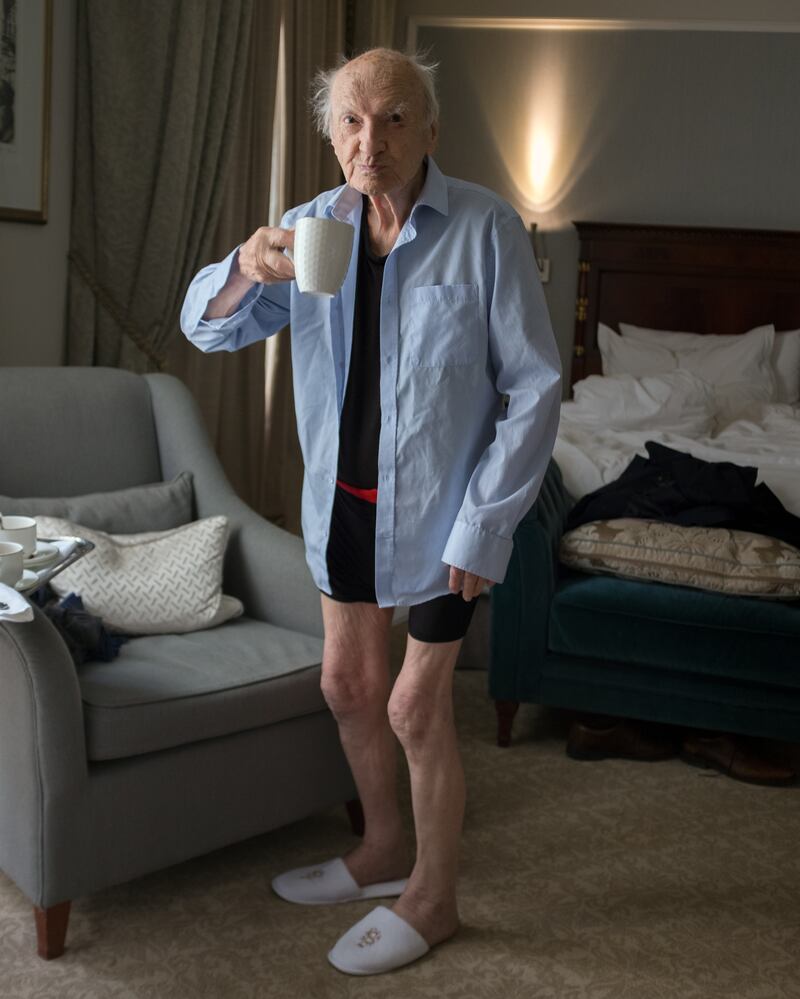
Instagrammers began visiting Hopkins. One, Vanessa, has become very close to him. She would cook and clean, talk to him, laugh with him. Hopkins’s care became more challenging. Vanessa recommended Nimmo, who also looks after one of her family members.
“Emma is an amazing carer. She saved Michael’s life,” says Reeves.
Nimmo says the same about him: “You’ve got to fight for people. Steve fought for Michael.”
After a fall last year, Reeves, now with full power of attorney to control Hopkins’s affairs, arranged high-quality private overnight care for him.
It is managed by Nimmo. Hopkins is now cared for every day in his own home, maintaining independence, not institutionalised, according to his wishes.
He is slowing down now. He still enjoys visits from the Southwark Irish Pensioners Project and community volunteers from Balham’s local Holy Ghost church.
[ The older Irish in London should not die aloneOpens in new window ]
Hopkins calls the church volunteers “the nuns”, even though they are no such thing. “The nuns called today, they made me tea,” he’d tell Reeves.
“He’s a very likable bloke, so endearing, so unassuming,” says Reeves, unassuming himself. “You said it yourself – he reminds you of your own Dad. People have just taken to him. He just seems to symbolise something.”

Reeves says he intends to keep his promise to Hopkins to avoid putting him in a home. He believes society should pay closer attention to the wishes of older people.
Reeves probably won’t arrange a 101st party next week for Hopkins. He thinks his friend wouldn’t be able for it.
The elderly Irishman finishes his tea, and thanks us for the conversations about his past.
“It’s nice to remember, isn’t it?”
He summons his ageing body to his feet and walks us to the door. “Thanks for calling. You’re always welcome.”


