

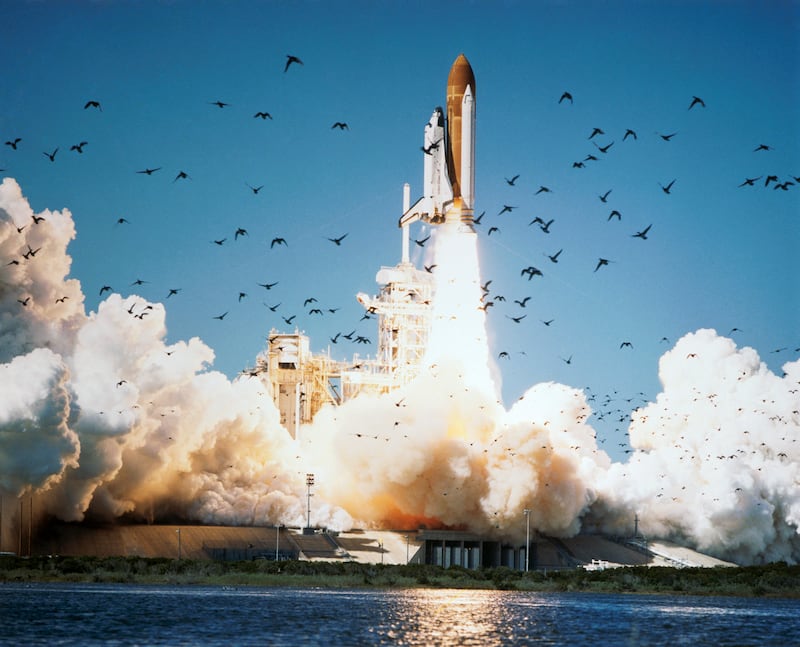
White plumes forked across a blue sky. These twisting towers of failure and folly puzzled the crowd at the Kennedy Space Center viewing site. This was meant to happen, wasn’t it? This must be the solid rocket boosters separating from the orbiter and external tank, as intended. Challenger was surely still up there somewhere, on its happy way to space.
The 2.5 million schoolchildren across the United States who were watching a special live Nasa feed, like viewers of fledgling network CNN, had a clearer view of catastrophe.
At Concord High School in New Hampshire, where 1,200 pupils had assembled to see their social studies teacher, Christa McAuliffe, become the first “average citizen” in space, senior class president Carina Dolcino was photographed with a party hat, balloon and the glummest of expressions. The image juxtaposes the paraphernalia of celebration with the dawn of a sickening bewilderment; the balloon is intact, but the air has gone out of the room.
Next week is the 40th anniversary of Nasa’s launch of mission STS-51-L on a fatefully cold day in Cape Canaveral, Florida. What followed 73 seconds after take-off was neither an unforeseeable accident nor an inevitable consequence of exploration, but the tragic outcome of a reckless roll of the dice that killed McAuliffe and six other crew members: Dick Scobee, Mike Smith, Judy Resnik, Ron McNair, Ellison Onizuka and Greg Jarvis.
READ MORE


January 28th, 1986, was the date of a very public disaster, one that came to be seen as emblematic of Reaganite overconfidence and space-race glory-chasing. It continues to spook a generation of children – my generation – for one obvious reason: much of the publicity had been aimed at us.
For years when I remembered those awful vapour trails, I thought I’d seen the launch live, but that isn’t possible. What I watched, aged six, was children’s programme Newsround breaking the news to viewers in Britain and Ireland just 21 minutes after the shuttle’s break-up at 11.39am eastern standard time. A brief clip uploaded to YouTube radiates shock. “Disaster for the shuttle,” announces the terse presenter, Roger Finn, as a fireball forms behind the programme titles.
This media moment makes scant sense today, but in 1986 there was no rolling TV news here and no multichannel bonanza-of-choice to fragment audiences. Like many children, I was watching Newsround at 5pm that day because I watched it every day. The programme, underlining the seriousness with which the BBC treated its children’s output, had won an internal battle to report first. Crucially, its viewers were already familiar with Challenger from the build-up.
I didn’t know the word “hubris” and couldn’t have named what I felt as disillusionment, but I recall wishing I could warn those smiling, waving crew members. When attention turned to the Atlantic Ocean, where the wreckage fell, the visuals seemed utterly dreadful – astronauts were meant to go in the opposite direction.
Seeking maximum publicity, Nasa had been considering recruiting a space-faring journalist before a committee recommended a teacher go first. US president Ronald Reagan unveiled the Teacher in Space Project in 1984, with McAuliffe selected a year later from more than 11,000 applicants.
The hype was most potent in the US, where she became a popular talkshow guest and public-service broadcaster PBS planned to air two of her in-orbit science lessons live from space. But McAuliffe’s effervescent persona ensured her name travelled, with media outlets seizing upon the woman-next-door qualities of Nasa’s chosen “teachernaut”.
But that she was on Challenger was the product of a surprising jadedness. The historic moon landing of 1969 transfixed viewers. By 1972, when Gene Cernan became the 11th and (for now) last person on the moon, the reception was muted. New York Times television critic John J O’Connor concluded that networks were correct to opt for mostly brief programme interruptions as pictures of barren moonscapes and floating astronauts became “ordinary and tedious rather quickly”.
Space exploration tallied with the Pentagon’s desire to wage the cold war off-planet, but then president Richard Nixon’s enthusiasm for it was conditional on Nasa keeping a lid on costs. The space shuttle was duly conceived as a “reusable spaceplane” that would “routinise” space flight, with a predicted 48 missions a year.
Amid frayed nerves, the maiden flight of the shuttle programme was completed in April 1981, when Columbia touched down. It was back in orbit that November. Sally Ride, the first American woman in space, and Guion Bluford, the first African-American in space, received their gold astronaut pins in 1983 on separate missions of the second shuttle orbiter: Challenger.
But space ennui was soon the subject of jokes again.
“Space shuttle is back. Is it back? Is it? I think it came in Monday? It’s back. Look at this, [only] three people know,” riffs Jerry Seinfeld in an early 1980s routine. “Maybe they should send up some guy who doesn’t want to go,” he says, miming the door-clinging panic of a reluctant astronaut.
Nasa’s solution was to send McAuliffe. Even before its search for a camera-friendly teacher, space flight had ceased to be the preserve of military test pilots. Still, this “ultimate field trip” crystallised a contradiction. Washington wanted to make the exceptional routine. Its message was: space is safe, space is normal, we can do space. And yet its target audience could reasonably have wondered why, if space flight posed so little risk even “ordinary” people could do it, astronauts were deemed heroes.
The loss of Challenger, on what was the 25th shuttle mission, sprang from the failure of the primary and backup O-rings – rubber-like seals – in the right-hand solid rocket booster, which allowed hot, pressurised gas to escape. A flame burned through to the orange-hued external fuel tank and the shuttle broke apart.
[ The Challenger disaster: a tragedy that knocked faith in space explorationOpens in new window ]
The deeper cause went beyond design flaws, stemming from dysfunctional communication, hierarchical management, cost-cutting stresses, schedule tensions and the systemic blunders of bureaucracy and arrogance. The truth was Nasa had been riding its luck with a litany of “anomalies” and near-misses.
The evening before, engineers at Morton Thiokol, the contractor that made the motors for the solid rocket boosters, were alarmed by freezing temperatures in Florida and recommended against launching. Their managers were then pressured by Nasa chiefs into giving them the answer they wanted. “Go fever” took hold.
Adam Higginbotham’s 2024 book Challenger is a much-recommended account of the mistakes and magical thinking that led to tragedy. Challenger: The Final Flight, a Netflix documentary series from 2020, is likewise gut-wrenching, though it omits mention of Roger Boisjoly, the Morton Thiokol engineer who linked the long-known “erosion” of the O-rings to their brittleness in cold weather. In July 1985, days after a radiant McAuliffe assured NBC’s Today that “space flight today really seems safe”, he sent his bosses a memo stating his “honest and very real fear” that the O-rings might not seal and that this would result in the loss of life.
Nobel Prize-winning physicist Richard Feynman, a member of the commission appointed to investigate, later added his own stinging appendix to its already damning report. “For a successful technology, reality must take precedence over public relations, for nature cannot be fooled,” he wrote.
Nor could the children who sobbed in the aftermath. This was a backfire both spectacular and immediate. The global coverage far eclipsed that garnered in 2003 by the disintegration on re-entry of Columbia, which also killed seven crew.

Memories of Challenger now evoke a nascent 1980s culture of thirsty, continuous, satellite-enabled news. Defining aspects of the story were revisited in 2021 in the first episode of Australian period drama The Newsreader, in which news anchor Helen (Anna Torv) insists they stay on air and replay the same footage over and over. She then zeroes in on the real-time bereavement of McAuliffe’s parents, Grace and Ed Corrigan, who were among the relatives filmed watching the disaster in abject distress.
Of the six who died with McAuliffe, Scobee, the commander, was a new grandfather who had decided this would be his final mission. He had already written his Valentine’s Day card to his wife.
Resnik, who flew on Discovery in 1984, was an expert in operating the robotic arm that deployed communications satellites. She was once asked by NBC if she was “too cute to be an astronaut”.
McNair, like Scobee, had flown on Challenger before, playing a saxophone in orbit. The second African-American in space, his home town had already named a street after him.
Onizuka was part of a Discovery crew sent on a January 1985 mission with clandestine military objectives. The first Asian-American in space, he had been changed by the experience.
Jarvis was a “payload specialist” from aerospace company Hughes who Nasa had bumped from two previous missions to make way for space-fancying politicians.
[ Who gets to go to space?Opens in new window ]
Smith, like McAuliffe and Jarvis, hadn’t been in orbit before. The pilot was aware that something had gone horribly wrong – analysis of sea-damaged tapes revealed that the final recorded words on Challenger were Smith exclaiming “uh-oh”.
Hauntingly, when salvage teams recovered debris from the crew compartment and the remains of the seven, it became apparent that they didn’t perish instantly in the fireball but were conscious after it, at least in the initial seconds.
Three of the four emergency air packs found in the sea were switched on. Their location suggested one, belonging to Smith, had been activated by Onizuka or Resnik. These packs were designed to be used in a launch pad incident – the orbiter had no ejector system. Its high-speed impact with the water, two minutes and 45 seconds after the shuttle tore apart, was not survivable.
Reagan spoke directly to children during his televised address that night. “I know it’s hard to understand, but sometimes painful things like this happen,” he said, before contending that fatalities were part of the process of exploration and discovery.
This rhetoric of unavoidable sacrifice soon unravelled. Instead, Challenger came to encapsulate enduring American extremes: brilliant scientific minds and courageous, dedicated pioneers at one end of the spectrum; at the other, the destructive delusions of those with unchecked power and an unbending will.
[ Nasa rolls out rocket for first mission in over 50 years to take crew around moonOpens in new window ]
It is strange to look back just as Nasa prepares to go forward: Artemis II, this spring’s crewed “lunar fly-by”, will pave the way for a return to the surface of the moon. Billionaires’ space jaunts are a derided display of wealth, and space itself a strategic frontier in frightening bids for military dominance, but exploration of our solar system remains a seductive ambition – one that humans will not give up.
An inspiring coda arrived in 2007 when Barbara Morgan, who served as McAuliffe’s back-up, reached orbit on board Endeavour, having left teaching to become a fully trained mission specialist.
A cultural legacy lingers. British writer Samantha Harvey won the Booker Prize in 2024 for Orbital, in which astronauts rotating the Earth witness 16 sunrises and 16 sunsets in a day. This is literature with a still, languid feel and a cosmic beauty; there is no hint of crisis. The fragility of life infuses the novel, nonetheless.
One character, Nell, says she has wanted to be an astronaut since Challenger met its fate because it made her realise that space flight was “a thing real people do, die doing”. It is not a fantasy. Nell later dreams she is a child again, swimming in search of the Challenger crew. She knows everything about the seven who died.


