

In the early hours of January 5th, 1991, Dennis Connolly decided to leave the Simon shelter in Galway city where he was staying. He wanted to meet up and drink with friends, rough sleepers like himself, known locally as “skippers”.
The men were sleeping in an old Volkwagen van which had been abandoned on a side street near the Spanish Arch. Dennis arrived at about 3am. There were five in the group. He names the others as Pa, John, Mickey and Martin .
It was midwinter and bitterly cold. A fierce Atlantic storm was also brewing up and gusts were already blowing hard from the mouth of the river Corrib, only yards from where they were. They could see the wind making “twisters” on the water.
They drank and then clambered in through the broken front window and settled down. Dennis was in the middle of the van, curled up “like a hedgehog” to keep himself warm.
READ MORE


“At about half past five, the wind got stronger and the van began to shake. I got out the window. There was a big old wall beside the van and stones were falling from it. I got hit by one. I called out to Pa, John, Martin and Mickey. I said to them, ‘Get out fast, the van is going to turn over.’
“Martin and Mickey got out. A rock hit me in the arse and then another one. My hip was fractured and I broke my leg and arm.
“Down came the whole wall and flattened the van like a sardine can.”
As Dennis crawled away from the wall he called out to Pa and John who had been trapped in the van. “I couldn’t get any word of them.”
He frantically tried to flag down a car that was passing but the driver kept going. Barefooted and in considerable pain, he managed to walk through the storm back to the hostel, more than a kilometre away. Mickey and Martin, unscathed, walked with him for a while but at some point they parted ways. As soon as he reached the hostel, Dennis banged on the windows and raised the alarm. Already he knew the fate of the two homeless young Galway men who were among his brothers of the street: John and Pa. “I knew then they were stone dead, the two of them,” he says.
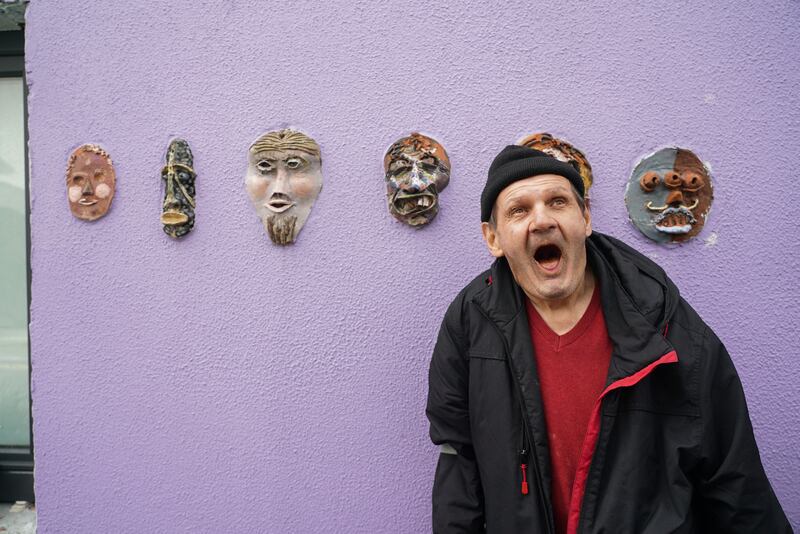
Dennis had suffered serious injuries and would spend months in hospital. “A doctor said to me you are a lucky man to be here.”
[ Homeless figure climbs to new record high of more than 16,300 peopleOpens in new window ]
Dennis would reflect on that moment during his recuperation. “I got a warning. If ever you get a warning you heed it,” he says.
January 5th was a near-death experience. But if truth be told, a lot of Dennis Connolly’s adult life had been a near-death experience. Anyone who spent any time in Galway between the 1970s and 1990s knew Dennis. He was known by a nickname that would not pass muster these days: Dennis the Wino. He would drink himself to incoherence and stupor every day of his life.
I was a cub reporter with The Connacht Tribune back then and covered District Court cases. Dennis was a regular at the weekly court sittings facing charges of breaking shop windows (mostly McCambridges of Shop Street) to steal wine. That most human of judges, John Garavan, would scold Dennis but would show him compassion and understanding. Sometimes Dennis wanted to be imprisoned to get a break from the relentless hardship.
At some stage, I’d given Dennis a lift out to the Salthill promenade. I can’t remember how it came about but we had a great conversation on the journey. I was struck by his self-awareness. He was sober at that moment but would not be for long. There was a bucket of slops which he had taken from the back of a pub carefully balanced between his legs.
My interest in Dennis was stoked by a remarkable article I’d come across the previous year, among a pile of old Connacht Tribunes stashed in the corner of the newsroom. It was written 10 years earlier, in March 1981, by Brian McDonald.
It began: “Dennis Connolly is 31, heading downhill fast – and he knows it. You can’t really expect too much in terms of longevity when your whole life has been revolving around the cheapest bottle in town since the age of 15.
“Sixteen years of aimless homeless drunken existence has taken its toll on Dennis Connolly. His uncared for frame bears all the hallmarks of a life of apparent self-destruction, now heading towards its inevitable conclusion.”
Dennis himself was very aware of that. “If I’ve got to kip out all the time now I won’t last long. I know that,” he told McDonald.
His entire life had that tinge of tragic inevitability to it. He was born in 1953 in Fursey Road, Shantalla, a council estate on the west side of the city. One of seven children, his mother, Bridie, was chronically ill throughout his childhood and died when he was five. His father, Paddy Joe, had fought for the British army in Egypt during the second World War, but by the time Dennis was born was unable to look after his children.
“He was an awful man for the drink. He would take the belt off and give you a few slaps,” he recalls.
At the age of five, Dennis and two sisters were taken into care. Initially they were in the same orphanage but an aunt in England took the two girls and at age eight, Dennis was sent to the notorious St Joseph’s Industrial School in Lower Salthill, an institution where sexual and physical abuse occurred. He says he was never sexually abused but it was a tough environment.
“I got a lot of beatings for nothing. The brothers were also abusing lads.”
When he was 14, an aunt in Galway took him in but they did not get on. She was strict and they rowed. He got a job as the office boy in an engineering firm but did not like it. He plotted a plan to escape. “I wanted to know where my father was. I heard he was in England.”
With his monthly wages, he paid IR£5 and 10 shillings to get the boat and train to London but could not find his father. He ended up sleeping in Euston Station and was picked up by the police and sent home. Back in Galway, his aunt refused to take him back, and he was sent as an inpatient to the psychiatric hospital in Ballinasloe, because “nobody wanted to take me”.
It was a huge institution and completely unsuitable for a 14-year-old boy. “I got all the dirty work. I got an infection on my throat and was passing blood. I was sent up to the ward for the sick. My job was to shave dead people. I must have done 60 corpses. You had to tie them up, keep their chin and mouth closed, and wash them down.”
After 18 months, his brother Gerard came back from England and signed him out. They slept in a hay-shed in Athlone that night and went to Dublin looking for work. After six weeks of sleeping in homeless hostels, Gerard left for England leaving Dennis, not yet 16, in Dublin. He says he ended up sleeping in a hayshed on the farm in Gonzaga College along with a group of other homeless men for a while. By this stage, Dennis was drinking heavily. Weeks turned into months and into years. His life became a pattern of begging, stealing and drinking, staying in hostels or on the streets, with occasional stretches in prison or St Patrick’s Institution for young offenders.

“Dublin is an awful place for homeless people. I felt sorry for them. Many of them came from the country and worked on the sites and then drank too much and ended up on the streets.”
[ More than 66% of homeless people in Ireland are in Dublin, report findsOpens in new window ]
In 1975, he made his way back to Galway. He found an abandoned shed on the far side of a high wall near the Claddagh Palace cinema in Lower Salthill. That was to be his main “home” for the following years. “I ended up more times sleeping on the ground because I was not able to get over the wall drunk,” he recalls.
In the 1980s, students from UCG, led by Conall Mac Riocaird, had set up Simon in Galway, initially doing soup runs and then establishing a homeless shelter.
Clients included Dennis and others in the small group of homeless people in Galway – untouchables to everybody else – who were his brothers of the street, his closest friends.
I left Galway in 1992 and during my visits home, did not come across Dennis. As time went by I forgot about him, perhaps presumed he had succumbed to his own prophecy. But about seven years ago, there was a report on RTÉ about Simon in Galway. And the main interviewee was Dennis Connolly. Unmistakably Dennis. That slicked back dark hair, the half-smirk, the perky look.
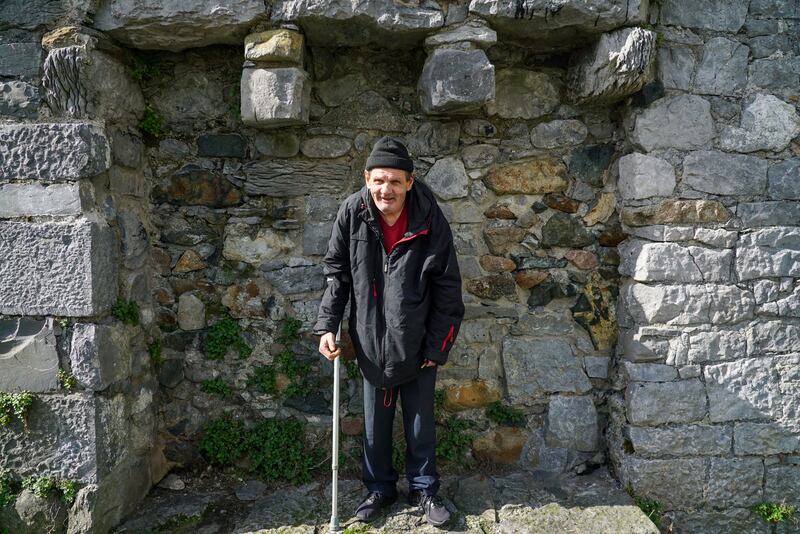
We meet Dennis now with Fintan Maher of Simon in Simon’s offices in Galway. Dennis looks great, and is full of talk and banter. The injuries from the wall collapse, and the previous years of self-neglect, have taken some toll and Dennis walks slowly with the aid of a stick. But he’s in no worse fettle than many men of 72. Fintan says that what prevented Dennis from the worst ravages of rough sleeping was he made sure that he ate every day.
Dennis heeded that warning on January 5th, 1991. It changed the course of his life. He started to go to AA meetings and has stayed sober since, with a few short lapses over the years. Dennis recites the AA vow word for word and thanks the sponsors who helped him through the first months. “I do not want to drink. If I take up one, it’s me, I never stop,” he says.
[ I Am Not an Alcoholic: Camaraderie was coming out of the cracks in the wallsOpens in new window ]
Simon found him his own flat in Mervue. He took up crafts and making models. He loves listening to sports and current affairs on radio. He has been an active participant in the homeless choir in Galway. And he has been, for some years now, Simon’s official ambassador in Galway.
We travel down to Lower Merchants Road where the wall once stood. New buildings now stand there. Dennis stands on the quay where the rushing river Corrib meets Galway bay. It’s not hard to imagine how powerful that storm was on that January day. He remembers Pa and John , young men who fell by the wayside and then died horrible deaths. He remembers his other brothers of the street.
“I’m the only one who survived,” he says. It is true. He somehow defied the inevitable conclusion predicted for him. He lifts his crutches in the air and declares: “I’m not Dennis the Wino any more. I’m Dennis the Legend.”


