
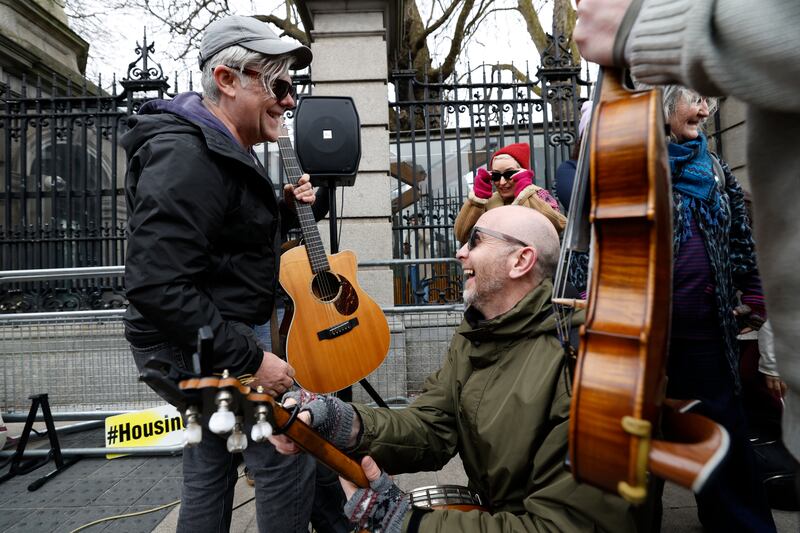
Under his hat and sunglasses, with a guitar slung over his shoulder, a soft-spoken man made his way up Molesworth Street and looked up at the clean, grey facade of Leinster House. Martin Leahy carried a yellow placard under his arm with the word #HousingCrisis emblazoned across it, parts of it a little scuffed, scratched and discoloured from more than four years on this one-man campaign trail.
Every Thursday for the last 200 weeks, Leahy has woken up at the break of day and driven from his home in west Cork to Cork city. From there, he has taken a bus from Cork city to Dublin where he would stand outside the national parliament and sing what has become an anthem of the housing rights movement: Everyone Should Have a Home.
Profound in its simplicity, the song has been praised by housing activists as a powerful but dignified protest against the housing crisis, and Leahy has since performed it on-stage with Christy Moore.
Leahy has stood on Kildare Street and sung the song in every season as his lyrics drifted over the glossy black fencing of Leinster House. Leahy, who had never been an activist before, was propelled into campaigning against the housing crisis when he suddenly found himself homeless.
READ MORE


A musician by trade, he had always been able to pay his rent in rural Co Cork but it was only when his landlord sold his former property that he was shocked to find he had nowhere else to go. Leahy, who said he was fortunate to have someone to stay with, became part of Ireland’s “hidden homeless” – a cohort of the population who do not have a home of their own, but who stay with friends, family or in refuges and so are not reflected in official homelessness statistics.
“This whole experience has been life-changing for me,” Leahy said. “The main point of my protest was not to accept it – we don’t have to accept this as part of life in Ireland, this crisis.”
Yesterday marked Leahy’s 200th protest of this kind, and his last. “It’s becoming a bit of a strain. Time-wise, financially, I travel up from west Cork every Thursday. And I suppose energy-wise as well.” Martin would sometimes book a gig in Dublin on a Thursday to try to defray the cost of his protest, but it is a difficult cost to bear.
Some of the politicians even seemed a little lonesome for the protester. Social Democrats spokesman on housing Rory Hearne told Leahy: “On a human level, I’m sad to see you go.” Sinn Féin’s Eoin Ó Broin praised Leahy for the “great dignity” and “great compassion” of his demonstration.
Housing campaigners that have got to know him over the past four years gathered to celebrate Leahy and his protests. Margaret O’Regan, a veteran housing rights activist, is one. When Leahy first posted a demo of Everyone Should Have a Home on social media, he woke up the next day to see it had been shared 50 times. “They were all Margaret,” he said, “sharing it to all different groups”. Sophia Mulvany, the 15-year-old disability and housing rights activist and her father Bernard Mulvany have befriended Leahy over his time in Dublin. “I hope one day I’ll be able to make people feel seen in the way Martin makes us all feel seen,” Sophia said.

Leahy was presented with a cake, with “200” spelt out in sparkly candles, and a picture of him with his guitar on the top. The icing was a little cracked in places, sustained on a bumpy journey on the Luas. One supporter said it might work as a reference to the defective concrete blocks scandal. Housing activists described how, over the 200 weeks, certain politicians would avert their gaze while they dashed in and out of Leinster House. One woman said it had even happened that very day.
Leahy performed the song twice for the appreciative crowd, explaining that he normally sings it about 20 times at each demonstration, “so you’re getting off lightly”. The final version was performed with the aid of his own activist orchestra: three guitars, a violin, a banjo, a saxophone and an enthusiastic choir of supporters. “Here we go,” Leahy said, “one last blast”.


