

Kilkenny College is Ireland’s largest boarding school. Boy and girl boarders make up about half of the 900-plus students at the second level school.
We visited the 20-hectare (50-acre) site – with classrooms, dormitories, a music and arts building, and outdoor hockey and rugby pitches – just outside Kilkenny city to find out what boarding school is like in 21st century Ireland.
“Boarding schools give students a great sense of belonging,” says Emma Raughter, principal of Kilkenny College, who was a boarder here herself. “Some of my closest friends go back to my school days. It also gave me great confidence to go to study in the UK when I was finished.”
Raughter says that some families in Kildare or Wicklow opt to send their children as boarders to Kilkenny College rather than commute to a fee-paying day school in Dublin.
READ MORE


“Some parents who want their children to be competitive in hockey and rugby leagues and yet don’t want the Dublin options will choose Kilkenny College,” she says. The equestrian club, where students bring their own horses for Sunday gymkhanas, is another draw.
“The school is rooted in the agricultural community, with the majority of boarders from farming or agri-food business backgrounds,” says Murt Larkin, chief operations officer at the college. The fact that the school hosts an annual 10km charity tractor run – and have tractor restoration as an extracurricular activity – is also testament to its agricultural hinterland.
Raughter says numbers were a little down for 2025-2026, with an intake of 58 first years, under the maximum of 68.
She suggests the cost of living crisis is a factor in this. “A lot of our boarding families are from rural areas. They are ambitious for their children but with improvements in many local schools and costs of third level – especially accommodation, they have other costs to consider,” says Raughter.
The boarding fees at Kilkenny College were €13,150 for the 2025-2026 academic year, compared with €11,000 for the 2021/2022 year.
[ Sign up to our Classroom to College newsletterOpens in new window ]
About a third of boarding students avail of means-tested grants for Protestant families who want to attend a school of their own religious ethos. Under the patronage of the Church of Ireland, the school gives priority to Protestants, but students of all faith backgrounds and none are also welcome. Kilkenny College entered the free education scheme in 2013, ending fees for day students at the school.
Larkin says Covid was an extremely traumatic period for the boarding school sector. “There was a bounce in numbers after Covid, but a fall-off in the last two years,” he says.

He says in boarding schools nowadays there is much more regulation to ensure everything is in place in terms of student welfare. “There is also a greater student voice, which we facilitate with a boarding council and a catering committee who meet a couple of times a term to look at menus.”
The two brightly lit diningrooms, with their lime green plastic chairs and collages of flower and leaf prints on the wall, are utilitarian and modern in feel, far removed from the long wooden tables and chairs in refectories of boarding schools in past eras. An app allows boarders to look at menus for the coming week.
Larkin also says that keeping dormitories maintained is a challenge for boarding schools. “Most children live in homes with multiple bathrooms and toilets so it’s a harder sell to parents now to put their children in a dormitory with shared showers and toilets,” he says.
With lights out at 10pm followed by frequent supervision, bedtime routines are strictly observed.
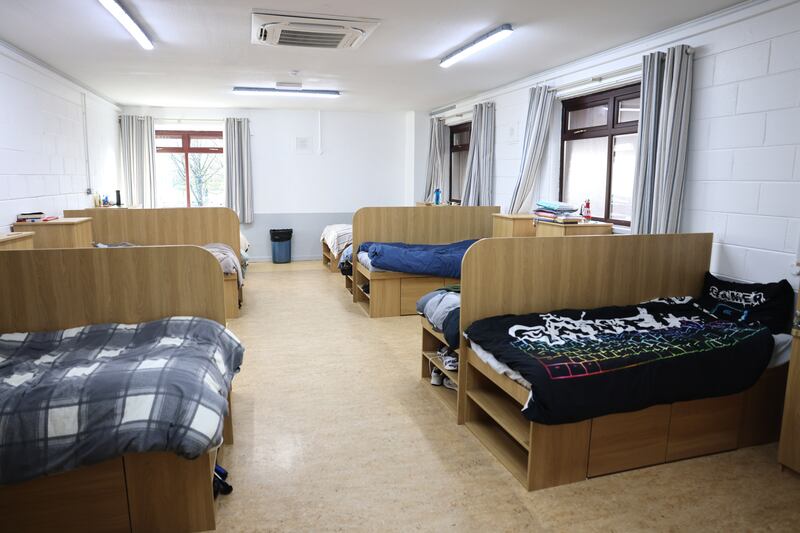
We are given a tour of some of the boys’ and girls’ dormitories of four, eight and 12 beds per room.
While they look warm and cosy, they aren’t luxurious. The senior cycle boarders can request friends to share smaller dormitories with, which also have kitchenettes to cook in.

The boys’ boarding houses are at one end of the campus while the girls are at the other end – and girls aren’t allowed into the boys’ dormitories or vice versa. The junior cycle boarders share rooms with up to eight beds, while the senior cycle boarders are in generally in rooms with four beds although there are a few two-bedroom dorms in the boys’ boarding house.
The only unscheduled free time the boarders have together is “astro-time” where boy and girl boarders can hang out together on outdoor pitches, supervised, between 8.40pm-10pm.
There are table tennis and table football games alongside large couches in the boys’ boarding houses. The girls’ boarding houses also have various seating areas with a few pianos scattered around.
Some of the girls’ dormitories are housed in the large reception rooms of the original Newtown House, the grounds of which Kilkenny College moved to from its original Kilkenny city buildings (which now house Kilkenny County Council) in 1985. The school became co-educational in 1973.


Far from the reality of boarders of their parents’ generation who often had classes on Saturday morning and only saw their parents at the end of each term, unless they visited them on Sundays, all boarders leave on Friday evenings, returning on Sunday after 8pm or on Monday morning before 8.30am.
Many students also opt to return home during the week for sports clubs or family events. International students – of whom there are a few – must find host families to stay with at weekends.
Fiona Prendergast, head of the girls boarding house and Pieter Swanepoel, head of the boys’ boarding house, both agree that technology is the biggest challenge when managing the boarders.


Prendergast explains that mobile phones, smart watches and tablets are all taken from junior cycle students before bedtime and returned to them in the morning before classes begin.
“It’s about helping them navigate through the dangers of social media while giving them access to their friends and family,” says Prendergast, who, like Swanepoel, lives on campus during the week.
Bronwyn Nortje, the school chaplain, says she deals with everything from homesickness to self-harming, suicidal ideation, deaths in the family, boyfriend and girlfriend problems. “I’m a neutral person they can come speak to or even just to be quiet in my room. I’m not a rule enforcer or a teacher and what they tell me remains confidential unless there is a safety concern,” she says.
Raugther, a supporter of the Leinster rugby team and a keen hockey player and coach (her school hockey jersey is framed in her office), says that playing and supporting sports is a big part of school life. “Because we are a country school, we have to get buses to matches and great friendships are formed on these journeys,” she says.
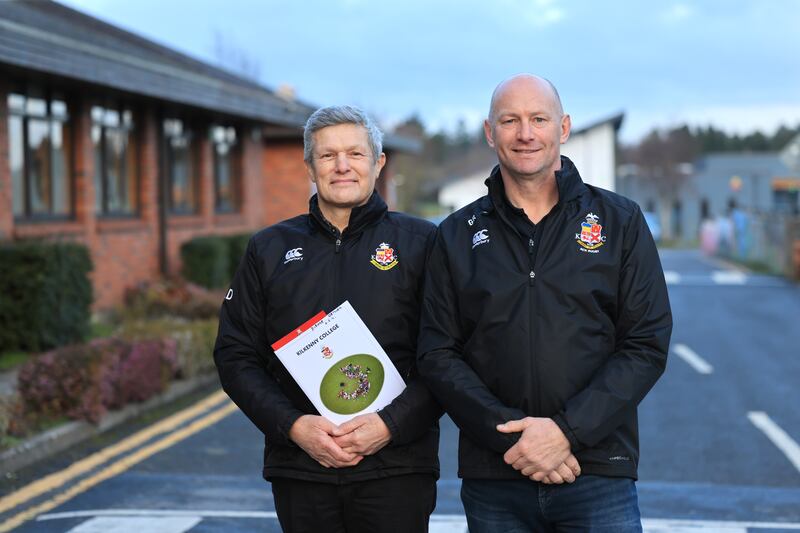
Gordon Rowe, director of rugby at the school adds that eating, sleeping and playing sports together develops great camaraderie among the boys. “It also gives them a certain grit. They give everything they can. There’s nothing quite like competing for your school.”
Elmer Dool, the director of hockey says that his job is to get as many boys and girls playing hockey from first year. “Players can be role models for other people. It’s easy to win but learning to deal with losing is character forming.”
Katherine Murphy, a French and Spanish teacher at Kilkenny College who commutes from Tinahely, Co Wicklow, choose to enrol her daughter Kate as a boarder in Kilkenny College.
“She had never even had a sleepover before she came. It took her two weeks to settle in. I have a busy life and she is in to so many things that are all available to her here. I’d be on the road every evening if she was home,” says Murphy, who was a boarder at the Ursuline Secondary School, in Thurles, Co Tipperary.
She adds that some parents are prepared to make the financial sacrifice of a new car or a holiday to send their children to boarding school. “It won’t suit children who are homebirds or parents who can’t part with their child,” she says.
Raugther says that while very few boarders leave, some decide not to come when given the chance to stay one night in June before starting attending the school the following September. “We do this so that they aren’t thinking about it all summer long and so that they can begin to form new friendships. It also allows someone to change their mind before term begins.”
Boarders’ stories

Adam Cole, a fifth year from Co Kildare
“I was given the option between here and a local school and because I was into rugby and my sister was already here. I chose here. Both my parents and their parents came to Kilkenny College. I settled in really fast and, socially, I think it’s good to be in a mixed school. Before transition year, all my friends were boarders, but now, the majority of my friends are day pupils.”
Tom Waugh, a sixth year from Co Wexford
“I didn’t know anyone when I started here. I was shy and quiet in first and second year, and at the end of second year, I asked my parents could I go to the local school. They said wait a while longer, and then I settled. You can get a bit separated from your friends at home, but I play Gaelic football, hurling and soccer when I’m home at the weekends. Socially I’ve grown so much. I can talk to anybody.”
Hugh Melaniphy, a third year from Co Offaly
“I’m the youngest of three and I came here because I’ve always loved sports. You spend your entire day together and, in the beginning, you’ll clash with people but you’re stuck with them. Over the years, you’ll find people you get on with.”

Bianca Thomas, a second year from Co Carlow
“I’m the youngest in my family and being a boarder has taught be to be punctual, tidy and organised. It took me a year to learn these things.
Rachel Ferguson, a fourth year from Co Laois
“I’m an only child and I missed my parents at first but then I started to make good friends. After a year or two, you figure out who your core friends are. You learn how to be more independent. There is a stereotype about boarding schools being big fancy schools, but you don’t have to be a certain type of person to be a boarder.”
Rachel McMonagle, a fourth year from Co Wicklow
“I was a day pupil in an all-girls Dublin school until halfway through second year. The commute was so hard that I became a boarder here instead. Now, I have so much more independence and time to do sports and projects at school. I love that I can collapse into bed for a bit at lunchtime for a break in the school day. Even though I’m Catholic in a Protestant school, I’m made feel very welcome here. Also, having guys in the school means it’s a much less toxic atmosphere than a girls’ school.”
Abby Johnson, a sixth year from Co Wexford
“You get to build very strong relationships with friends as a boarder. You also learn to respect each other’s spaces. I didn’t start off clean and tidy, but I’ve learned by being around others to be less messy. Being tidy helps clear your mind too.”


