
Music teacher Áine Balfe and her husband, Daniel, estimate they spend around four hours a day and up to €150 per week commuting between their home in Ardee, Co Louth and Dublin.
The couple, who are both post-primary teachers in the city centre, have been travelling the route for 11 years but say traffic congestion has gradually become worse over that time and increased “a lot” over the past six months.
Balfe (38), who works at St Patrick’s Cathedral Grammar School, says their commute via the M1 motorway that connects Dublin and Belfast used to take about one hour and 15 minutes but has risen to two hours, sometimes more.
“It’s quite tiring and it’s hard physically on the body,” says Balfe.
READ MORE


“It’s a long time to be sitting in the car but we both really love our schools and have very supportive management and teachers and we love the students.
“It’s hard when you’re really settled in a school and enjoy it to walk away from that to try and look for a closer school.”
Balfe, who is originally from Co Louth, says they considered living in the capital with their three young children but were priced out of the market.
A private bus operator does provide a service from the town to the city centre but the times don’t align with their childcare drop-off.
“You’re talking about 6am to 6pm door-to-door really and it’s the same for a lot of people, not just teachers,” says Balfe.
“There have also been changes to the city centre traffic system, which has had an impact as well. It makes it very difficult for schools in the city centre to attract teachers to want to work there because it’s hard for them to get accommodation and then if they’re paying high commuting costs, they’re trying to offset that from their wages.”
Dublin is ranked the 10th most congested city in the world, according to the TomTom Traffic Index, with the average travel time per 10 kilometres standing at 33 minutes.
The issue of traffic congestion, in particular delays on the M50, has been raised continuously by commuters, politicians and transport experts over recent months. Even visiting celebrities are noticing. “I apologise for us starting late, but you have a traffic problem out there that you have to sort out,” composer Hans Zimmer told an audience at the 3Arena, Dublin last month when he took to the stage 15 minutes behind schedule.
The problem was exacerbated this week as the Luas Green line, running from Broombridge in Cabra West on the northside of Dublin to Brides Glen in south Co Dublin, was out of service following a power outage.
A recent transport modelling project estimates the economic cost of congestion has grown from €172 million to €439 million between 2016 and 2025 within the Greater Dublin Area, a 155 per cent increase.
Congestion is projected to cost the country economically about €2 billion by 2040, according to the Department of Transport.
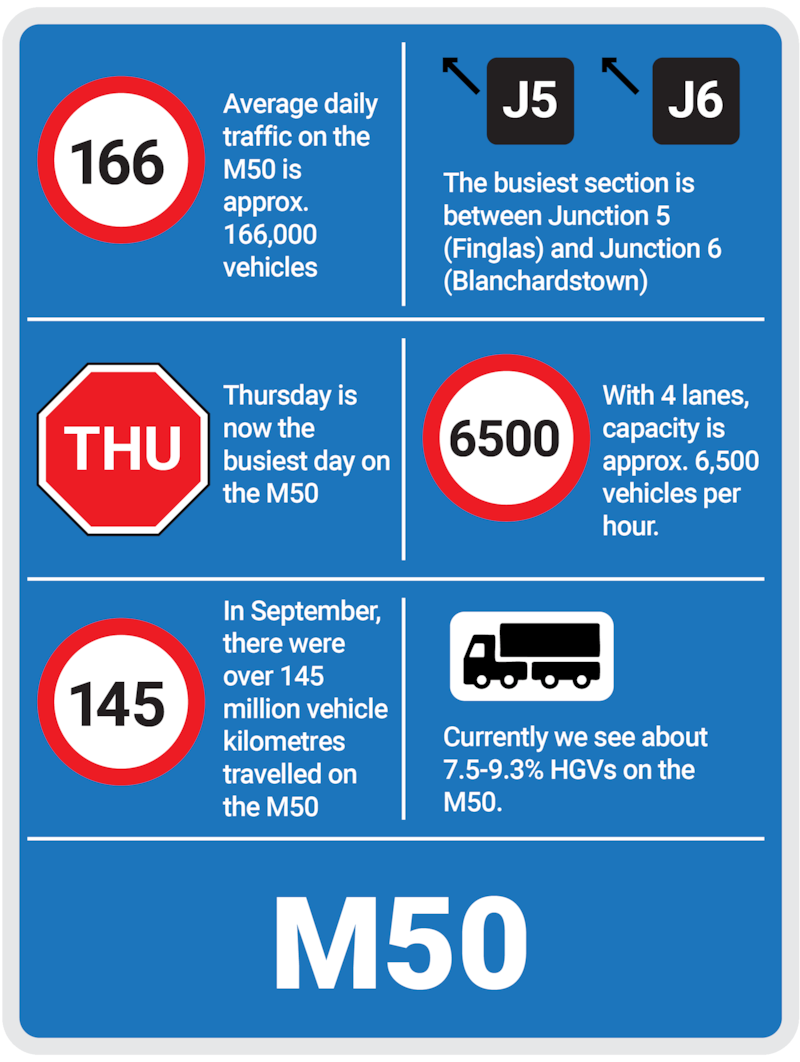
Transport Infrastructure Ireland (TII), the State agency responsible for the national roads network, says the M50 is “at capacity”, with traffic levels now “higher than ever” and “beyond Celtic Tiger numbers”.
There has been a 20 per cent uplift in traffic volumes across all motorways in the last 10 years, with the M50 seeing a 40 per cent rise on the northwestern stretch between junction 5 (the Derry-Ashbourne exit) and junction 6 (the Cavan-Blanchardstown exit), which is currently the busiest section. A record 145 million kilometres were travelled on the M50 in September.
TII says it has “maximised” engineering elements including widening, removal of the West Link toll barriers to switch to electronic tolling, upgrading the interchanges to make them free flowing, putting in an intelligent transportation system that can regulate traffic speeds during incidents and having dedicated crews located on the M50 to deal with collisions as they arise.
Sean O’Neill, TII’s director of corporate communications, says from an infrastructure and operational standpoint “we’re really doing everything we can”.
“The M50 network is the Achilles’ heel of the country and if it doesn’t work well it has an impact throughout the entire island of Ireland, not only for goods and services, but for people getting to anywhere they need to go,” he says.
“Giving people an alternative who don’t need to be on it during certain times of the day, if there are public transport opportunities, MetroLink in particular, is an important subset of the conversation,” he adds, referring to the proposed northern rail line running out of Dublin city centre.
Brian Caulfield, professor in transportation at the Centre for Transport Research in Trinity College Dublin, says increasing traffic volumes are down to a mixture of population growth and public transport and infrastructure not keeping pace.
“People are moving further away from Dublin city centre because they can’t afford to live here and that’s resulting in longer commutes,” he says. “We did have a bit of respite around Covid because people were working from home but as that trend is starting to stop, we’re starting to see all this congestion happening again.”
Prof Caulfield says relatively quick “fixes” to help the situation could be bus-based park-and-ride facilities and improving public transport reliability.
“If you provide all this really good public transport and people aren’t using it, the only tool left in the toolbox is charging people to use their cars; putting in a congestion charge or new tolls. That’s the kind of thing that’s required,” he says.
The introduction of a congestion charge, similar to that introduced in London in 2003 to cut traffic, is “very unlikely”, says Prof Caulfield.
“Bringing in a congestion charge, a metro, anything to change people from their norms and their habits is really difficult to do and it takes a lot of political courage ... Any fixes are at least two or three years away so it will get worse, unfortunately, before it gets better.”
[ No quick fix for ‘tiresome’ M50 gridlock, Minister saysOpens in new window ]
A new strategy, aimed at alleviating the economic, environmental and social costs of congestion, is expected to be published by Minister for Transport Darragh O’Brien shortly. The draft strategy does not include specific recommendations in relation to congestion charges, according to the Department of Transport. It says congestion charges would be a matter for the consideration of local authorities and could not be introduced without the input and support of communities and local government representatives.
“The decision to introduce such measures is not vested in the Minister for Transport,” the department says.
Mr O’Brien says the Government is “not oblivious” to the growing problem of congestion and the “harmful effects” it is having on the daily lives of people, communities and businesses.
O’Brien points to the roll-out of the BusConnects project as a means of helping and says that, of the €24.3 billion being invested in transport over the next five years, €12 billion will go to public transport projects, including €2 billion to MetroLink.
The National Transport Authority (NTA), the State agency responsible for public transport across the country, says the Greater Dublin Area Transport Strategy 2022-2042 sets out a framework for the development of transport across the region over the next two decades.
Rather than expanding road or motorway capacity either on the M50 or elsewhere, the focus of the strategy is on improving access to non-car modes of transport for more people.
“In other words, shifting a proportion of the motorists on to alternative transport modes,” the NTA says. “Clearly, for many users this will not be feasible, but many others may be in a position to change if a suitable public transport alternative is available.”
[ Tolls, buses and remote working: The short-term solutions to M50 gridlockOpens in new window ]
The NTA also points to BusConnects as part of that strategy, along with MetroLink, Luas Finglas, DART+ and a network of park-and-ride facilities.
Dublin Chamber says congestion has been “a major issue” for its members, with almost half saying they have been negatively affected by it.
The organisation says it is “disappointed” to see public transport projects, such as DART + South West and Luas Finglas, that have been granted planning permission and are “shovel ready”, being pushed out to 2029 “or beyond”.
The Irish Road Haulage Association (IRHA) says that every hour a truck is sitting in traffic on the M50 costs the haulage company more than €100, with large haulage businesses having multiple trucks crossing the motorway every day to get to Dublin Port.
Ger Hyland, president of the IRHA, says higher prices for hauliers means “higher prices on the supermarket shelves”.
“Everything you wear, eat or consume comes in the back of a truck,” he says. “If we face delays and extra costs, then those costs will end up being paid by the consumer.”