
The first Air Corps flight ever to carry troops into a conflict zone was piloted by the service’s only fully qualified and commissioned woman pilot.
Capt Lauren Cusack was one of the pilots who flew the €70 million Airbus C295 into and out of Beirut, Lebanon, last Thursday in what was a groundbreaking operation for the Air Corps.
The flight into Beirut, which has been the target of Israeli air strikes for weeks, was required to bring 26 Defence Forces personnel into Lebanon, and to extract 16 returning personnel – civilian and charter flights having been grounded because of the Middle East war.
The complex operation started in Baldonnel, Dublin, and involved stops in Rome, Italy and Larnaca, Cyprus, before reaching Beirut, with a flying time of 12 hours each way.
READ MORE


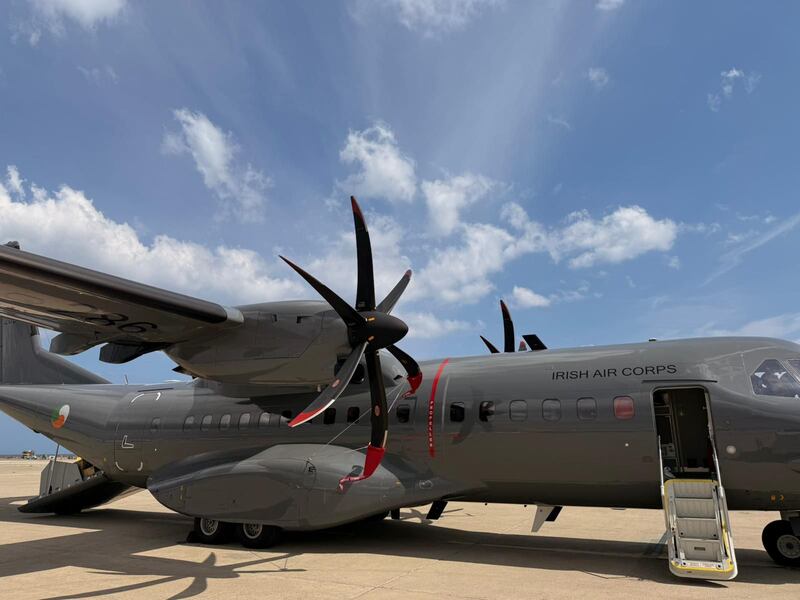
The complex operation started in Baldonnel, Dublin, and involved stops in Rome, Italy and Larnaca, Cyprus, before reaching Beirut, with a flying time of 12 hours each way.
“Given the volatile security situation in the region, operating into Beirut added another layer to the planning,” said Cusack. “Route selection, threat assessments and the departure window all required careful consideration.
“Close liaison with Defence Forces personnel on the ground in Beirut meant when we touched down, everything was in place for a quick engines-running turnaround, with all 16 returning personnel accounted for.
“That kind of joint effort between Defence Forces assets is what makes a mission like this work. By Saturday evening we had 286 back in Casement Aerodrome, with the mission complete. It’s the kind of tasking that tests both the capability of the aircraft and the depth of planning that goes on behind the scenes.”
Cusack, from Donabate in north Co Dublin, studied aviation management at Dublin City University, graduating in 2016. Before joining the Air Corps, she gained a civilian pilot’s licence and worked as part of Aer Lingus check-in staff.
She will soon be joined in the Air Corps by two more female pilots, who are due to be commissioned in the coming weeks.
The flight Cusack piloted into Beirut last Friday returned 26 Defence Forces members, including a leadership team, to Lebanon. There were also vital supplies on board for the Irish troops already serving on the ground with the United Nations Interim Force in Lebanon (Unifil).

Those flown in had been serving with Unifil but were on leave when the war in the Middle East broke out. This meant their planned rotation flights, usually provided by a civilian carrier, were cancelled, stranding them at home.
In addition, a team of Defence Forces engineers needed to be extracted from Lebanon, along with a medical evacuee.
Given the security situation on the ground, the Airbus C295 underwent a rapid turnaround, spending only 30 minutes on the tarmac.
“We wanted a Ryanair turnover, done as quickly as possible, with no hugs or high fives,” said Col Denis Hanley, Air Corps director of operations and planning.
He described the C295 plane, which was delivered to the Air Corps just last year and has a 5,000km range, as a “force multiplier”.
It gave the Air Corps the capacity and flexibility to carry out long range operations like that to Beirut, he said. Hanley described the mission as having “proved the concept”, adding that the aircraft would now be used to transport Irish troops in Kosovo.


