
In the space of two years, a playschool in Co Donegal went from applying for planning permission to expand to receiving an order of condemnation due to defective concrete blocks (DCB) and facing an uncertain future.
Fiona McCrabbe has been the manager of Raphoe Community Playgroup for the past seven years and has worked there for 30. .
The playgroup has been operating since 1982 but moved into the building 25 years ago.
However, there were “cracks right from day one,” McCrabbe says. “More than just settling cracks . . . these were opening up quite quickly. We had them repaired several times inside.”
READ MORE


She wanted to extend the building as they could not cater for all the children who needed the service. She tested the building for defective concrete and received a positive result in 2023.
In the months that followed the result, the playgroup centre saw rapid deterioration. In March 2024, she received news from the engineer that the building was condemned.
“It was a Saturday morning and I sat in that room by myself and cried. My whole life’s been in here.”
McCrabbe was able to stay in the building until June as the engineer put steel straps on the worst cracks.
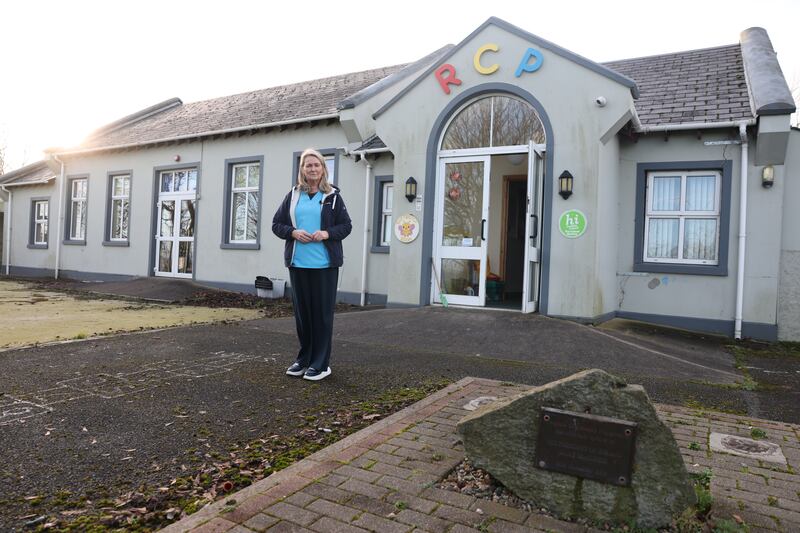
Standing outside the playschool, the impact of DCB is obvious. The building has shifted and as a result a hand can be placed through one side of the front window. Stepping inside to the children’s cloakroom, rows of empty cubby holes are surrounded by cracks. As well as cracks on its walls, the main room also had a large crack across the floor.
“Somebody actually dropped a knife down there and it just disappeared. So there’s nothing under that,” McCrabbe says.
Outside, at the back of the playschool, steel straps have been placed on the worst affected areas. However, the cracks continue to grow, as paint and plaster lie on the ground.
McCrabbe says when they were operating from this building, the children were not allowed around the back.
Since September 2024, the playgroup has been operating out of two premises, a prefab and a room they rent in the local community centre.
As the centre is also used by others , the room has to be set up and deconstructed each morning and afternoon, meaning staff need to arrive earlier and stay longer.
McCrabbe describes the stress on her and her team as “unbearable.”
She has received some Government funding to help pay rent and employ a quantity surveyor. She also applied for funding under the Building Blocks Capital Programme for Early Learning and Childcare but was denied.
Demolition and a full rebuild is recommended but the group cannot afford it.
“It’s now about €35,000 to €40,000 to demolish the building, €1.2 million was the last estimate we had for rebuilding. That was to open three rooms this size, two side by side and one upstairs, so that we can accommodate all the children that really need to avail of a service."
So far with testing, filling in cracks, employing engineers, moving between premises and other issues, the playgroup has spent over €50,000.
“If we were aiming for something, I think it would relieve a lot of the stress, but we’re just in limbo,” McCrabbe says.
The playschool is booked for the 2026/27 year, with a full waiting list.
“They [the children] used to draw pictures in here of the playgroup with the playgroup falling down... Aged three, four and five, they shouldn’t be subjected to worry like that.”
McCrabbe says some of the children and staff members are also living in homes with defective concrete.
When she got the news about the building’s defective concrete, she sent a letter to parents saying “the children’s safety was paramount, but at the same time, we weren’t going to close, we would find somewhere for the children in Raphoe”.
“You could sit and cry. I did cry. But we’re not the only facility facing the same,” she says.
She believes more than 25 childcare facilities in Donegal also have DCB.
Ardara Community Childcare received a positive test result in February 2024.
Manager Sinéad Hanlon says receiving the news was “devastating” but did not “entirely shock” them.
The facility has been in operation for over 40 years and has been based at its purpose built site since 2007. She first noticed cracks when she started in 2022.
“I noticed cracking both inside and outside, particularly in the preschool room. At that stage, it appeared consistent with settlement cracks . . . So, there seemed no immediate cause for concern.”
In 2023, the provider considered expanding the service. As the cracks were becoming more noticeable and starting to flake, they engaged with an engineer and testing was carried out in August. Following this, they were told a total demolition and rebuild was necessary.
Hanlon says the impact on the children has been minimal as they work hard to ensure the building remains “safe and well maintained and suitable for use”.
The building is deemed safe for them by an engineer who conducts annual safety checks.
Each day, Hanlon and deputy manager Bridget Barrett carry out daily risk assessments of the building.
She says for families, it has created a sense of uncertainty. “They understand that the building is currently safe and well maintained, but they also every day see the deteriorations, so they’re naturally concerned about their future.
“The advice we’ve received is very clear. There is no long-term fix for this issue . . . we urgently need clarity and support to ensure the service has a future.
“We don’t qualify for a redress scheme. We don’t have a pot of gold to just pick up and move somewhere else and where do we move to?
“We are in a race against time, each year it’s getting worse, it’s not going to get any better. We’re just smoothing over the cracks.”
The cracks inside and outside the building have to be filled about every eight months.
Michelle Murray is the deputy manger at Letterkenny Community Childcare and has worked there for 12 years.
“I started to always notice the cracks here, maybe after I’d been here for about a year or two. But thought it was settling cracks or just wear and tear cracks.”
The childcare facility has been operating for over40 years and moved into its current building in 2003. The building tested positive for DCB in 2019.
Since then, cracks have appeared in every room of the facility, on the floor and outside. Some of them run the length of the two-story building.
The business tried to move premises but were unsuccessful in finding anywhere. They have purchased a site across the road to build a new playschool with the help of fundraising.
They also received €750,000 from the Building Blocks Capital Programme and secured a loan of €1 million.
However, they say it is “impossible” to fundraise the additional €1.25 million to complete the build and need Government assistance.
They care for 148 children and an additional 500 are on a waiting list.
Murray says it’s “very worrying” for staff. “Are we going to be told some day its not fit to open?
“Its stressful, we come in and we do our work. We do the best for children every day, but it is that worry in the back of your mind thinking like the place is falling apart.”
The building’s safety is assessed about every 18 months. The cracks were particularly bad on the outside walls as the cracks deepened and plaster became flaky. Parents and staff were concerned about debris falling from the building.
The playschool replaced a large section of one of the outside walls with new plaster. “Its only going to get worse,” says Murray.
Responding to queries on the issue, a Department of Housing spokeswoman said: “At this point, there is no plan to extend the DCB grant scheme.”
Meanwhile, Donegal County Council said it does not hold a database of playschools/creche facility buildings affected by defective blocks in Donegal. It said there was no scheme in place at the moment for buildings affected by DCB other than eligible dwelling houses.
A spokeswoman for the Department of Children said while it “does not have direct responsibility for structural remediation or compensation for buildings affected by defective concrete, the department is doing everything it can within its remit by assisting services in difficulty through the Case Management process.
“Through this, services may also access Sustainability Funding following an assessment of need,” it said, adding there are examples of sustainability funding for services who needed to relocate due DCB.


