
Aodhán Ó Ríordáin is ending his 40s quite differently to how he began them. “When I turned 40 I’d no kids. And now I’m nearly 50 I have three,” he says.
The Labour MEP’s youngest daughter Róisín was born prematurely a few days ago at 26 weeks’ gestation, weighing a tiny 2lbs 3oz (the weight of a 1kg bag of sugar).
She’s doing well though, he says, and he’s hoping he’ll get to hold her in a few days. “It’s really more positive than we could have hoped, but stressful for all that, because you have an image in your head of what a newborn looks like, and this doesn’t really compute with the image. She’s very small and there’s tubes and things.”
Róisín’s birth comes at the end of a difficult pregnancy for Ó Ríordáin’s partner Nicola Byrne. Byrne is a nurse and the couple have two children together. Their other daughter Sadhbh is 1½. He also has a daughter, Anna (7), with his ex-wife, broadcaster Aine Kerr. “The first 40 years of my life ... being a father wasn’t something that I prioritised, or thought much about. Now it’s a huge part of my life.
READ MORE


“I’m conscious of my age. I’m 50 next year. I reflect on that, how good I’ll be in 10 years’ time or 20 years’ time, because when Róisín’s 21, I’ll be 71. It does make you reflect on the balance in your life and how much time you give to things, and the quality time that you spend with your kids.”
Ó Ríordáin explains that Byrne’s waters broke when she was just 18 weeks pregnant. “At that point, certainly I thought it was over. And we had an emotional conversation at that point about how we would manage this and tell people… We got through that and she was still kicking away. But then there was a particularly distressing night where there was a significant bleed and we had to rush to the Rotunda, and neighbours were unbelievable to step in and mind the other little ones.”
He recalls the kindness of strangers that night as they arrived at the hospital. “We were sitting there in a very distressed stage. And we were politely asked to move the car. And a guy who was there with his partner – and you’re not there at midnight on a Friday night unless you have to be there – said ‘here, I’ll move it for you’.” Ó Ríordáin didn’t take the man up on the offer, moving it himself, but the man “sat with Nicola and made sure she was okay”.
“The level of care, the professionals in the hospital were just absolutely incredible, and I think that ripples out to everybody else’s attitude around the place,” Ó Ríordáin says.
He describes the maternity hospital as a place “where great joy meets great tragedy”.
“We thought we were going to be in the great tragedy side of things twice and then she just kept kicking away,” Ó Ríordáin says.
“I had to fly back from Strasbourg. And then I had to fly back from Brussels, expecting a birth at 24 weeks, and then a birth at 25 weeks. You’re worried about the chances of survival. Then at 26 weeks and five days, because of the level of pain and discomfort, it was just unsustainable, the medical decision was to deliver her via c-section.
“If men gave birth maternity hospitals would be palaces and we’d get three years off. And there’d be an awful lot greater attention on maternal care.”
The experience has made him think of a friend who lost his twins at 24 weeks. “I remember he named them. And there was a ceremony for them. And I wasn’t there. Work had me over in Turkey as a junior minister. And I’ve always reflected on it. That was a wrong decision to make. Because life is short, tragedy is big, and it lasts a lifetime,” he says.
“You remember the people who were there and prioritised you. That friend has been absolutely incredible to me over the last number of weeks, sending me messages, asking me how things were, giving me little bits of advice, encouraging me along the way.”
Ó Ríordáin is hopeful that Róisín will get home in March. “Hopefully, in a few months’ time she’s home and she’s happy and she’s got two older sisters who are crazy about her and a wider family.”
He admits finding it “challenging to go in to see her, because she’s so small and she’s so vulnerable and there’s tubes and wires”.
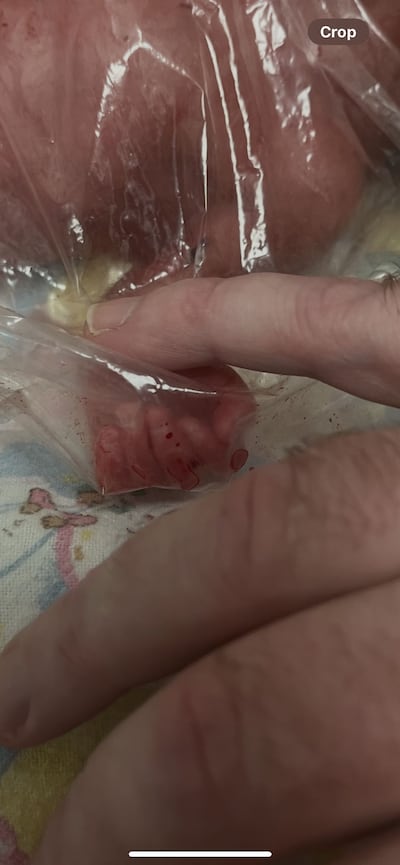
“But you’re encouraged to read, and Dublin City Council library section have books there that they’re encouraging parents to read to their little babies in intensive care,” Ó Ríordáin says.
Christmas Day will look a little different for him this year. “We’ll take a trip into the Coombe.”
Róisín’s care was transferred to the Coombe as they had more ICU beds, Ó Ríordáin explains. “Christmas Day is Christmas Day and we have so much to be thankful for and if the only slight irregularity is to take a bus into the Coombe, well we can do that.
“There were times in my life, before I became a father, where I didn’t really look forward to Christmas because work was what preoccupied my head. Or I found the summer holidays very long, because I just wanted to get back ... I’m not in Strasbourg this week when I should be, but I think, like all professions, life has to give you space to be a human being and I think the European Union Institutions will survive without me for a week.”
In spite of the worry of the last few months there has been the odd bit of respite, distraction and laughter, Ó Ríordáin says. “At a very sensitive point in the pregnancy, when it was touch and go, I asked Nicola could I go to the Ireland vs Portugal game. She said, ‘yeah okay, go on’. And I said, ‘because if Ireland beat Portugal and I wasn’t there I’d never forgive myself’. As soon as the words were out of my mouth, we managed to laugh.
Róisín almost arrived at 23½ weeks, around the time Troy Parrott was scoring the winner in injury-time against Hungary. “I made a submission that maybe she should be called Troy, but no.”
The worrying pregnancy and the early delivery is “a lot to get your head around,” Ó Ríordáin says. “It’s on your mind the whole time and you can’t escape it. I’m away and I look at my phone when I wake up. And, hopefully, there isn’t a phone call or a message to say something has gone wrong. You’re checking in all the time. You’re trying to do your job to the best of your ability, but you know that your head is elsewhere. And also you have to guard your other kids from it, because you don’t want them to think that there’s something wrong.
“We had literally told Anna the baby’s sex and we had discussed the name, which Anna had chosen. Anna had wanted Rose and we went for Róisín. We had told her on the Tuesday and the very next day we had a massive scare that she was coming early. I was on a flight on the way home and I thought that I was going to have to land to bad news and maybe have a very difficult conversation with my older daughter.
“Even now, Anna can’t come in to see her. She won’t physically see her until March, and you’re just unsure as to what kind of photographs of her will help, because there’s a lot of tubes and wires and she’s incredibly small.”
However it has been for him as Róisín’s dad, he’s conscious the ask is even bigger of Róisín’s mum. “Nicola throughout all this has been absolutely incredible. To carry the pregnancy. To go through all that stress. To have the physical discomfort, the bleeding, the leaking, the pain. To have the c-section. The recovery from the c-section. And now the pumping. And obviously being in hospital for a month and missing Sadhbh, and Anna hugely. It’s a lot.”