
Main Points
- Status yellow rain warnings are in force for counties Dublin, Louth and Wicklow until 9pm.
- Met Éireann has warned that further heavy rain on saturated ground combined with high river levels and high tides is a ‘worst-case scenario’ and will lead to localised and river flooding and difficult travel conditions.
- The National Emergency Coordination Group has warned that the risk of flooding in the east and southeast is “very high” as further heavy rain is forecast this week.
- A fire and flood repair specialist working on damaged homes in Wexford, Wicklow and Dublin said “this flood is not like any other flood before.”
That’s all for this evening.
Follow along tomorrow for further rolling coverage.
Following a meeting of the National Emergency Co-ordination Group, officials warned that with “heavy and persistent rain” forecast for the rest of the week, especially for southern and eastern counties, there is a danger of “further river, surface and coastal flooding,” reports Political Editor Pat Leahy.
The group added: “High spring tides over the coming days, combined with strong winds and surge, may cause wave overtopping, coastal and estuary flooding.”
Read the full story here.

The status yellow rain warning, in place for counties Dublin, Louth and Wicklow, has ended at 9pm on Tuesday evening.
A weather advisory is in place for all of Ireland until Monday, February 9th.
Wednesday’s Forecast
Met Éireann says Wednesday, nationally, will be mostly cloudy with some heavy showers coming from the south.
At times, it will be brighter, mainly over the midlands and western counties.
Highest temperatures of 5 to 10 degrees, with mostly moderate easterly winds.
The national forecaster says Wednesday night will remain cloudy as rain feeds in from the south across southern counties.
Further north will be drier and experience some clear spells.
Lowest temperatures of 3 to 8 degrees, with moderate to fresh easterly winds.
There are no weather warnings in place for Wednesday but marine warnings have been issued.
A small craft warning is in place for all coasts of Ireland from 6pm on Tuesday to 12am on Thursday.
A status yellow gale warning is in place from Carnsore Point to Dungarvan to Mizen Head, as easterly winds will reach gale force eight, from 11pm on Wednesday to 8am on Thursday.
A weather advisory is also in place for all of Ireland until Monday, February 9th.
Iarnród Éireann confirmed that services have resumed between Athlone and Ballinasloe after the service was suspended due to an obstruction on the line.
Some services will experience delays of 20 minutes following signalling issues between Clonsilla and Coolmine that have since been resolved.
Taoiseach says change needed to Ireland’s flood warning systems
On Tuesday morning, Taoiseach Micheál Martin said the country’s flood warning systems need to change.
He told Newstalk’s Claire Byrne programme that development of a text-based system “is under way” but “will take a lot of work”.
Such an alert system is where “emergency planning is heading”, he said, but it is “some distance” away.
On Monday, Martin visited areas badly hit by flooding in recent weeks, including Co Wicklow, and on Tuesday he described what had happened as “quite frightening”.
“This was literally water flowing down the mountains with nowhere else to go,” he said, adding that it took “roads with it” and damaged “a lot of houses and businesses in the process”.
Martin said “funding allocations” need to be planned as flooding events become more likely.
He added that “prevention” is key but said flooding schemes are “complex and they do take time”.
More “short-term work” is needed to tackle flooding, he said, adding that more “nature-based solutions” are also needed. - Press Association

More flooding to be expected
More flooding is expected as heavy rain is forecast to fall on already saturated ground and swollen rivers, the National Emergency Co-ordination Group has warned.
It is urging the public to be alert for flooding saying: “The situation can change very quickly and even small amounts of rain could result in significant impacts in areas where river levels are high and/or where the ground is already saturated.”
It said high spring tides and strong winds could also cause wave overtopping, coastal and estuary flooding.
It met on Tuesday to “prepare for the risk of further flooding this week”.
Experts said departments, agencies and local authorities are “on alert” and working on measures to “mitigate” the impact of the rain that is expected later this week.
Fire and flood repair specialist Kevin Kelly said the devastation caused by last week’s flooding is different from what he has previously seen.
His team is working on around 100 homes in Aughrim in Co Wicklow, Enniscorthy in County Wexford and Rathfarnham in Dublin city.
In business since 2002, he said: “This flood is not like any other flood before, as in the force of this flood, the way it came and how fast it came.
“It’s a miracle, miracle, that nobody drowned in it”.
The strength of the flood water also meant it left a lot more “filth and mud and dirt” than usual in people’s homes.
He has described the past week as “mind-boggling”, with his phone constantly ringing from 8am to 11pm.
However, he said he has been surprised to find many of the people he has dealt with are “relaxed” about the situation.
“There is a feeling this time that the Government are taking care of them,” he said, adding the response has “absolutely” been better than previous incidents. - Press Association

Aqua Dam to be used to prevent further flooding in Co Wexford
An Aqua Dam which has been used successfully in Athlone, Co Westmeath to prevent flooding is to be used in devastated towns and villages in Wexford, reports Sarah Slater.
Fianna Fáil councillor Aidan Browne, a cousin of Minister for Housing James Browne, who is from Enniscorthy, said that after liaising with Taoiseach Micheál Martin, Minister Kevin ‘Boxer’ Moran, local residents and businesses about what is needed on “an interim basis to help against flooding on the River Slaney, the Aqua Dam, which has been used in Athlone successfully, has been brought to Enniscorthy.”
Cllr Browne said that this is the “first step” of interim measures being taken by Wexford County Council. Further interim measures are currently being discussed between council staff and the Office of Public Works (OPW).
Cathaoirleach of Rosslare Municipal District and non-party councillor Ger Carthy also confirmed that following a meeting today concerning flooding in Bridgetown which has been hit by devastating floods, most notably in 2001, 2025 and last weekend construction of temporary flood defences will begin tomorrow.
“(This) will protect the Kilmore Seafood side of the village. The pumps will remain on site. I want to thank Minister Boxer Moran for his continued support and the Council for their tireless work”.
Husband and wife team Toddy and Tara Roche, who both run the Kilmore Seafood shop, which has been hit with bad flooding three times in four years, said that hopefully the temporary solution will work in the short-term.
The couple have lost tens of thousands of euros of stock and equipment in the 12 years they have been open because of continuous flooding.
“The news has lifted our hearts a little bit. The council is to build up banks around our place near the canal. What they are going to use is soil, hopefully it will hold and have time to bed in before we are faced with any more flooding.
“If the soil doesn’t have enough time to bed in then it will be washed away,” explained Roche who along with his wife Tara have considered closing down their business because of continuously being hit.
He said that the council engineer was with them in the shop today explaining what is to be done.
“The council are doing the best they can, it’s the OPW and Government now and speed up the proper solution of building concrete banks on either side of the canal,” Roche added.
The shop was hit for a third time last Friday night and the early hours of Saturday morning with 10 inches of water after a deluge of rain from Storm Chandra which caused the river Slaney to burst its banks yet again.
“We lost some stock but no electrical equipment this time as we had everything high up on crates. Only for the council gave us a massive big pump to help us, we would have been hit as bad if not worse than last November,” he explained.
The couple spent all of Saturday and a lot of Sunday last mopping up after the flooding. “We are aiming to re-open again this week but we’ll have to wait and see,” due to more rain forecasts this week.
Last November the Roches prepared as best they could to battle against Storm Claudia which hit the south Wexford village. Five feet of water engulfed homes and businesses in the area.
The couple are worn out from fighting the flooding. “At this stage we don’t have the money to put back into this to lose again. It’s 50/50 if we keep going. If we buy in stock and this happens again we are completely in the red and owing money. It’s a tough one (to decide what to do),” added Roche.

South Dublin County Council said its Severe Weather Assessment Team is monitoring the situation closely due to the current yellow rain warning in place despite river levels remaining within normal parameters.
The council is continuing to work with other local authorities and other partners through the NECG Liffey Catchment sub-group.
All available crews remain on call to respond to any issues with trucks preloaded with sandbags, for distribution if needed.
Dublin City Council’s Flood Management Team is responding to ongoing adverse weather conditions and related impacts.
River levels remain high and there is a high tides advisory. Further periods of rainfall are expected on already saturated ground.
The council is monitoring river levels and coastal conditions closely, to ensure appropriate responses as required and is in regular contact with the National Emergency Coordination Group on all aspects of recent weather events.
Due to tidal warnings, carparks along coasts at Sandymount and Clontarf will be kept closed to protect against possible wave overtopping. The cycle lane at Clontarf will also remain closed as a precautionary measure.
Floodgates at Eden Quay Boardwalk and along the River Dodder will remain closed.
Crews remain active across the city, making arrangements for possible events and responding to issues as they arise.
Dublin City Council maintains a limited supply of sandbags at strategic locations for use in response to identified flooding risks. These resources are deployed by the council where required, with priority given to critical infrastructure and locations assessed as being at immediate risk.
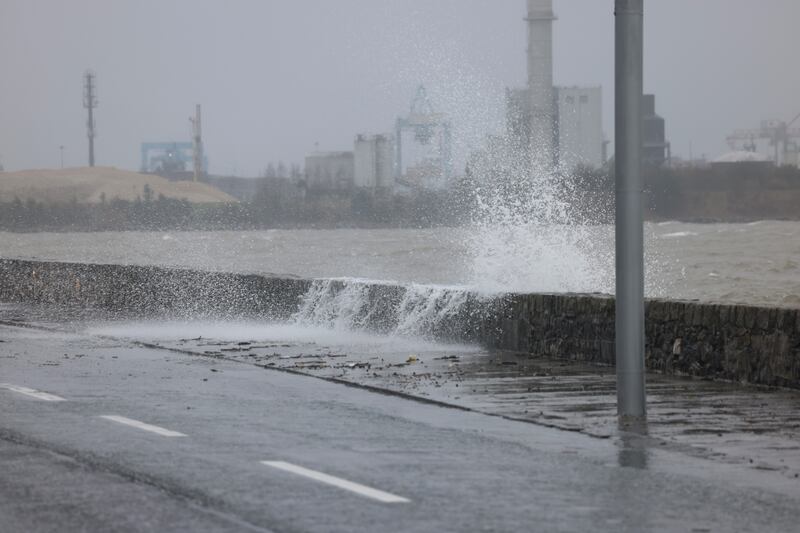
A spokesman for Cork City Council said it did not have to respond to any issues resulting from the yellow rain warning and have not been made aware of any.
The council will close Wandesford Quay before high tide this evening and again at high tide on Wednesday morning, with localised surface flooding expected on a number of low-lying city centre quays.
Tuesday morning’s high tide at 6.29am passed with localised surface flooding only on several low-lying quays.
With scheduled high tides over the next 36 hours coinciding with a forecasted tidal storm surge, more surface flooding is expected in the same areas at 6.46pm on Tuesday and at 7.08am and 7.24pm on Wednesday.
No property damage is expected but surface water is likely in the areas of Wandesford Quay, Lavitt’s Quay, Union Quay and Kyrl’s Quay.
The council is closely monitoring the situation.
It will close Wandesford Quay from 5.45pm to 7.45pm on Tuesday evening and again from 6am to 8am on Wednesday morning.
Motorists are being advised to avoid parking on the quay.
The localised flood events, the associated road closures and lane restrictions will impact traffic flow and public transport timetables during these times.
Motorists and commuters are advised to expect delays and to plan accordingly. The road closures and restrictions will be lifted quickly once high tide passes.
Pedestrians are advised to exercise care in the affected areas during the high tide times.
Motorists are advised against parking in the affected areas before high tide, to drive with care in the affected areas, and to allow time for potential diversions or delays.
Localised flooding in several areas of Louth after heavy rainfall
In county Louth, heavy and persistent rainfall caused localised flooding in several areas throughout the day. In Drogheda, Wellington Quay, the R167 Boyne Road, and the R150 Marsh Road experienced significant flooding, while the R167 Queensborough, Baltray was left impassable.
The Ramparts walkway will remain closed for the remainder of the week after the river Boyne burst its banks.
In north Louth, parts of the road at Ballagan/Ballynamoney were left badly undermined by debris washed inland by the sea.
Met Éireann advises that heavy and persistent rainfall will continue through the week, particularly affecting southern and eastern counties.
Sandbags are available from Louth County Council depots at Bush; Town Hall Yard, Dundalk; Dundalk Machinery Yard (behind the Garda Barracks); Ship Street, Drogheda; Wellington Quay, (Stockwell Lane) Drogheda; Woodlands Depot; Ardee Civic Office Yard; North Quays, Drogheda; Greenhills, Drogheda; and Baltray, Drogheda.
A high tide advisory is in place until 10pm on Thursday with maximum surge levels of 0.39m and 0.33m in place for Dundalk Bay and Drogheda respectively.
A council spokeswoman said it is likely Wellington Quay in Drogheda will flood during the period of high tides. Members of the public are urged to use an alternative route during these hours.
Motorists are also advised to avoid Haymarket Bridge, from the direction of the Donore Road, Dublin Road and North Road, during high tide on Wednesday (10:30am-2.30pm) and Thursday (11:30am-2.30pm).
Main Street in Blackrock will also be closed to the public for high tide from 12pm on Wednesday and Thursday and from 11pm-1am nightly from Tuesday to Friday.
In Co Waterford, flood defence barriers were erected in Passage East and Waterford city. Four carparks, deemed a flooding risk, in Dungarvan (Davitt’s Quay, The Pond, The Lookout and Castle Street) were closed from Saturday evening and will remain closed until Wednesday.
The capacity of the drainage system at Passage East was severely compromised due to the heavy and persistent volume of rain that fell over the last week, in addition to the saturated grounds, said a spokeswoman for Waterford City and County Council.
The Council has developed a proposal for a complete upgrading of the storm network system in Passage East for which a funding source is awaited.
Control measures are in place for properties elsewhere, with the Local Authority operational teams continuing to supply sandbags where required.
The L4051 Knockeen at Carriganard, which flooded today, remains closed and diversions are in place.
Waterford City and County Council’s severe weather management team is monitoring the situation closely and ground crews are dealing with issues such as blocked drains, gulley overflows and are actively engaged for clean-up operations.
Motorists are advised to slow down, increase stopping distances and watch for surface water and debris on roads. Avoid driving through flowing or standing water and if the road ahead is flooded, do not enter, turn around and find another route. Motorists are also reminded to be conscious of vulnerable road users such as pedestrians and cyclists.
The public is advised to stay away from swollen rivers, streams and flooded riverbanks, as banks can collapse without warning. The public is also advised to stay away from coastal areas during this period as The Irish Coast Guard appeals to people to “Stay Back, Stay High, Stay Dry”.
A Cork County Council spokesman said, “there is nothing of note to report in Cork County” following today’s yellow rain warning.
“Cork County Council’s Severe Weather Assessment Team will continue to monitor weather conditions over the coming days.”
Emergency Humanitarian Flooding support for impacted businesses is now open.
The Minister for Enterprise, Tourism and Employment, Peter Burke, has received government approval to open the expanded Emergency Humanitarian Flooding Scheme (EHFS).
The scheme has been extended to €100,000 from the previous €20,000 to reflect the significant damage caused in the wake of Storm Chandra.
The definition of “small business” for these schemes will also be updated to include those with up to 50 employees.
It will support small businesses and community, voluntary and sporting organisations affected by severe flooding.
“Businesses have taken an enormous hit, and we are determined to stand with them every step of the way. We know the devastation recent weather has caused for employers, workers and whole communities.
“This scheme is designed to deliver real financial relief fast, so owners can focus on reopening their doors, protecting jobs and restoring local life.
“Behind every damaged premises is a person, a livelihood and a community depending on them, and our priority is to ensure support arrives quickly and helps businesses get back on their feet,” said Minister Burke.
The Irish Red Cross will continue to administer the scheme on behalf of the Department of Enterprise, Tourism and Employment. Independent professional assessments will be conducted by assessors appointed through the Irish Red Cross.
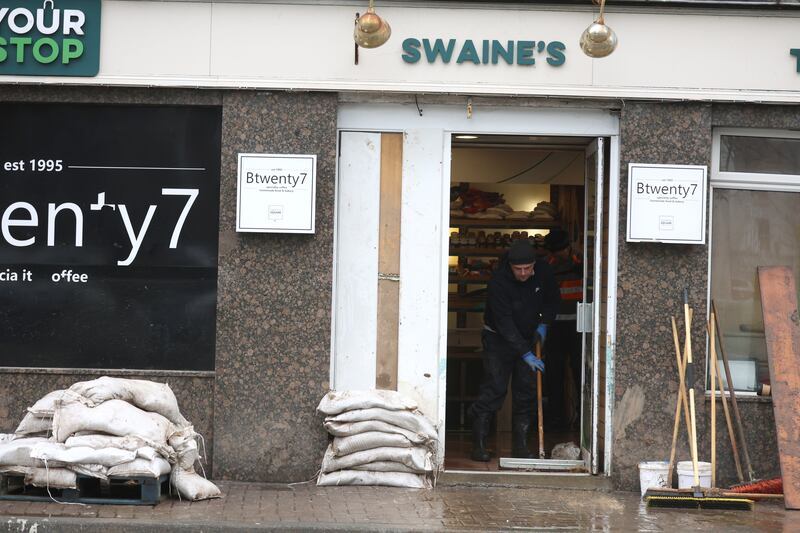
Taoiseach Micheál Martin will hold a ministerial meeting later today to discuss the collective response to recent floods, and following his visit to affected areas in the south east on Monday, reports Political Correspondent Jack Horgan Jones.
Cabinet members attending include the Tánaiste, Minister James Browne, Minister Jack Chambers, Minister Boxer Moran and Minister Sean Canney.
National director for the Fire and Emergency Management Keith Leonard will be among the officials attending along with senior officials from the Taoiseach’s department as well as the departments of defence, social protection, transport, public expenditure and reform, finance and the OPW.
The agenda will be;
- The Emergency Response, with an update and overview from Ministers Browne, Moran and Canney.
- Future reforms of flood warnings and flood protections.
And:
- Preparing for the next Cabinet Committee on climate
General topics for discussion will include short term plans on flood response and interim protections, flood schemes in general, repair of roads, and an update on humanitarian supports.
The Department of Social Protection’s emergency response payments have three stages of supports;
Stage 1 – cash for immediate humanitarian needs
Stage 2 – help with furniture, white goods etc
Stage 3 – Building repairs and renovations
Iarnród Éireann said delays are easing on some Dart networks while some services are operating with delays of 20 minutes.
In the National Outlook for this week, Met Éireann said, more flooding is likely along rivers and in coastal areas due to a combination of already saturated ground, high river levels and high tides.
Low pressure to the southwest of Ireland will bring further spells of rain.
Heavy and persistent rain showers will affect southern and eastern areas.
A weather advisory is in place for the whole country until February 9th.

Due to persistent flooding at a Wexford town cemetery following the heavy rain of recent days, mourning families are unable to visit the graves of loved ones in the Crosstown cemetery, reports Brendan Furlong.
Parts of the cemetery have been reduced to a “complete bog” making access through the grounds totally impossible.
A local councillor, Leonard Kelly, has requested the District Engineer, Laurence Lett if any short-term measures could be implemented to allow visitors and families access to the burial graves of family members.
Cllr. Kelly, at a meeting of Wexford Borough Council, told council officials that Crosstown was “somewhere that people go to on a very frequent basis, it’s a place of calm,” but some of it has become a “complete bog due to the rain.”
The local councillor has asked if this situation could be addressed in the short term and “if it needs a bigger project, could we look into that?”
Lett said his team were in the process of carrying out works at Crosstown before the end of the month but they have since been stymied by further heavy rainfall.
“The council is very anxious to get some remediation works done but at the moment engineers can’t get in to do them because the weather has been so bad there. The staff had hoped to get it done this week but are unable to do so,” he said.
A spokeswoman for Wicklow County Council said they remain ready to respond to the ongoing flooding situation as issues occur.
Repair work is still ongoing to damaged roads, pipes and manholes. The council continues to engage with business owners and residents and requests from the public for sandbags are responded to following assessment of need and subject to availability.
“This is an ongoing response situation for Wicklow County Council. Our teams remain vigilant, monitoring the situation to assess potential impacts in the county, and in particular for the recently flood-affected areas.”
The following roads are closed following recent weather events:
- L7251 Gowle Road between Killabeg and Clonmore (Co. Carlow), Coolkenna
- L7245 Ballynultagh Road between Shillelagh and Ballynultagh
- L7740 Killinure to Money Road, Coolkenna
- L7235 Money to Parkbridge Road at Moylisha and Newry, Parkbridge
- L7744 Tomnafinoge Road, Coolboy
- L7233 Ballard Cross to Boley Road, Shillelagh
- L71331 Ballysilloge Lane, Knockanana
- The 21 Bends to Enniskerry has one lane closed to traffic & a ‘stop go’ system is in place.
The council is continuing to asses damage on other roads as flood waters recede.
Wicklow County Council advises:
Motorists and commuters to please travel carefully, allow extra travel time and reduce speed.
Do not by-pass Road Closed signs and do not drive through floodwater, turn back and use alternative routes.
Check with Transport Operators before planning journeys and to monitor forecasts, as conditions may change quickly
Keep children and pets away from waterways and flooded areas.
Stay back from riverbanks, streams, and coastal areas – water levels can rise quickly.
Keep away from coastal edges, harbours, piers, and low-lying promenades during high tide.
In county Louth, the main street in Blackrock was closed during hightide due to some overtopping but reopened at around 2pm and the road sweeper has been out to remove any debris.
A spokeswoman for Louth County Council said, some flooding can be seen at pinch points in Drogheda such as Wellington Quay/North Quay, Baltray, Marsh Road and are asking the public to avoid these areas.
“We are advising the public to heed all road signage in relation to closed roads and to not drive through floodwater. We expect flooding/overtopping throughout the week during hightide times at both Main St, Blackrock and Wellington Quay, Drogheda and ask the public to use alternatives routes at these times.”
A spokeswoman for Dún Laoghaire-Rathdown County Council said a weather advisory was issued for the East Pier due to over topping and Southeasterly winds.
Preventative work is also taking place ahead of further rainfall predicted later in the week.
Iarnród Éireann says 30-minute delays are expected on some Dart services as a result of signalling issues following flooding at Blackrock in Dublin.
The line between Bray and Greystones has reopened after services were suspended due to a vehicle hitting a bridge.
The status yellow rain warning issued for counties Carlow, Kilkenny, Wexford, Waterford and Cork has ended.
The warning was in place from 9pm on Monday to 3pm on Tuesday.
A yellow rain warning remains in place for counties Louth, Dublin and Wicklow until 9pm this evening.

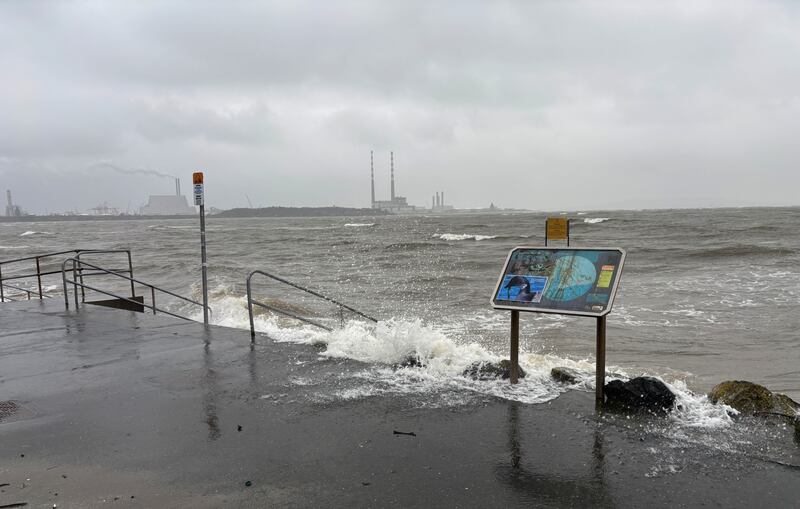

Dublin is facing the brunt of the rain that is expected to fall in the coming days after a very wet January and early February.
Dublin City Council is monitoring river levels and coastal conditions closely.
Tidal Warnings prompted the council to close car parks along coasts at Sandymount and Clontarf (from Tuesday morning 6am). The cycle lane at Clontarf will also close as a precautionary measure.
Eden Quay boardwalk (floodgates) will close mid-morning as a precautionary measure and flood barriers are being put up along them.
The flood gates along the River Dodder will remain closed until further notice.
Dublin City Council says it has maintained a limited supply of sandbags at strategic locations for use in response to identified flooding risks.
Met Éireann senior forecaster Gerry Murphy said the worst place for rainfall on Monday is eastern parts of Wicklow into south Dublin with between 10mm and 15mm in rainfall.
The rain that is deluging Wicklow, Dublin, Meath and Louth will be slow moving so plenty more rain will fall between now and the end of the status yellow rain warning at 9pm.
There is no good news on the horizon, he says, as the weather patterns which has brought such deluges to the southeast and east will remain.
“The pattern is set to continue for the rest of the week,” he said. There will be a brief respite on Wednesday, but during the evening another band of heavy showers will push through.
Thursday will see another weather front cross the country. He told RTÉ’s News at One programme: “So the overall pattern of the weather at the moment is that the low pressure, which would normally be further to the north, has pushed very far south.
“The air then moves anticlockwise around those lows, and is pushing up those bands of rain from the south, and that pattern is set to continue right the way through the rest of the week. It will continue until at least the end of this week.”
He said there is now an upgrade of the rainfall radar with the addition of five more radar stations across the country.
“It will give us much greater coverage of rain on a more local level. They will be able to distinguish between the types of precipitation and those could lead to more accurate forecasts.
The director of the National Emergency Coordination Group, Keith Leonard, said more flooding can be expected in the coming days.
“We are looking at Dublin and Wicklow around Thursday evening into Friday morning. I would say Thursday night is definitely going to be a pinch point.”
The combination of heavy rainfall, very high tides and onshore winds could lead to local flooding in the Dublin area.
He warned that some of the same places that flooded before will flood again this week.
Carlow County Fire and Rescue Service is appealing to motorists not to attempt to travel through flood waters following several rescues over the past several days.
A fire and rescue service spokesperson explained that over the past week they have been “mobilised to rescue motorists stranded in floods” on county roads, deploying firefighters with specialist protective equipment and rescue stretchers.


“As we enter another yellow rain warning with rain falling on saturated lands and elevated waterways, please follow Carlow County Council advice and do not pass road closed signs or drive into flooded roads, please take an alternative route,” the spokesperson added.
Carlow County Council have again issued a warning on road closures due to flooding and significantly damaged roads.
Taoiseach Micheál Martin has said there needs to be balance when it comes to interventions with regard to flood defences.
“There needs to be balance in how you assess this. I think we need, in terms of interventions, we do need to evaluate, constantly evaluate our systems and how we respond,” he told Newstalk’s Claire Byrne show.
“We have brought in a whole lot of regulations around floodplains and people shouldn’t be building on floodplains. The planning regulator has in many instances, much to the chagrin of many local authorities, decided to de-zone land and so on like that.
“And the whole idea of that was around avoidance of building on floodplains, but the weather is changing as well and it’s having a very negative, significant impact. And in the context of this last week’s development plan, I made it clear that we had to invest more in adaptation and mitigation efforts.
“In the way we did in the engineering side in a sense, and would look for more nature-based responses. I think we need both. I’ve seen where we’ve brought in flood-relief schemes, about 56 have been completed now in towns like Bandon and Fermoy and across the country.
“And it makes a huge difference. And we have a hundred at the moment at different levels and stages of development.”
Mr Martin agreed the warning system might need to change. It was not just a case of matching national weather forecasting with local characteristics or local situations.
“That would take a lot of work in terms of river catchment areas and being able to give more precise forecasting for specific local areas. And that is work that’s under way already.
“But I think in the first instance the humanitarian response which we’ve initiated through the community welfare officers and the social protection in terms of grants to households that have been impacted so they can get stuff fairly quickly and then the business supports which are quite substantial supports.”
Regular columnist Sadhbh O’Neill, writing in The Irish Times today, believes we should look at more nature-based solutions to alleviate future flooding.
Met Éireann forecaster warns of ‘worst-case scenario’ with more rain exacerbating flooding
Met Éireann meteorologist Holly O’Neill has warned that although the levels of rainfall predicted for today would be normal for this time of year, coming as they do after a week of heavy rain, it means that there is a risk of flooding.
“It’s a wet day, it is a lot of rain. But given the fact that we’ve had such a consistent period of rain over the last week, any extra accumulations of rainfall that we get today, particularly over the southeast, whether it’s 10mm or up to 30mm, it will have a more significant impact,” she told RTÉ’s Morning Ireland programme.
“It’s rain on top of rain, the rain has nowhere to go basically at this point because the ground is so saturated, the rivers are so high or at bank-full conditions.
“So the most likely impacts are going to be for those in the southeast, unfortunately, because they’ve already borne the brunt of that rain for such a prolonged period.
Ms O’Neill was also speaking on Newstalk Breakfast where she elaborated on the further checks involved.
“We have higher-than-normal high tides, coinciding with this, we also have quite strong easterly winds, particularly on the southeast and east coasts.
“So that means that rivers can’t discharge, which then means that rather than the levels gradually falling, the rainfall is actually just exaggerating the risk of river flooding. So it’s really a combination of the worst-case scenario.”
The chief executive director of Carlow County Council, Coilín O’Reilly, told Morning Ireland the River Slaney was the main focus for the local authority at present.
“The Slaney has a particular dynamic in Tullow in that it fills and empties quite quickly. So the river levels there are back to, inverted commas, normal winter levels, so it can take an element of rain into it.
“The key thing, the problem for us all now, is the water table is so high and the land is so saturated. So we’re seeing things here in Carlow we’ve never seen before.
“We have water come through the grass in housing estates – that the water table is now the same level. We have roads collapsing because the soil under the structure of the road has actually collapsed. We’ve had buses and vans go through roads with their wheels because the substructure of the road does nothing to support it.”
Keith Leonard, the chairperson of the National Emergency Coordination Group, told Newstalk Breakfast that local authorities across that east region area are on high alert and have engineers out monitoring the water levels in real time in many of the catchments.
“Certainly, in some pinch points, there’s no doubt there may have to be people who are moved from their homes. We’d hope those would be very limited operations,” he said.
“Generally speaking, local authorities try to do small engineering works or to put in temporary flood defences and temporary flooding operations to try and mitigate the worst impacts of flooding. But there’s a point beyond where ... that just isn’t feasible.”
Mr Leonard said the Government had committed to funding this operation until it is not needed.
“I suppose the key piece with all these things is crews and you know crews have been working on this now for over a week and probably are starting to get fatigued. So there is mutual support across the local authority system to try and again support outdoor staff, engineering staff and other people who are in the front line of this response.”
Met Éireann has issued a weather advisory for the coming days for the southeast and east.
An advisory is usually issued in advance of a weather warning so the public can prepare for bad news.
The advisory is for the whole of the State and lasts until February 9th.
It states that “spells of heavy and persistent rainfall will continue through the week of February 2nd, particularly in southern and eastern coastal counties.
“Rain will fall on saturated ground where river levels are high with high tides expected this week. This will lead to further flooding along rivers and in coastal areas.”
Met Éireann has provided a commentary on why the extremely wet weather is continuing to deluge the country.
Unfortunately, it is set to continue into this week and the same areas will be getting the worst of it.
Wexford will get 260 per cent of its usual rainfall for the week, Dublin 263 per cent and Cork 254 per cent.
This is on top of last week’s rainfall, which saw four-and-a-half times the average rainfall for the south and southeast.
A strong jet stream is keeping low pressure anchored off the southwest coast. This will in turn generate spells of rain over the coming week that will mostly affect counties in the south and east.
Met Éireann concluded: “For much of the week the winds are expected to be south to southeasterly too which is an onshore direction for counties across Munster and Leinster. This combined with high tides can further exacerbate the synoptic set-up.
“Looking ahead to the rest of the week and low pressure remains dominant. This in turn will result in spells of rain continuing across the south and east.
“Over the coming week more than twice or possibly three times the average amount of rainfall is expected.”
Taoiseach Micheál Martin will meet senior Ministers, the National Emergency Coordination Group, the Office of Public Works and local authorities to discuss accelerating flood relief measures.
In advance of the meeting, the Taoiseach posted on X: “I want to assure that all government departments and response agencies are fully focused on protecting properties and alleviating flooding to the greatest extent possible over the period ahead.”
There is a lot of anger and dismay in Enniscorthy that flood measures first mooted in 2010 have never been given planning permission.
An incorporeal Cabinet meeting today will sign off on increased flood-relief payments of up to €100,000 per affected business.
The National Emergency Coordination Group has issued the following advice
- Monitor Met Éireann forecasts – conditions may change quickly. Visit https://www.met.ie/ for the most up-to-date information. Information is also available across the Met Éireann App, social media platforms (@meteireann) and other news media sources.
- Check local authority websites and social media channels for information on road closures, flooding updates and community alerts.
- Allow for disruption when travelling. Plan extra travel time and reduce speed.
- Expect surface water, debris and poor visibility.
- Do not bypass Road Closed signs – the road ahead is unsafe, the damage may be hidden beneath water and you may be putting your life at risk.
- Do not drive through floodwater – turn back and use another route.
- Check with transport operators when planning journeys.
- Stay back from riverbanks, streams and canals – water levels may rise quickly.
- Keep children and pets away from waterways and flooded areas.
- Keep away from coastal edges, harbours, piers and low-lying promenades during high tide.
- The Irish Coast Guard advice remains: Stay Back, Stay High, Stay Dry.
- Check in with neighbours, older people or anyone who may need assistance in case conditions worsen.
- ESB Networks is highlighting the dangers posed by fallen live wires and is advising the public and the emergency services to stay away from these fallen cables and to report such cases to it immediately. ESB Emergency Services can be contacted at 1800 372 999. The public can monitor www.PowerCheck.ie. in regards to power restoration times.
- Uisce Éireann customers can check the website and social media channels for updates and to get in touch with any issues or concerns via their 24/7 customer care centre at 1800 278 278. The public can also sign up online to their free text alert system to get regular updates about their local supplies – see www.water.ie.


Taoiseach promises interim flood defences for Enniscorthy
On Monday, Taoiseach Micheál Martin told sceptical householders and business owners in Enniscorthy, which was badly hit by flooding last week, that interim flood defences will be put in place in the Co Wexford town immediately.
Arriving on Monday at Abbey Quay, which featured submerged cars during the worst of the weather last week, Martin listened intently to Conor Swaine, proprietor of the Btwenty7 coffee shop, who told him the town needed help. His business was flooded, as was his father’s grocery shop across the river on Shannon Quay.
Martin assured Swaine that immediate support would be in place, interim flood defences would arrive and, in the longer term, there would be a permanent defence scheme.
“You can only take him at his word,” said Swaine as the Taoiseach, followed by Minister for Housing James Browne, Minister of State for Infrastructure Kevin Boxer Moran and a posse of about 30 journalists, cameramen, council workers and gardaí moved on up the street.
Outside Holohan’s bar, Martin spoke to owner Niall Holohan.
“I told him I would give him a shovel to start the work now, save him coming back again,” said Holohan.
At a press briefing before Martin went on to tour flooded towns in Kilkenny, Carlow and Wicklow, he said: “the objective is, first of all, to provide humanitarian support to the families and also supports to the businesses that have been impacted.
“Secondly, the OPW will work with the local authority in respect of interim measures to try to protect these houses and this location more generally. And there are interim measures that can be taken to provide that protection and reassurance and we will do that.”
He said a further “substantial, comprehensive scheme” would be submitted for planning permission.
Wet conditions could be replaced by freezing weather and snow
Ronan McGreevy writes: The extremely wet conditions of recent weeks could be replaced by freezing weather and snow by the middle of the month, according to some longer-term predictions.
Much of the weather chaos in the northern hemisphere has been caused by a weaker-than-usual polar vortex this winter. The polar vortex is caused by high-altitude winds that rotate anticlockwise around the North Pole and usually trap extremely cold air in the Arctic region.
This year, the polar vortex has weakened and frigid air has drifted south, causing freezing temperatures across North America and northern Europe.
This has caused a blocking high-pressure area over continental Europe and the jet stream has drifted south of Ireland, dragging up warm air from the Atlantic, resulting in a lot of moisture and the recent heavy rains and flooding.
It is also bringing unprecedented wet weather to Portugal and Spain, with further deluges expected in the coming days.
Met Éireann climatologist Paul Moore said the latest runs from the advanced weather models show a split in the polar vortex occurring around the middle of the month.
A split occurs when two high-pressure areas push the vortex from either side. In Europe this can cause high-latitude blocking, dragging cold, easterly air over Ireland.
Such a weather set-up led to the infamous Beast from the East in 2018, which was preceded by a split polar vortex.
Yellow rain warnings in force
Warnings of heavy rain and possible flooding have been issued for a number of counties in the south and east of the county.
A status yellow rain warning came into effect for Dublin, Louth and Wicklow at 6am on Tuesday. It is due to be in place until 9pm.
Met Éireann issued yellow rain warnings for Carlow, Kilkenny, Wexford, Cork and Waterford from 9am on Monday until 3pm on Tuesday.
It said further heavy rain falling on saturated ground combined with high river levels and high tides will lead to localised flooding, river flooding and difficult travel conditions.
A weather advisory said: “Spells of heavy and persistent rainfall will continue through the week of February 2nd, particularly in southern and eastern coastal counties.
“Rain will fall on saturated ground where river levels are high with high tides expected this week. This will lead to further flooding along rivers and in coastal areas.”


