The Delirium Archive
Project Arts Centre, Dublin
★★☆☆☆
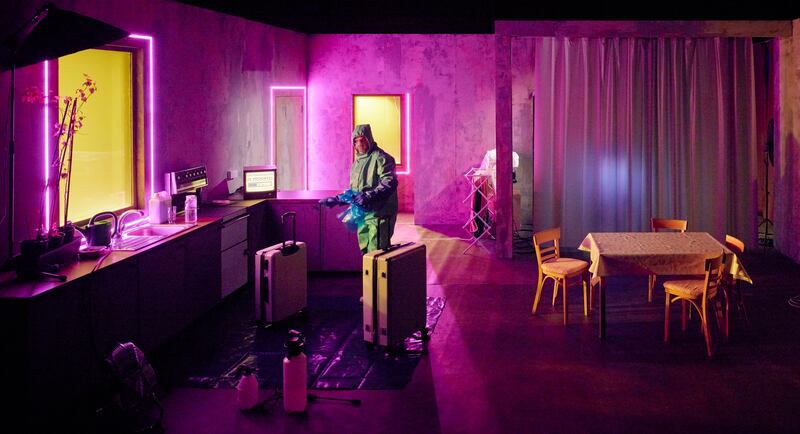
Shane Mac an Bhaird’s new play opens in a drab kitchen-livingroom whose uneven grey walls evoke a perpetually postponed paint job. References to “Nef”, Lacken and Ballina, among other places, situate the house in Co Mayo. But the wilds of the west remain firmly out of view throughout The Delirium Archive, as we watch a family of four grapple with life in confinement.
All of them wear dressing gowns (which initially suggests an average day in lockdown circa April 2020). But ominous mentions of “yellow fog” point to a far greater, albeit unidentified catastrophe, which means no one can venture outdoors without a hazmat suit.
To help relieve postapocalyptic tedium, the characters take turns donning a headset that cuts them off from the other family members while immersing them in the past.
Early on, the mother, Caitríona (Úna Kavanagh), is transported to a youthful holiday and romantic encounter in Spain. But other memories are more troubling, as when her befuddled, highly strung husband, Tomás (Ronan Leahy), revisits an embarrassing blackout in the delivery ward following the birth of their daughter, Octavia.
READ MORE


The latter, performed by a sparky Megan McDonnell, is the play’s frustrated voice of reason. By donning the headset the family “transmit” memories to an “archive”, which will eventually be collected by a mysterious “company”.
And then, Octavia warns, it can do whatever it likes with the data. Whereas she remembers enough of life before the yellow fog to lament what has been lost, her younger brother, Vassilinki (David Rawle), seems condemned to antic neurosis by undersocialisation.
Sure enough, a “collector” from the company whizzes in by aircraft, claiming he wants to run a few tests to complement the data in their archive, which promises to be a “keystone submission”.
Played by Ian Toner in this Rough Magic production, he initially cuts a thrusting, dynamic figure, who seems to offer an outlet to the remnants of civilisation. But his sinister designs, as well as his own insecurities, will in time reveal themselves.
The play suggests that permanent confinement with your family might be intolerable, but the alternative of individual isolation is far worse.


The Delirium Archive gestures at a clutch of big themes: surveillance capitalism, intergenerational inequality, climate breakdown and transhumanism. But these remain individually underdeveloped, and the overall effect is scattershot and ultimately confusing. The play’s central idea about how we blithely collude in the theft of our privacy also feels far from revelatory.
Eoghan Carrick’s 90-minute staging leans towards comedy. But the zany script and bleak, claustrophobic setting call for more farcical energy and sharper jolts of pathos.
As it is, the dystopian world of The Delirium Archive remains ill defined and devoid of terror. The characters inhabit a devastated environment yet face no apparent material concerns and continue to be inexplicably supplied with power and even alcohol. Food, strangely, never appears.
The most chilling dystopias constitute plausibly horrifying adaptations of a familiar reality. Such internal consistency is sorely lacking in The Delirium Archive.
The Delirium Archive is at Project Arts Centre, Dublin, until Saturday, May 9th