

Una McKevitt has built a career in the seams between Irish cultural forms that are usually kept apart: theatre and comedy; the rehearsal room and the arena; the intimate first-person story and the big night out.
Across plays, live shows, podcast tours and publishing, her work repeatedly returns to the same terrain: how Irish people live inside structures they did not design, and how humour becomes a way of surviving systems that are emotionally exacting and often quietly coercive.
That range is deliberate. McKevitt’s career as a writer and director spans theatre, comedy, live podcasts, screen development and publishing, and she is often most visible not as a front-facing author but as the structural intelligence shaping other people’s material. Early on she became known for documentary-style theatre rooted in interviews and first-person testimony; in recent years she has played a pivotal role in translating conversational comedy into large-scale live performance.
But for now she’s returning to the role of theatre writer. Her new play at the Abbey Theatre, Fair Deal, which Conall Morrison is directing, arrives at a moment when housing is no longer simply a political crisis but a near total atmosphere. It shapes elections, friendships, WhatsApp chats and the inner weather of adulthood.
READ MORE


McKevitt approaches housing not as a policy problem but as a psychological and social force, one that turns a basic human need into a measure of worth, security, maturity and love. Set over a single night in a family home, Fair Deal uses a dispute around care and inheritance to ask a more unsettling question: not who gets the house, but what the house has already done to the people inside it.
McKevitt’s work is threaded by subjects that are personally affecting and socially charged: care, illness, dependency, adoption, eating disorders, mental health, family obligation. Yet she approaches them with humour that does not soften the impact or invite sentimentality. The wit feels distinctly Irish in its resistance to moral instruction.
“I think it’s literally my nature,” she says. “I love poetry and beautiful prose, but that’s just not the kind of writer I am.”
She did not arrive in theatre through the usual Irish route of youth drama and early acceleration. She arrived, as she puts it, “late”.
“I went back to do drama when I was 28, in Trinity as a mature student,” she says. “And I didn’t make my first show until I was about 32 or 33, and now I’m 50.”
[ Motherland star Philippa Dunne: ‘People love Anne, and it really touches me’Opens in new window ]
Late felt real. “I think it probably really annoyed all the 18-year-olds, very intense, like you are an old lady when you’re 28 and they are 10 years younger than you.”
What it gave her, she says, was focus. “When we were leaving, a lot of people were just going to branch off and do master’s degrees and go into different industries. I remember thinking, ‘I’ve gone back, I’ve done it. I’m not going to stop. I don’t want to get derailed again.’”
That long, deliberate route matters to Fair Deal, which is partly about adulthood as a moving target. In Ireland, adulthood has become tethered to property in a way that feels both practical and moralised: you are not simply meant to live somewhere; you also have to own it.
McKevitt traces that obsession back through memory. “Conversations about houses have always been around. I remember being in the back of the car with my mam and my aunt, and they would just comment about passing houses. That was more benign, more about design.”
As a child she obsessed over the houses in period films, imagined living in grand manors like Little Lord Fauntleroy.
Then came growing up, reality checks, the boom and the panic that the door was closing forever. “I remember feeling that sense of, ‘If you don’t buy a house now, you’ll never have a house.’ That’s probably when it first struck me that we’re a bit bonkers.”

For a while she was living in the temporary arrangements familiar to artists. “I was floating around, trying to make plays and living in people’s spare rooms, while everyone around me was buying houses. And it all seemed very grown-up. I always felt like a late developer.”
For McKevitt the fixation is rarely about status. It’s about a basic right becoming so difficult that it colonises the mind. “It’s now seen as maybe going to Mars – something so supremely difficult that it takes up a huge part of people’s lives. It’s not just taking up 80 per cent of conversations; it’s taking up 80 per cent of people’s brain space.”
That sense of brain space is not abstract. It links directly to who can make art, and under what conditions. “I do think, you know, it sounds pretentious, but the room-of-one’s-own thing is pretty important. I was living with my best friend, and it was great, but what was very difficult was trying to find space to write.
“A large part of the writing process is kind of walking around doing absolutely nothing, living in your own head. When money is tight, that can look like moodiness, but actually you’re just trying to warm up to write something.”
Eventually she rented her own place, an expense she describes as daunting and transformative. “I probably won’t go on holidays again,” she says, laughing, “but I can give my work the attention I always wanted to give it.”
In Fair Deal the family home becomes a power structure as much as a refuge. McKevitt talks about projection, scapegoating and familial roles with the insight of someone who has watched these dynamics play out repeatedly.
“In families where power is important to the people who have it, they will cross-role people so they can activate them in different circumstances. If somebody challenges them, then real basic psychology kicks in. That person becomes the scapegoat. Everything they do needs to be framed negatively so the parent or caretaker can stay in charge.”
She pauses, then says it plainly. “Families are power structures. There are hierarchies. There are kings and queens.”
In Ireland those roles can feel unusually durable, shaped by tradition and slowed social change, then jolted by rapid shifts. “Generationally, people in their 80s and 90s inherited a very specific model of family,” McKevitt says.
“Now you can have four generations inside one family with completely different expectations of what family and care should look like. That creates a lot of confusion and hurt.”
The idea of care is central in Fair Deal, as it has been throughout her work. One of the play’s characters needs full-time care at home, raising questions of whose responsibility that is, what sacrifices are demanded and what that means for the dependent person.
“I’m interested in who is most vulnerable in a structure based on power,” she says. “When people lose agency, when they become dependent within that structure, physically dependent, that really interests me.”
It’s so embarrassing when people say women aren’t funny. I always say, ‘Then why are most male comedians just talking about things their mother or their girlfriend said?’
These are serious themes, but Fair Deal is deeply funny. McKevitt’s humour emerges from precision rather than jokes. “It’s very character-based; the humour is sly. In the wrong hands it could be ignored.” Sometimes the comedy comes from refusing to signal it. “I watched a fight scene yesterday, and they played it straight and it was hilarious,” she says gleefully. “It was realistic, violent, terrible. Real life is absurd.”
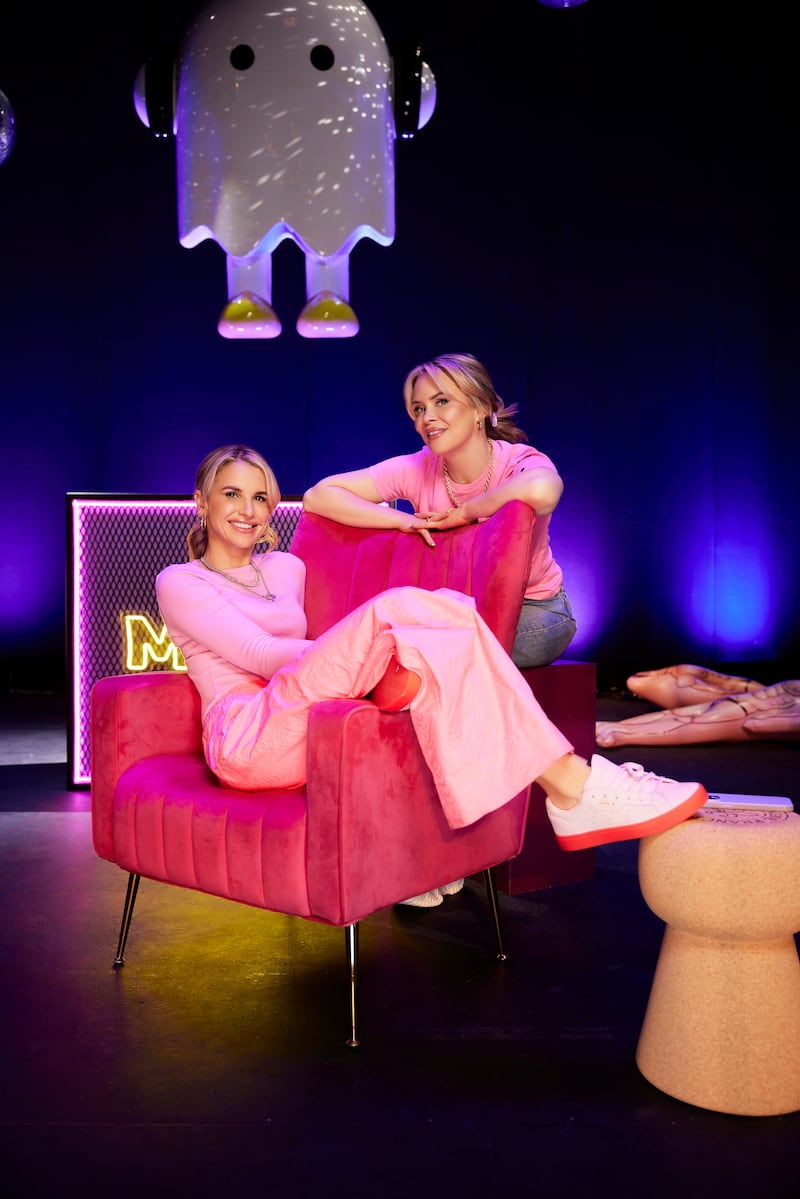
That instinct for rhythm, structure and audience attention also underpins McKevitt’s extensive work in comedy and live podcasts. She was the creative force behind the arena tour of My Therapist Ghosted Me, starring Joanne McNally and Vogue Williams in a part-cabaret, part stand-up live version of their podcast, and directed the Irish stage tour of the Spencer & Vogue podcast, this time featuring Williams and her husband, Spencer Matthews.
Her long-running collaborations with comedians include one with PJ Gallagher, as well as multiple projects with McNally, including Bite Me and The Prosecco Express, which have addressed topics such as adoption, loss and eating disorders but always lead with energy and humour. McKevitt wants audiences to enjoy themselves.
“I’ve always had the audience at the centre of my mind,” she says. “Comedians have no shame about that. They have no pretensions. They are laser focused on whether people are having a good time.” She finds it healthy. “Theatre can get stuck in styles or ideas about what it should be. With comedy you can just break out of that by being outrageous. Someone like Joanne does that instinctively.”
Live podcast shows are their own craft puzzle. They have to feel spontaneous and intimate yet scale to audiences in the thousands without becoming mechanical. “The work was never just technical. After every show it was what landed, what felt stale, what needed to change. It had to stay alive.”
She recalls early shows where something was missing, despite everything working on paper. “We did the first preview and it was absolutely fine. But 200 people and 1,000 people are different. They loved listening, but the room needed lifts.”
The solution was not overdesigned: it was risk. A long-forgotten pop single from Williams’s early career was unearthed. McNally was handed ribbons and told to dance to it – something that could have been mortifying turned out to be comedic genius. “It could have been the cringiest thing ever. It was throwing pasta at the wall. But it worked because they were doing it for the first time, not overthinking it. The room blew up.”
[ Chris Walley: ‘There is a degree of living like a monk – but a fun monk’Opens in new window ]
Her relationship with McNally goes back to Singlehood, a stage comedy in which a group of people discussed their love lives. This was in 2014, long before arena tours were imaginable. “She talked about being single and being buried with her parents, asking her mam to leave room for her. That set the tone straight away,” McKevitt says. “No one was surprised she was funny. What stood out was the bleakness underneath the humour. That combination is what makes her hilarious.”
McKevitt offers a comparison that sounds like admiration and disbelief. “It’s taken me 15 years of trying to be a writer. With Joanne, once she started, she was off like a rocket.”
When she talks about live podcast audiences, McKevitt describes an atmosphere, a sense of connection, of communal joy. “We were in Melbourne, and there were 3,000 Irish women singing The Cranberries outside the theatre. Everywhere we went, it felt like a reunion party.”
The rampant success of McNally and Williams’s shows has shown the huge appetite for female-led and confessional comedy. “Joanne is very aware of power structures like those that women live in, and so she can find a way to destabilise those a little bit in a way that’s hilarious.
“With Ghosted, I think it was the chemistry, the representation of friendship, having somebody you have a kinship with and a connection to. I have a person in my life who thinks I am the funniest person that ever lived, and I just think we all need that person.”
She laughs when the old trope surfaces. “It’s so embarrassing when people say women aren’t funny. I always say, ‘Then why are most male comedians just talking about things their mother or their girlfriend said?’”
As Fair Deal approaches opening night, McKevitt is clear about what she wants from audiences. Not agreement but argument. “I’d hope the conversations in the bar afterwards are about the characters,” she says, “and that people are standing up for different ones. That there’s ambiguity, that people relate to different characters.”
And she really wants audiences to have a good time. “I want people to leave with that little buzz, like, ‘I was going to go straight home, but, actually, maybe I won’t.’”
Fair Deal is on the Peacock stage of the Abbey Theatre from Tuesday, February 17th, until Sunday, March 28th; it previews from Wednesday, February 11th


