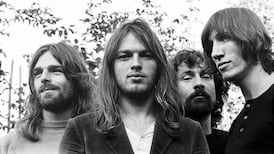
Prog rock was about to crash headlong into punk when Pink Floyd released Wish You Were Here, their sombre, disembodied masterpiece, in September 1975. The band was too successful to be threatened by the gobby, sneering barbarians at the ramparts, yet a sense of impending collapse is threaded through this brilliantly bleak record, now reissued as Wish You Were Here 50, a 50th-anniversary box set.
Floyd would stagger on, but Wish You Were Here feels like the end of something. If it soon became clear that punk was never going to destroy Pink Floyd, it was in part because they were too busy immolating themselves – as acknowledged, if perhaps subconsciously, by the cover image of two businessmen shaking hands, one engulfed in flames.
Wish You Were Here is Pink Floyd at a moment of transition, haunted by both their past and their future. By the mid-1970s they were caught between the shadow still cast by Syd Barrett, their long-departed leader, and the rising resentment that Roger Waters, who had then become their main songwriter, felt towards his bandmates.
He would later give unfettered voice to those frustrations on The Wall, a solo undertaking in all but name and the last time he would share a studio with his soon-to-be-ex colleagues.
READ MORE


As is often the case with great albums, Wish You Were Here also comes with its own mythology. It was during the recording of the LP at Abbey Road studios, in London, that a bloated, incoherent figure dropped by. Dead of eye and waxy of skin, with shaved eyebrows, and clutching a plastic bag, he was assumed to be an EMI staff member fallen on difficult times.
But then, to their horror, the group copped that it was Barrett, their once raffish frontman, whose obsession with Kenneth Grahame’s book The Wind in the Willows and conspicuous consumption of acid had shaped the sound and aesthetic of early Floyd.
Creepier still, his visit was on the day they were mixing Shine On You Crazy Diamond, their bittersweet coda to him (“Now there’s a look in your eyes like black holes in the sky”).
It was Barrett’s forced exit in 1968 that allowed Waters to find his voice as Floyd’s driving force, yet Barrett’s former comrades never came fully to terms with his absence: he is the ghost haunting this LP, and how unsettling it must have been to have him suddenly manifest, like a shade walking out of the walls.
“Two or three people cried. He sat around and talked for a bit, but he wasn’t really there,” Storm Thorgerson, their sleeve designer (and an old pal from their early days in Cambridge), said about the incident.
Waters would later clarify that Shine On You Crazy Diamond was not wholly about Barrett: he was a metaphor for those who withdraw from a world they find too awful to exist in.
“He’s just a symbol for all the extremes of absence some people have to indulge in because it’s the only way they can cope with how f**king sad it is, modern life – to withdraw completely. I found that terribly sad.”
Prog rock was notorious for its musical excesses, yet Wish You Were Here is notably trim: just five songs across 44 minutes (and two of those, one at either end, make up the nine-part Shine On You Crazy Diamond). Not that it doesn’t push the raft out: Welcome to the Machine is seven minutes of stadium claustrophobia, driven by David Gilmour’s ominously unspooling guitar – a jam at the gates of hell.
Ennui gives way to anger on Have a Cigar, Pink Floyd’s tirade against the greed of the music industry. Little did they know how much worse it would be half a century later.
This generously over-the-top reissue features bonus cuts and live recordings, including a complete 1975 concert from Los Angeles, plus remastered versions by the latter-day progger Steven Wilson and a verse by Simon Armitage, Britain’s poet laureate.
Yet the emotional core remains the title track, a grandiose lament that draws on both Barrett’s absence and the schism between Waters and Gilmour, who had knocked heads so often that they were essentially punch-drunk in each other’s company.
It’s the sound of all things ending, as indeed they would several years later, when Waters left the group in a strop, burning bridges that remain unmended to this day.