

Amanda Feery is no stranger to choral music. She sang in choirs as a child, in church and at school. It wasn’t quite casual. The school choir, she says, was “a very hardworking, seriously dedicated, secondary school choir. We competed a lot and did a lot of concerts.” And in the run up to a feis she would be exhausted, with 8am sessions, sometimes four mornings a week. “My teenage system didn’t really want to be getting up that early, but I would just roll out of bed and go to choir. I loved it.”
She became the piano accompanist for the school’s junior choir. “So I was getting a lot of experience with what goes around the singing, as part of the accompaniment.” And she had her very first experience of contemporary choral music. “I can’t remember the name of it now, but we sang a beautiful Ian Wilson two-part choral piece. I was singing a lot!”
In the context of her new work for Ireland’s leading choral group, Chamber Choir Ireland, she faces none of the technical limitations that most works for amateur singers are subject to. She draws a loose connection with composing for percussion which, in the world of classical music, can involve as many instruments as a small orchestra. “There is,” she says, “a kind of a choreography involved with a single player moving around from instrument to instrument. But it doesn’t like take over my creative plan.”
She’s talking about the fact that what might look easy in a score, might actually be impossible to perform. “The only thing I would say about the logistics for a choir is that obviously they’re humans, they have to breathe.”
READ MORE


The text of the new work, Little Visitor, is the English text of Doireann Ní Ghríofa’s poem, Sólás/Solace, from her collection Lies. “In Irish folklore,” says Feery, “it was believed that a visit from the sedge warbler was the soul of a dead infant coming back to comfort the mother through bird song. I’ve wanted to write a piece on this type of loss for some years now. I was thinking maybe it would materialise as an instrumental work. Then this project came up and the collection was sitting on top of a pile of books in my room! I opened it and saw this poem straight away.”
She’s a great fan of Ní Ghríofa’s work. “I just love the sounds of her words. There’s loads of different textures, I feel, in reading them aloud, but also the imagery within the words. It’s a real treasure trove. Solace is a short poem, but there’s so much in there, a lot of imagery to explore and kind of feed upon.”
The poet, she explains, wrote this text, “based on her own pregnancy loss. It’s a topic where there’s a complexity to the grief, because you’re grieving maybe a person you’ve never met, or you’ve only got to hold for a few hours. You’re grieving the life they never lived. The subject matter itself is kind of ontological. It’s a lost future. It’s something that never happened.
“Whereas you might be at a wake for the funeral of someone who died in their seventies and have loads of stories to share. There’s a comfort there and a solace through talking with other mourners about the person and the life they’ve lived. Whilst pregnancy loss is so common, that strange grieving part isn’t really talked about that much. I was really drawn into this poem because the character is just sort of waiting and yearning for the visit of this bird as the infant’s voice.”
In the context of working again with Gabriel Crouch and Chamber Choir Ireland, she says, “Obviously good performers and a good conductor not only influence the rehearsal and the performance of a piece. But they totally feed into the creative process as well. You go into it with a fearlessness and a confidence because of what you know about the performers.”
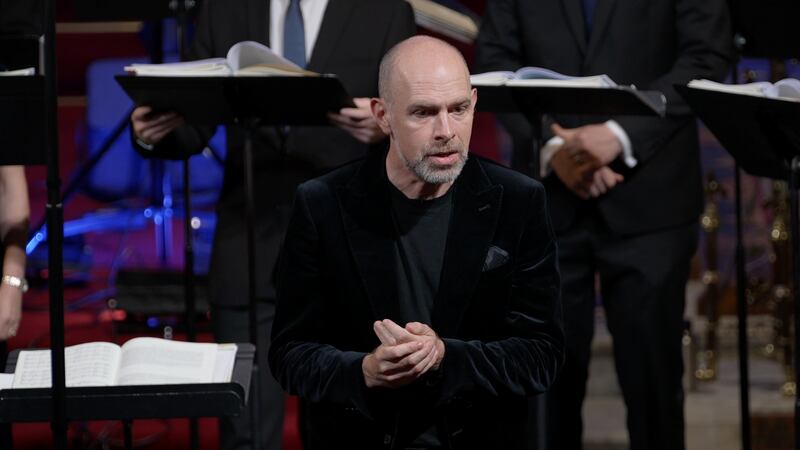
The new work is titled Little Visitor, and Crouch conducts it in his debut programme as artistic director of Chamber Choir Ireland. He is currently director of choral activities and professor of the practice in music at Princeton University, where he also conducts the 152-year-old Princeton Glee Club, and where Feery was the Mark Nelson Fellow in Music, completing her PhD in 2019.
He describes himself as the only singer in a large musical family of string players, “the one that got away,” and one whose early claim to fame now links him to a hot news story. As a 12-year-old member of the choir of Westminster Abbey, he sang a solo at the wedding of the former prince Andrew and Sarah Ferguson.
He places far more weight on his membership of The King’s Singers, from 1996 to 2004. “That taught me a huge amount about the ways that singers can combine relatively small sounds to create a very impactful whole. The King’s Singers sing in a very soft tone for the most part. They very rarely access the full capacity of their voice. You know 80 per cent of what that group does is listen incredibly carefully to each other. I learned all this stuff about what perfect matching of vowels and tone really means and what that can do to excite the atmosphere.”
The King’s Singers create what he calls “a palette of musical expression which does not come from breath support or from a traditional idea of vocal technique. It comes from the canny way that singers can combine their sounds with other sounds. And that’s a very very useful tool for choir singing. But of course with a choir, you can also access the full capacity of a technically proficient voice as well. You have that wonderful dynamic range at your disposal. And by very careful approach to the process of just pronouncing words of singers’ diction you can add a huge range of rhetoric to your singing as well. Your capacity as storytellers becomes something that’s very exciting and compelling for listeners.”
Back in the 1990s he also became interested in the way that music through singing is taught in the United States. One of the attractions was the country’s “really sincere effort to kind of formalise what conducting technique is and particularly for singers. There are great centres of choral music-making across America where it’s taught differently. But there is this sense in America that you can have no musical background at all and then suddenly get swept up by music aged 18. And that by enrolling in the right course and by reading the right textbooks you can become a conductor. You study your way to that position. Now, obviously that has its drawbacks and I think it’s very rare that someone would have the innate musicianship to become a truly great musician through that route.”
But in Europe, he says, that route “would just be unimaginable. You just kind of absorb music to feed your musicianship as a child, as an adolescent. And then perhaps as a conductor, it just starts to come back out of you in this sort of intuitive way. That’s why, you know, there are lots of organists who become conductors. But they don’t study their way to becoming conductors. They just start lifting a hand off the keyboard and waving it, in exactly the same way that continuo players would have done in baroque music or in oratorio performances of the past. But in America there is this desire to really formalise the study so that it’s accessible to everybody.”

Given his position as British-born person who is “plugged in as a musician in the United States,” he is “especially interested” in the music that’s being written in Ireland and the US. So, five of the nine works in his debut programme, titled To Star the Dark, fall into that category, those by Amanda Feery, Ayanna Woods, Missy Mazzoli, Meredith Monk, and Emma O’Halloran (another Princeton alumna). To those he’s added pieces by three Baltic composers (Galina Grigorjeva, Justě Janulyte and Lucija Garuta) and a single British work (by Joanna Marsh).
In a broader perspective, he sums up his goal by saying, “I listen to a lot of new music and I’m always trying to find the voice that’s going to move the needle, that’s going to expand our sense of what it is a choir can do.”
Gabriel Crouch conducts Chamber Choir Ireland at the Pepper Canister Church in Dublin at 6.30pm on Saturday, March 7th, and at Old St Mary’s Church, Clonmel, as part of the Finding a Voice Festival at 4pm on Sunday, March 8th


