

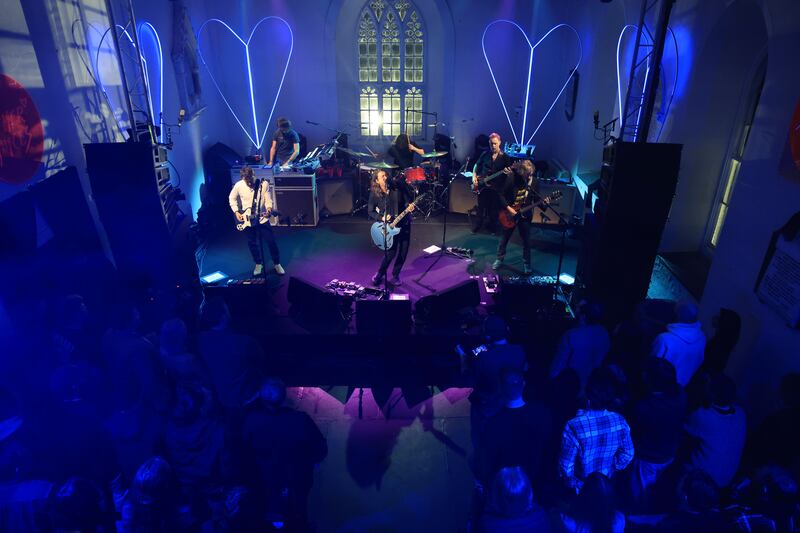
I’m sitting in Dingle’s Benner Hotel with Philip King, the man behind the South Wind Blows radio show, the Other Voices festival, innumerable arts documentaries and several records with his band, Scullion. It’s the morning after he brought Foo Fighters to Dingle to play a secret gig in St James’ Church and people keep stopping to talk about that experience.
“Well done, Philip,” says one passerby.
“It’s nothing to do with me!” says King, beaming.
You can’t talk to Philip King without learning about other people – the archivists, musicians and poets who inspire him. He quotes poetry. He hums bars of songs. He recalls meaningful interactions with artists. I keep breaking off from writing this piece to go listen to the music and read the poetry he mentions. He sees himself as just part of that great flow of tradition, a curator, not a promoter or even a film-maker.
READ MORE


Take I am Stretched on Your Grave, the song for which he wrote a melody, on Sinéad O’Connor’s 1990 album I Do Not Want What I Haven’t Got. It was originally a 17th-century poem called Táim Sínte ar do Thuama, which the short story writer Frank O’Connor translated for a collection called Little Monasteries. “There was something so emotional about it and so final, a study in grief, really.” He knows a lot about grief. He lost his parents when he was a very young man. “I was 19 and 21 when they died. It was so long ago now but you still miss them.”
He recites a bit of the lyric: “‘The priests and the friars approach me in dread, because I still love you, my love, and you’re dead, and still would be your shelter through rain and through storm, but with you in the cold grave, I cannot sleep warm.’ Rhythmically, meter wise, it suggests melody. There is a version of the song that Diarmuidín Ó Súilleabháin, the great sean-nós singer from Cúil Aodha, used to sing. I was unaware that that song existed … I absorbed the lyric so that it was in my head, it wasn’t like learning it off. I just probably read it so much that it was there and then I put a tune to it.
“And, as it happened, the first Scullion record was made in the late 70s, and we were recorded in Windmill Lane. I remember Mícheál Ó Domhnaill and Kevin Burke had come back from a Bothy Band tour and we were having a pint in The Windjammer – a very early pint.” He laughs. “Then they came in and played that air out of it at the end.”
[ Foo Fighters turn St James’ Church, Dingle, into the world’s smallest stadiumOpens in new window ]
He loved music from a very young age. His father, a garda, brought a radio home on the carrier of his bike when King was child in Cork city. “The notes of music that were dropped into my ear from the radio! I grew up with reading, writing, arithmetic and I’m dyslexic, so it was very difficult. In the school system if you couldn’t do those basic things, it could be quite cruel. Songs were a saviour for me in many ways, because I seemed to be able to absorb them.”
One of his first musical loves, he says, was Rory Gallagher’s strain of blues rock. “We used to refer to Cork harbour as the Lee delta,” He laughs. “I’d save my pennies. Get the train to Dublin. There was an import music import shop in Capel Street called US Discs. The Clancy Brothers is going on. The [Sean] O’Riada thing is going on, the beginnings of Sweeney’s Men.”

And then there was Planxty. “The excitement of seeing Planxty play before Donovan in the City Hall in Cork in 1971,” he says. “I always remember the sensation. We were having a couple of pints in the Phoenix bar. I walked over to City Hall and Planxty came on they started with the Raggle Taggle Gypsy and they finished with Tabhair dom do Lámh. And by the time they finished there was a sense that this was ours.”
After an Irish and English degree in UCC he taught history and English at a school in Dundrum, Dublin, but his heart wasn’t really in it. “I was always coming back from a gig being deposited at the gates of the school at nine in the morning.
“Eventually Sonny Condell, myself, the late Greg Boland, and a piper, Jimmy O’Brien Moran, made that very first Scullion record.”
Scullion still record and perform (their most recent record, the excellent Time Has Made a Change in Me, came out in 2022). Later in the 1980s King started making documentaries with his wife Nuala O’Connor, firstly with Hummingbird Productions and then with South Wind Blows. What was the ethos? “Several years ago, Nuala and I were at a wedding somewhere, and somebody said, ‘What do you do?’ and we said, ‘We run a small production company.’ And they said, ‘But what do you do?’ And she said, ‘If you want to push me, we celebrate what’s about to happen, and we capture what’s about to disappear’. And I think that really sort of gets it.”
Their first big project was the BBC series Bringing it All Back Home. There was a special instalment made for Disney for which O’Connor ended up winning a Grammy. They got the commission over the line because King bumped into BBC2 boss Alan Yentob drinking with fellow TV executive Michael Grade in the Shelbourne Hotel and bent his ear about the Everly Brothers (Yentob had made the definitive film about them).
Bringing it all Back Home looked at Irish migrants’ impact on American music.
“It would appear that they carry nothing of value with them in terms of material goods – but what they have in their heads and their hands and their feet? They have songs and they have tunes. They decanted them wherever they went … [Bluegrass musician] Ricky Skaggs got very tearful. He said, ‘the high lonesome sound in Kentucky, is the music remembering where it came from’.”
And it was a success? He laughs. “The success of all of these things is they get made at all.”
He and O’Connor subsequently made films about Seamus Heaney and the musician Liam O’Flynn (The Poet and the Piper), John McGahern, Nigel Kennedy, Daniel Lanois (Rocky World, for which King was nominated for a Grammy), Thomas Moore (“the first singer songwriter”) and, most recently, Dónal Lunny (In Time, directed by O’Connor). In the noughties they made Freedom Highway: Songs that Shaped a Century.
“We were in South Africa with Hugh Masekela and the Soweto String Quartet ... We met with Pete Seeger … He’d arrive in town [and] he’d leave 10 songs behind him, but he’d pick up two new ones he didn’t know … I spent a fascinating day with Tom Waits in California and he said songs are like seeds. The wind takes them and blows them. They land and they represent themselves in a different way.”
King is a part of that tradition. He and his family have lived in Dingle for 28 years (his relationship with the place goes back to his secondary school years there in a Gaelscoil). He does his radio programme, The South Wind Blows, from home “on the dusk of an evening, as night comes in, ‘like some dark River’, as Richard Thompson says.”
Other Voices was established in 2001, and a spin-off TV show started on RTÉ in 2003. The festival is celebrating its 25th anniversary this year. “I never thought it’d be going 25 years later,” he says. Huge stars have played over the years, though often before they became hugely famous. “I remember a woman walking down the street saying, ‘Who’s playing in there tonight?’ I said, ‘Amy Winehouse’ and she said Amy who’?” He laughs. “Dermot Kennedy played in Kennedy’s bar and there were four people there and two of them were his parents.”
Good music stops time, he says. He lists some of his highlights: The fado singer Mariza, The Gloaming, Séamus Begley, Dove Ellis (who’s on the new series). “Kae Tempest got up and did Rainy Night in Soho with Colm Mac Con Iomaire … We try not to be prescriptive … The church can be very intimidating for a huge band ... Some people say, ‘Jesus. I never realised this place was so small’,” he laughs. “But they get over it. [Foo Fighters’ singer] Dave Grohl got it right. They played a rock show, a sweat-on-the-walls job.”
The current trad revival, which involves bands such as Lankum, Poor Creature, Amble and Kingfishr, reminds him a little of the scene he was part of in the 1970s. “But I think there is a confidence about us, now. The Amble lads can really hold a ballad and all those Irish people in Australia are listening to that, and I think it’s a very accurate emotional reflection of what this generation are feeling. That slots into ‘Will I ever have a house?’ and their emotional connection to that is they can sing that song with them.”
He thinks you can see the emotional life of the country, a history of social change, in the songs. “You walk into Rita and Sarah [Keane]’s kitchen – no matter what happens in the world, they’re not going to stop singing,” he says. “And people are not going to stop sitting at their knee, taking the songs and bringing them to the next place … In Moya Cannon’s beautiful poem, Carrying the Songs, she says, ‘Songs were their soul’s currency, the pure metal of their hearts.’ Those things are going to continue to occur. That’s woven into our DNA in terms of the way we communicate emotionally with one another.
“But it’s absolutely necessary that the institutions of state are not just seen to offer lip service to this. All artists should have the basic income, and it should be forever ... The downstream effect of that, in terms of our emotional health and wellbeing, is an investment that is not alone important, but essential.”
Over the course of our conversation King mentions more than 50 musicians, poets, philosophers and film-makers (I’ve cut many for space reasons). Before we’re finished, he evokes a few more. Jacques Attali, for example: “What music does is it make audible, the thing that gradually becomes visible.”
And the singer Frank Harte: “If you were to listen to the soundtrack of Ireland, the singers and songwriters and musicians over 25 years, it would give you a great emotional sense of what it felt to be alive through that period.”
Other Voices is a particularly valuable document in this context, he says. “If you have the ears to listen, to hear what’s there, it’s very revealing emotionally. It’s an emotional history. If you go back to it, it’ll tell you something.”
Other Voices is on every Thursday at 11pm on RTÉ2.


