

A teacher lets a student know that he also wants to say “f**k you” to the world. A store owner shows great kindness to a customer. A son shares a secret with his father. Elizabeth Strout has always included what she describes as “moments of grace” in her novels, but in The Things We Never Say, set in a coastal town in Massachusetts before and after the re-election of Donald Trump, these moments of connection and empathy appear in even sharper relief.
I ask Strout, speaking from her home in Brunswick, Maine, if she thinks this new novel will spark conversation in the United States.
“I don’t know. I suspect it will. I really don’t know how this book will be received over here. I have some trepidation, but there it is.”
For long-time fans of the American writer, there is much to love about her new central protagonist: Artie Dam is a 57-year-old high school history teacher who, when we first meet him, is enduring acute feelings of isolation and suicidal ideation.
READ MORE


His wife Evie has become “far more officious” since a tragic accident; his son Rob has “turned quiet” and distant. His students seem more subdued and fearful than ever; at parties, people “never say anything real”. Events, both in his own life and the political life of the country, threaten to hinder or colour his friendships.
The Things We Never Say is not located within the same Maine-centred universe to which recurring Strout characters such as Olive Kitteridge, Lucy Barton and Bob Burgess belong, but the precise sadness of those novels is here in spades.
“I never want to leave somebody in despair at the end of a book. I just hope that there are enough moments of grace in it that people will feel a sense of comfort, and some sense of life-affirmation going on in the middle of Artie’s despair,” Strout says.
The book opens with a quote from Carl Jung that proves an efficient pointer to what is happening to Artie and those around him: “Loneliness does not come from having no people about one, but from being unable to communicate the things that seem important to oneself, or from holding certain views which others find inadmissible.”
Strout came across it when she was first starting to write about Artie. “I thought, ‘Oh, I think that’s exactly what I’m trying to say in this book.’”
She doesn’t usually plan her novels. “I never know where it’s going. But with this book I realised I had to put down breadcrumbs, or little clues, along the way,” she says. She was writing chronologically, rather than her usual method of writing scenes out of order, then shuffling them around, and she knew she wanted to open the book with Flossie, Artie’s widowed friend, cajoling him to remain his “old jovial self” after she leaves town.
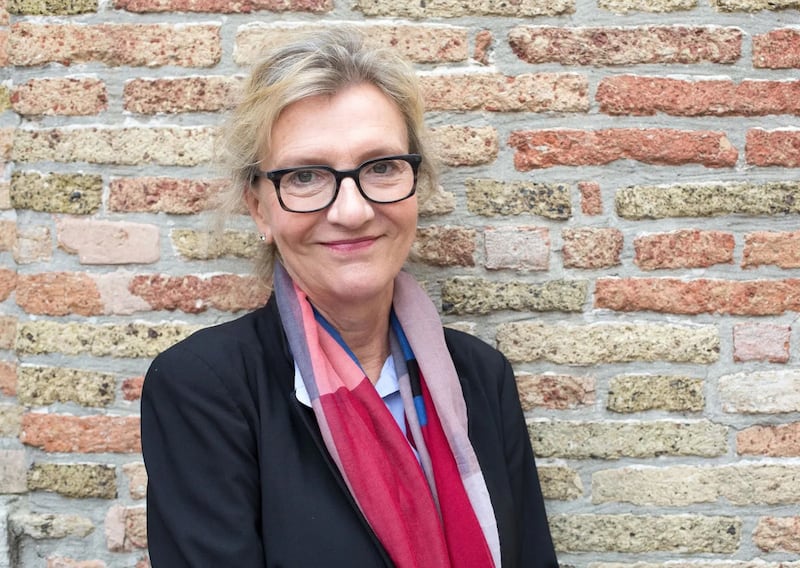
“Artie has spent his life being thought of as jovial. He thinks of himself as jovial. He’s gotten through the world by being jovial. And then we’re going to find out that he’s not.”
Hoover Lakeland, the principal of Artie’s school, anticipates that “he” – Trump is unnamed throughout – will win the election because voters “crave authority”. Another craving is repeatedly mentioned. Artie is struck by the memory of his late sister guiltily consuming confectionery sugar. In a volatile household, she was “just looking for something sweet”. Did Strout intend this as a metaphor for polling-station logic?
“I don’t think about what I’m doing when I’m doing it. I’m actually just concentrating so hard on being inside the character’s head and writing his story, finding his story, and then when I find it, I realise, ‘Oh, that is actually a metaphor for such and such.’ But I don’t mean it when I’m writing it,” she says.
This is not the first time she has woven politics into her work. The Burgess Boys, her fourth novel, was “pretty overtly political” in how it dealt with racial tensions and hate crime in the “very white state of Maine”. She has also written in close step with current events before, with 2022’s Lucy by the Sea set against the fraught backdrop of the pandemic.
This time there was simply no avoiding the fallout of Trump 2.0 in the lives of ordinary people. “I didn’t set out to write a political book. I realised, okay, I need to record this through Artie’s point of view.”
Strout finished The Things We Never Say more than a year ago, but in an epilogue that moves from mid-2025 into the near future she refers to “those protests in which people were killed in the streets”. This was fiction, until it wasn’t. Between its writing and the book’s publication, it came true.
We don’t know what state the world is in when we leave Artie, but we know that another character who feels obliged to leave the US is still living abroad and can envisage a time “when due process just no longer exists” for anyone.
The election result itself is starkly recorded at the midpoint of the novel, in two short sentences that sit on a mostly blank page. “It just came to me, and I thought we’re going to give this one page – a whole page with these two lines on it – because that’s when this rupture in Artie’s life really starts.”
She chose to set the novel in Massachusetts because she was “just sort of tired of Maine”, she says.
“I mean I was just sort of done writing about Maine for the moment. I thought, you know, enough, enough, enough.”
The state has a similar coastline to Maine, but “there’s more money, more people”. She and her husband – James Tierney, a former Democrat attorney general of Maine – took a two- or three-day drive down its coast in search of the visuals she needs to start a book, and found a house that could be Artie’s.
Massachusetts is a Democratic stronghold, with Kamala Harris winning the state by 25 points in 2024, but this result masks an eight-point swing to the Republicans compared to the 2020 election. The trend makes it a fitting place for a man like Artie to be surprised by the leanings of those around him and, in one case, resolve not to spoil a friendship by talking about politics.

“It’s not in my family, but I certainly know many families where this has split the family, divided the family,” says Strout.
“I have a very, very old friend who was a supporter of Trump’s, but no longer is since he posted the Christ picture – that was too much for my friend. But he and I have never spoken about it. Well, he did about the picture. But we just tacitly agreed [before] to never speak about it. We’ve known each other forever, and we love each other, so we just never said anything about it, and that’s how you deal with it. But it’s odd, it’s very odd.”
This coping tactic is necessary to preserve some friendships, but it also – as that Jung quotation suggests – foments loneliness, she thinks. And yet something else, which she interprets as a compensatory behaviour, is happening at the same time.
“I have noticed, and I’ve asked other people and they have noticed this too, that if you go to the store, for example, and the person is checking you out, we will have a little bit of conversation and be very nice to each other in a way that I don’t think we used to be. We were a little more indifferent with these meetings of strangers,” she says.
“There is a need, I think, in this country for people to be kind to each other, to feel the kindness, to receive it and to give it, in whatever small way we can.”
That speaks to how shocked people are feeling?
“Yeah, it’s a very ... it’s a deeply sad time.”
One of Artie’s regrets is that he didn’t properly get to know his late father – a common realisation not specific to his generation or men, Strout says.
“I’m 70, and I was just saying to somebody else that I think about my [late] parents briefly every day and they become more and more mysterious to me. My father’s been dead for years, and yet every so often I think, ‘Wait a minute ... why? What was that conversation really about?’ So I think that at a certain point, we do begin to realise we did not know our parents. Or, at least, I didn’t.”
The Things We Never Say was announced as a standalone book, but that doesn’t mean this is the last we will see of its characters. “I’ve thought about Rob’s wife, Francesca. She’s a little bit intriguing to me, and I’ve fooled around with a few little scenes, but to write about a concert pianist would be a huge task. I’m not saying I’m not up for it, but we’ll see.”
Strout has learned to never say never, especially when it comes to the question of whether she will return to her Maine-linked characters, who crossed paths in 2024’s Tell Me Everything.
“I feel like I’m not [going back to them], but I’ve said that every time. Every time I’ve finished a book I’ve said, ‘Oh, I’m done with that,’ and I’ve believed it. So now, even though I feel that way, I’m not going to say it, because I don’t trust myself. I just don’t know what will come next.”
As for what comes next for The Things We Never Say, Strout is poised to return to New York, where she also has a home, and she will promote the book in the US before travelling to Europe for stops that include the Hay Festival in Wales and the sold-out Borris Festival of Writing and Ideas in Co Carlow. Later in the summer, she will travel to Denmark and Norway.
It has been a feature of Strout’s past signings and festival appearances that women confide in her about struggling with the same jealousy and resentment that Olive Kitteridge feels towards her daughter-in-law.
“If you’ve had this thought, then probably somebody else has. We all think other people haven’t had the thoughts we have had,” she says.
In the same vein, the way in which Artie – a good man who already feels disconnected from those around him – is both quietly worn down and directly affected by Trumpism is likely to be devastatingly relatable to many.
The Things We Never Say is published on May 7th by Viking


