

It is seven years since Anna Burns won the Booker Prize for Milkman, but she has not been idle since then. She has been in pain.
After we greet each other at a hotel in Belfast, she puts a wooden board on her seat, so that when she sits down it will relieve the discomfort of nerve damage caused by surgery that went wrong in July 2014, delaying Milkman’s completion for two years. She is hopeful that a specialist will be able to help her and has just begun a series of operations.
For a writer whose method requires sitting completely still at her desk, calmly waiting for the voices of her characters to make themselves heard, this incapacitation must be excruciating.
“When I got damaged in surgery, nothing else mattered, but I’ve always kind of lived like that, in survival mode. I don’t write as well now, only for about half the amount of time. It interferes. It builds up.”
READ MORE


Burns doesn’t like taking regular painkillers, so she manages the pain through physiotherapy and her own techniques. In the meantime she has written a 5,000-word essay that in part addresses how she feels about this medical calamity.
“It’s quite an angry piece, but writing the essay did not compound the emotional experience of having been damaged in surgery. This can happen sometimes with me and writing, in that the distress about something gets worse rather than eased if I try to write about it. I’m glad to have got it out of me. It’s helped me, brought me to something I needed.”
She is also working on three writing projects, two fiction and one non-fiction. “The non-fiction thing might turn into fiction, but it feels non-fiction. I don’t want to talk about it too much, in case I lose the energy on it. After I wrote my first two books it seemed to become normal practice for me to have quite a few things out on the table at the same time. I’d start, stop, shift around and redirect all the time. Or I mean I’d be redirected, as I follow the energy wherever it takes me.
“There are no guarantees when it comes to me and writing. As far as I know, I’m back in the book that I started after my second book was published. I still call it my ‘third’ book even though Milkman pushed in while I was writing it and got itself written and published before it.
“I would rather not describe them, though, because, being so very tenuous, they might go away if I do. Having said that, I don’t know whether they will complete. That feels out of my hands. I wouldn’t want a book for the sake of having a book. I want the right book, and I hope it wants to come to me.”

Burns’s debut novel, No Bones, from 2001, about a young girl growing up during the Troubles, was shortlisted for the Orange Prize – now the Women’s Prize for Fiction – and universally praised.
Well, almost. The writer and former Sinn Féin publicity director Danny Morrison attacked it as a “misanthropic portrayal of the nationalist people” of Ardoyne, in north Belfast, and worried that “a Southern Irish or English audience would read this novel believing the fictional context to be a faithful representation of reality, even if the story is completely blown by its surrealist affectations”.
How would she respond? “I don’t have any comment to make on Danny Morrison’s dismissal of No Bones,” Burns says.
Little Constructions followed in 2007, the story of a chaotic clan of violent criminals and damaged children. Just as characters in Milkman don’t have first names but are identified only as Middle Sister or Maybe Boyfriend, the ones in Little Constructions have very similar names that blur their individuality, such as Jetty, JanineJoshuatine, Janet, Jennifer. Was that intentional? Even if not, what effect does she think it has?
“The similar names was intentional only in so far as I recognised early on in the writing that these J names were coming out and seemed to persist in being there,” she says. “I kept them but didn’t plan them in advance. Little Constructions is an abuse story – abuse re-enacted almost exactly and passed down through generations. So I suppose the names tumbling into each other reflect, even if only in a small, spontaneous way, a sense of repetition and compulsion.
“The title came from a conversation with a friend, who was talking about a pilot who referred to making constant little adjustments when flying planes. I said, ‘Oh, just like life,’ but I misremembered “little adjustments” as “little constructions”. I knew right away that that was going to be the title for my book.”
It makes me think of her writing method, a bit like a jigsaw, various little constructions assembled into a novel. “Yes, I liked it for that. That’s how I work. You kind of know when you’ve got the business, playing around with things, moving it about, then it takes off somewhere else and you follow the energy.”
I commit to turning up. I put in the hours whether things come or not.
— Anna Burns
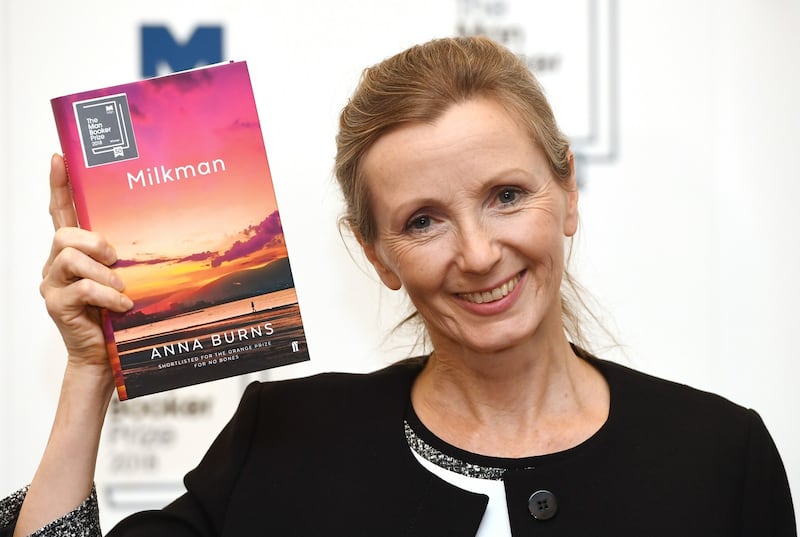
Next came a self-published novella, Mostly Hero, in 2014, “the hilarious, hell-raising descendant of Quentin Tarantino and the Brothers Grimm”. But in Milkman, which appeared in 2018, she produced a modern masterpiece; as well as the Booker Prize, it won the Orwell Prize for political fiction and the Dublin Literary Award and topped an Irish Times poll in 2025 of 60 authors and critics to be voted the best Irish fiction of the 21st century so far.
Milkman is set in an unnamed city that is recognisably the author’s native Belfast. The 18-year-old narrator, Middle Sister, lives in an enclave under the coercive control of a militant faction opposed to the repressive, discriminatory state, its groupthink-prone inhabitants doubly besieged and surveilled. The eponymous Milkman, a much older, predatory paramilitary, stalks her.
To stay independent and true to herself, she takes refuge in 19th-century literature, reading as she walks to navigate this claustrophobic environment whose inhabitants are trapped by history, poverty and paranoia. Burns’s feisty, feminist narrative is circuitous rather than linear, its repetitiveness reflecting her characters’ entrapment, but it is surprisingly, surpassingly funny, with sly, often absurdist humour.
“It manages that alchemy that Irish books are so good at,” Anne Enright wrote, “of turning our difficulties and our shames into some strange kind of glory.”
“At the novel’s narrative heart,” wrote Declan Long, “is the extreme, exhausting absurdity – the routine horror and maddening comedy – of everyday reality in this society of incessant, micropolitical pressure and unrelenting sectarian suspicion … a work of disconcerting literary invention: estranging and exciting in its audacious transformation of vernacular conventions.”
Having grown up in Ardoyne, where one-quarter of the victims in the 30-year conflict known as the Troubles were killed, it seems likely that she must have witnessed terrible things, but she has never spoken of it, perhaps never been asked.
“I did see people getting killed,” she says. “My father and a neighbour were shot. He survived but the neighbour didn’t, God love her. That turned up, to my surprise,” in Burns’s fiction. Colette Meek, a 47-year-old mother of four, was killed by a stray bullet outside her home on August 17th, 1980, during an IRA assault on an RUC patrol.
“Another time, someone” – Trevor McKibben, a 19-year-old IRA man – “had been shot dead by soldiers, and I was mitching school. My friend Sean McBride asked if I was going to the chapel. I said no, I don’t do that; I never went to the chapel with the coffins. I was going on home and had got to the top of the street and a bomb went off. Loyalists had put a bomb in one of the wreaths, and my friend was killed.” McBride was 18 when he was murdered in the 1977 attack, alongside 19-year-old Sean Campbell.
“A few months before, another friend of ours was shot, John Savage. I was just turned 15, and he was lovely. Soldiers told the car to stop. John was hanging out of the car, said don’t shoot, we’re not armed. He was a mad boy, but he was 17 – his hormones were all over the place.
“My sister said there is a clip on YouTube of a soldier boasting about shooting John. I want to watch it but can’t do it yet, because I know how angry I’ll get. That was a terrible death, I’ve written about that.”
In 2025 the British ministry of defence reached an out-of-court settlement with Savage’s family over the killing by paratroopers of the unarmed teenager in December 1976.
Burns works through this trauma, in both fiction and non-fiction. Sometimes it’s a means of getting it out of her system. She has spoken about clearing a space for fiction by writing cathartic non-fiction, which she keeps for a while as evidence that she has got it out before throwing it away in regular clear-outs. But, on other occasions, fiction emerges that is based on real events, working its way out in a different guise, such as the shooting of her father and Meek.
Burns grew up in a part of Belfast known as the Murder Triangle, bounded by Antrim Road, Crumlin Road and Cliftonville Road – the latter also known as Murder Mile. “My brother says he first heard names like Fenian and Taig from a neighbour on the other side of our back yard. It was another reason to leave.”
When Catholics were burned out of their homes at the start of the Troubles, in August 1969, Burns and her family were evacuated to Finner Army camp, in Co Donegal, for three months.
“I remember the spaciousness of it. I was afraid of the sheep, worried I wouldn’t be able to climb the stiles in case the sheep chased me. There was loads of food; we didn’t grow up with that. We got into Belfast and Derry gangs. I think we thought they were Protestants. We cried our eyes out when we had to go to school; then there were Free State children, so we bonded against this new threat. The nuns were friendly. I still have a wee booklet one gave me.”
Burns, who was one of seven siblings, lived most of the time across the road from her parents, in her aunt’s house. “I had that nice peacefulness but also the rowdiness. I liked having both. Me and my sister would play school, with the teachers shouting, and play with dolls, beating them up. One day the neighbours, these old ladies, came – they were really nice – asking us not to make so much noise.”
Burns disliked school, but she was later inspired at night school by Pat McCann, who taught her English. She was also working night shifts as a copytaker for newspapers, typing as journalists dictated their stories over the phone.
She moved to London in 1987 to study for a Russian degree. She loved the literature but was drinking a lot (night shifts on Fleet Street didn’t help) and realised that her real purpose in leaving Belfast was to get sober, so she quit drinking and studying and started writing.
It was the culture. Belfast was a very boozy place, and I started young. I can remember asking adults to get me drink, and they’d do it.
— Anna Burns
She didn’t go to Alcoholics Anonymous, “as I was frightened of ’13th stepping’ – getting hit on. You go to a meeting and you’re a mess; someone else there is also a mess but wants to take you under their wing.
“I sensed I wouldn’t be safe there, so a friend took me to Adult Children of Alcoholics. They want to go deeper. I found this helpful for understanding myself and my own motives for drinking. My understanding is that AA want you to get sober; they don’t look into why you were drinking.”
Why was she drinking?
“Because of the Troubles and it was the culture. Belfast was a very boozy place, and I started young. I can remember asking adults to get me drink, and they’d do it. You could go to a bar with an empty bottle and say this is for my da and they’d fill it up.”
She started going to writing classes in London. “I started doing these exercises for the class, but nothing wanted to finish. I didn’t mind, as I wasn’t looking to be published.”
Charles Palliser spoke of writers who plan and plot and of others who don’t know what’s coming at the end of a sentence. He advised those like Burns, in the latter group, to look at everything they had written and they would see where it was pulling them, even if they didn’t know when they were writing it.
She went home and laid everything out on the table, and it started to crystallise. She realised she had a recurring character and there was a lot about the North.
“I started focusing; the other stuff faded away. It told me I was writing a book set in Northern Ireland, and so I started writing things that ended up as No Bones.”
Her method is to be peaceful, quiet, present at her desk, waiting for voices to manifest themselves. What is her understanding of where those voices come from? Is it essentially her subconscious, similar to a dream?
“I never think about it,” she says. “It doesn’t matter to me. To start analysing it, you might lose it. I don’t mind if people think I’m crazy.”
In the early days she would go to sleep with a dictaphone and a notebook by her pillow. She might wake up with just one word, but it would have meaning for her, or a better version of a sentence she had already written.
“I commit to turning up. I put in the hours whether things come or not. I go for a walk and then it might suddenly shift.”
I wonder if there is a parallel to her work as a copytaker, but no.
“I would see a character, then two characters talking. I would listen in on their conversation. At some point my thinking head comes in. It’s not all dictation, though it’s lovely when it happens. Two stories in No Bones were like that. I thought, This is great – I’m getting it all for nothing.
“Sometimes I have the sensation of taking down a huge chunk of writing that comes to me quickly and effortlessly. It’s a wonderful experience but it’s rare. Certainly. I’m in flow when it’s happening. I do, though, also feel in flow at other times when I don’t have that sensation. It’s just a slower flow.”
Burns’s first agent struck a great deal for No Bones, but there was a personality clash, so on the back of its success she negotiated her own deal for Little Constructions.
She spent years working on another book, but then the characters from Milkman took over. She had run out of money by this stage so did a lot of housesits, as it had become harder to rent, having to prove you had income for a year, and two months’ rent up front. Milkman was started in London, then along the south coast of England, between Brighton and Eastbourne.
She and her family had drifted apart, but after the Booker Prize there was a reconciliation, and she moved home, staying first with a sister near Belfast and now in the beautiful Antrim coastal village of Cushendun. But there was also a push factor.
“England is getting more and more authoritarian. I thought if I don’t go I might not get out – I don’t feel safe here. I wanted to get back to my family, my sisters in particular.”
Two key influences as writers are Alice Miller and Jeffrey Masson, specialists on the effect of intergenerational trauma on families and individuals. I sense that there is a personal story here, but Burns is reluctant to expand on it, as it is not just her story to tell.
“But even just take the Troubles, the conditioning of what is supposed to be normal. When I was living in England I thought, it’s not bloody normal. I knew cerebrally it was crazy, but I felt everyone is traumatised over there and they’re all being ignored.
“When I came back, one thing I noticed is people are talking more about their experience. I find that’s really healthy. No one ever did when I was growing up. You just got on with it.
“I remember coming over to Milltown [cemetery] to look for friends’ graves, and it was shocking walking up some of the paths. Oh my God, I know this person or I remember that happening. And then things on gravestones like ‘Murdered by the British army’. I thought, this is truly shocking – and they were so young. My sister was the same; we had to stop. My God, this is horrific, and we never noticed how shocking this was. It was really so sad.”

I ask which other Troubles fiction impressed her, and she singles out Eoin McNamee. “At a sentence level, The Bureau is very emotional. It brings up the sadness and the waste. I loved The Blue Tango, the first one of his I read. Someone told me about Resurrection Man, about the Shankill Butchers. That book was amazing. Some of my mother’s friends were killed by the Butchers, two of my brothers’ friends. I remember people who were chased. I told Eoin I sent him a fan mail and I’m so glad he didn’t get it, because it was so gushing and mad.”
Burns has described the language in Milkman as a mix of Belfast dialect and archaisms. Might this be because the characters are stuck in the past – Elizabethan English for a 16th-century quarrel?
“I do like that interpretation,” she says, “but, again, as with the J names, I really don’t know. It came out that way and it felt right. I’m not the kind of writer who plans out my books in advance. Instead I wait for my characters to come and to reveal to me what the story is about and to show me how things work in their world. I discover it as I’m getting it.
“In the initial stages it seems I don’t have much control in the matter. I wait and try to be still and to sense for energy and for clues. I don’t attempt to interpret or classify or tidy up anything to make it make sense to me as I’m getting it, especially if I’m being taken off on a path I could not have anticipated – which often happens.”
I wonder if Middle Sister’s circumlocution is a defence mechanism, when to be straightforward is to give oneself away. “Yes, I think the narrator’s circumlocution is an unconsciously learned defence,” Burns says, “and I come across this in real life – and not just in the North. It seems to link with a sense of instinctive wariness about declaring oneself – or, worse, of having oneself declared – in potentially frightening or threatening circumstances.
“In Milkman, as in my upbringing, it was unsafe to be straightforward about anything. I think the characters’ preference for nameless anonymity reflects this. So does the language restrictions and the use of rumour and their obsessive hypervigilance to protect what’s really important to them.”
As well as Miller and Masson, Burns has been influenced by all sorts of people and places and things. “Some people don’t really like that answer. They seem to think it’s a cop-out from admitting that one has influences at all and from pinpointing who or what they are. I know not to be influenced by anything would make for a dearth of a life, and I do not aspire to that.
“But I don’t really know all my influences in writing or living. I think so much comes up from the unconscious and the subconscious and weaves itself in and out and through my writing life, also through all other bits of my life as well. This is why I was attracted to Miller and Masson, who wrote on the unconscious and on re-enactment behaviour and on human psychological states. In my early 30s I read the works of both these writers before I had any idea I would also become a writer. The Northern Irish Troubles, of course, was also an influence.
“As for inspirational writers on writing, I would name Julia Cameron, who wrote The Artist’s Way. This is a book about discovering one’s own creativity and dealing with all sorts of obstacles to unfolding that creativity.
[ I wanted to write a book about Irish women’s writing. They told me to include menOpens in new window ]
“Other great influencers on writing, in my opinion, are Natalie Goldberg, Dorothea Brande and Brenda Ueland. I particularly like their idea of following your instinct when you write and not worrying about it having to make sense in the early stages. Just commit and turn up and let whatever wants to come come. This works well for me, as I can’t really write any other way.”
Does she, like Middle Sister, prefer 19th-century fiction to modern fiction? “I used almost exclusively to prefer 19th-century fiction when I was younger, in my teenage years mainly. That changed in my 20s with The Master and Margarita, by Mikhail Bulgakov, and The Third Policeman, by Flann O’Brien. They seemed to open the 20th-century-literature door for me in an invitational, exciting way. I think, though, I still feel more at home in the older stuff.”
Faber reissues Milkman and Mostly Hero this month. This interview is extracted from A Hosting: Interviews with Irish Writers 1991-2025, by Martin Doyle, which will be published by Lilliput Press on April 16th


