
There comes a certain point in the creative process when one throws their pen in the air and thinks “who even cares?” For most, this happens at their desk. For me, I was on a private-hire barge at sunset, floating down the Regent’s Canal in London in the company of 20 prosecco-fuelled nurses, who were all determined to take a selfie with a blow-up naked man.
It was a hen do, of course, and I was about to explain the premise of my book for the fifth time, yowling ever-more loudly over “...Baby One More Time”. I moved my penis straw to one side, took a sip from my plastic wine glass, and began again.
“It’s called Banshee. It’s a collection of short stories by Irish woman contemporary authors – retelling myths and legends through a feminist lens.” I was boring myself at this point, truth be told. “Like, Children of Lir, but told by Fionnuala. Or Deirdre of the Sorrows, but it’s her point of view.”
The eyes of the red-headed nurse from Castlebar I was speaking to lit up. “God, I can’t wait to read it,” she said. “I’m called Deirdre, and I grew up thinking my name brings sorrow to all men.” It was all I needed to hear.
READ MORE


It may seem like a stretch to connect the centuries-old folk tale of doomed love to being a woman in 2026. But these tales have deep roots – the fates outlined many years ago still latch on to us in present day.
At Irish college in Inis Meáin as a teenager, I loafed beneath stone age dolmens, known locally as Leaba Diarmuid agus Gráinne, imagining the lovers seeking shelter from the wind and rain. When it came to naming my daughter Aoife, I scoured ancient myth and legend for representations of her name. (I decided to disregard the cruel witch Aoife from Children of Lir, and instead lock in on Aoife MacMurrough.)
As the barge trundled on into the night, I wondered if this connection with myth is inherently Irish. Do Jocastas grow up thinking they will marry their sons? Do Dianas feel compelled to hunt? Do the moods of Lunas wax and wane with the phases of the moon?
I was halfway through the second round of edits of Banshee and stuck on an a retelling of Deirdre of the Sorrows, which is set in a Magdalene laundry. I dropped my daughter at creche and walked home, trying to solve a plot point as I strolled.
On the short stretch between the creche and my house, I passed three bus stops plastered with advertisements for the Mother and Baby Institutions Payment Scheme. Women who had once been silenced were now the subject of state redress. Stories, belatedly, being acknowledged.
It struck me then: these myths are not relics but frameworks. They can be used as a way of speaking about modern womanhood.
Though these tales are ancient, the women in this collection are not. Whether it’s Credhe (of The Battle of the White Strand, as told by Nikita Gill), Macha (in Wendy Erskine’s retelling of the Labour Pains of the Ulliad), or Gráinne (a pregnant schoolgirl on the run in Megan Nolan’s retelling), these women turn their back on societal expectations. They dare to face fate head on. They try and try again to find the path that is right for them. Even if they can’t change their final destination, they can decide how they get there.
Salma El-Wardany on retelling Deirdre of the Sorrows

Growing up in England, I didn’t come across much Irish mythology. My granny is a sensible Irish woman who doesn’t hold much regard for myths and monsters, nor was she prone to nostalgia or waxing lyrical about the Emerald Isle.
Instead, she took me up mountains in Scotland and taught me practical things; how to read a map, how to use a compass, and how to survive if you ever got caught on the mountain after nightfall. In between, she would answer my incessant questions about Ireland and what it was like growing up there in the 1940s. She would often tell me it was different back then. Harder for women. She was not afforded the freedoms I had. The rest was left up to my imagination.
When I was asked to contribute to the Banshee anthology I jumped at the chance, especially when I was offered the story of Deirdre of the Sorrows. I didn’t know anything about the tale, but my granny is called Deirdre and it felt like fate. The kind of magical weaving of life that happens in myths.
Researching Deirdre’s tale, I was struck by the sadness of it all. No matter how much the story changed in various retellings, the tragedy was always inevitable. Deirdre’s fate is devastating and certain, so I wanted to write a version that empowered her, and while the tragedy and the sadness was still present, offered a glimpse of freedom and happiness for Deirdre once she takes matters into her own hands.
I set the story in a mother and baby home because the Magdalene laundries are a part of Irish history that is so obviously tragic. In many ways, it’s the perfect setting for a story about a woman who lacks agency and is forced into a situation against her will.
My mother taught me about the laundries as a young girl and upon probing my granny about them, I learnt that she used to walk past a mother and baby home on her way to school every day. She was so close to tragedy, and yet so far removed from it. I hope my retelling of Deirdre of the Sorrows offers something similar. A life so close to sadness and pain, but a life in which a woman in those circumstance comes out on top in the end.
Wendy Erskine on retelling The Curse of the Ulaid
My myth to retell was The Curse of the Ulaid. The goddess Macha comes to the house of a mortal, the widower Cruinniuc. She takes care of his children, brings order to his home, and eventually becomes pregnant. But her presence in his world is contingent on Cruinniuc never mentioning her to anyone.
At a festival held by Conchubar Mac Nessa, king of Ulster, Cruinniuc boasts that his wife can run faster than the king’s horses. The king duly demands that a race takes place and the heavily pregnant Macha has no choice but to accept the challenge. She wins, giving birth to twins shortly after finishing. She curses generations of men of Ulster to suffer her excruciating labour pains.
I didn’t need to reposition Macha in this story. She was already central and not some marginalised deity in need of a glow-up. Neither did this myth use the “dangerous goddess” trope, with its misogynistic insistence that powerful women figures are essentially capricious and cruel. No. Macha is content as a transformational presence in the domestic sphere, and only issues her curse after extreme provocation. My artistic task, therefore, ran to something different: to recalibrate the tale to a world not entirely unlike our own, and to invest it with a specificity of detail.
Macha arrives in a terrible storm, hair hanging soaked, leather biker jacket dripping. She is accepted across the threshold by the youngest son, Finny, and it is he who will prove to be most profoundly and lastingly affected by her presence. The house itself is a ramshackle place where rust from the fridge bleeds watery brown. Yet before long there is bread on the table, polished brass, light.
The men in the story like hedonism, quick bucks, pedals to the metal, long country roads, racing cars. Yet Macha is the drive to beat them all. Instead of the festivities of the king of Ulster, there’s an amphetamine-filled weeklong Lammas bacchanalia, a cross between a cattle mart and a Hells Angels gathering.
Look and you will see a woman squat in an alleyway while her friend eats candy floss. Instead of Cruinniuc, we have Ol’ Sexy Blue Eyes, the kind of guy who would, as they say, put a bob on himself each way. And yes, he is still a braggart. His boastful words in front of everyone assembled – plus she can driver your getaway car faster than any – give the story its crucial reversal, its peripeteia. They also give it its title. But Macha – in all her mystery and strength – provides its heart.
Anne Griffin on retelling Clíodhna’s Wave
Women’s Aid Femicide Watch records the number of women who have died violently in Ireland since 1996. Up to November 2025, 277 died this way. One in two were killed by a male partner or former partner.
This backdrop of rage and jealousy that has killed so many women over the centuries is written into our lore, our histories, our fairy tales. This normalisation often means we don’t even see the horror any more.
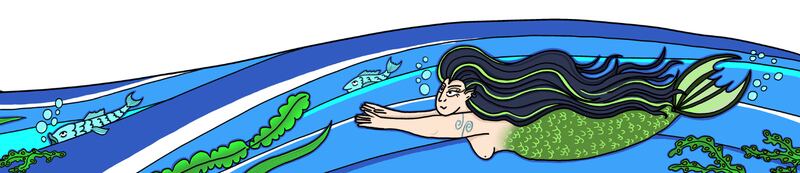
In the mythological tale of Clíodhna’s Wave, of which there are many iterations, Clíodhna lives in Tír Tairngire, the land of promise. There, Manannán Mac Lir rules. A stranger arrives, Ciabhán, and Clíodhna and he fall in love and decide to return to his kingdom of Ulster. Furious, Manannán pursues Clíodhna on the waves and drowns her. In his book Thirty-two Words for Field, the late and wonderful Manchán Magan surmises his reasons were one of three: to take back her power, to limit her freedom, or to crush the love she had for Ciabhán.
In my modern retelling, Clíodhna is a lost young woman in Cork city beguiled by a man, older, powerful and skilful in manipulation. He uses her, farming her out to others to do so also. And while Clíodhna is clever and resourceful and finds ways to outsmart him – and even in one glorious, short-lived moment finds her freedom – he has been watching all along, amused.
He kills her – for who is she to best him? – kicking her body into the sea at Glandore harbour. But within those waters, Clíodhna finds her power and rises with the waves in a fury. Through mist and cloud, she travels back to Cork where she haunts her killer for eternity.
Clíodhna’s wave is a real thing in Glandore. On stormy nights, the wave is seen and heard. “Its eerie roar bellows out from the cliff rocks,” Magan wrote. On the day I visited Glandore, during the writing of my retelling, I could feel it, the simmering power of the water – hugged and corralled as it was by the cliffs, the perfect funnel for the waves to rise and charge the shore – there was much more, and it was the despair at so many women lost on this island at the hands of those who had no right.
Banshee: Mythological Irish Women Retold edited by Ailbhe Malone is published by John Murray in Hardback


