What does Ferdia Lennon’s Glorious Exploits have in common with Lebor Gabála Érenn, the medieval Irish Book of Invasions? Both works feature migration narratives where Celtic Ireland is connected with ancient Greece.
Lennon’s captivating tale of Athenian prisoners in fifth-century BCE Sicily inserts the Celtic migration myth of the Sons of Tuireann into a novel inspired by ancient Greek historiography, as the mysterious blow-in Tuireann becomes an unexpected patron for the prisoners’ theatrical productions of Euripides.
The Lebor Gabála Érenn, which preserves that tale of mythological Celtic siblings, variously connects migration narratives of Gaelic origins to ancient Greece. In the earliest recension, Ireland is occupied by different waves of settlers, including Partholón mac Sera (originating from Greece), and the Fir Bolg (who come from Greece).
In the 17th-century O’Cléirigh recension, links to Greece are expanded: the tribes of Nemed, who settle Ireland, receive military aid from the daughter of the Greek king, while the Tuatha Dé Danann, latter settlers, inhabit Greek islands and forge a military alliance with the Athenians.
READ MORE



In our earliest surviving text on the migrations of the Gaels, the ninth-century poem Can a mbunadus nan Gáedel?, written by Máel Muru Othna of the monastic community at Othain (Fahan), Co Donegal, Greece is claimed as the direct point of origin for the Irish people. Migration, here, is as much a story-shape as a historical fact – and the classical world is one of its favourite staging grounds.
Ireland’s origin legends feature ancient Greece as a significant presence. Our own national epic, meanwhile, James Joyce’s Ulysses, composed while Joyce himself was on the move between Trieste, Zurich and Paris, is famously structured around the classic Greek migration epic, Homer’s Odyssey. Subscribers to the first copies of Ulysses peppered the globe – spanning Europe, the US, South Africa, New Zealand, Latin America, and India – and Joyce’s meandering epic had a huge impact on postcolonial literatures, influencing writers such as Jorge Luis Borges, Leopoldo Marechal, GV Desani and Salman Rushdie.
Back in Ireland, post-independence, an Irish-language Odyssey was composed by the extraordinary polymath and ardent nationalist Pádraig de Brún. Inflected throughout with Irish vocabulary and motifs from the caoineadh to the aisling, de Brún’s Irish epic draws, as did Joyce’s, on his own experiences of migration and warfare.
The story of Ulysses’ displacement through war and his ultimate homecoming is a constant of Irish literature, for instance as a motif in the Fermanagh poet Eochaidh Ó hEodhusa’s poem addressed to Donnell O’Connor Sligo (d. 1611) where the patron is Ulysses returning to his rightful territory, imagined as his spouse Penelope.
Several decades later, in Cambrensis Eversus (a refutation of Gerald of Wales’ claims of Irish barbarism), John Lynch would frame his lament on the disenfranchisement of Irish Catholics through an Ireland-as-Penelope metaphor, Ireland as a loyal neglected wife, beyond reproach, awaiting resolution and justice. Like many 17th-century Irish authors, Lynch was writing from a position of exile in Europe, and Irish bardic poetry produced after the 1607 Flight of the Earls shows a significant increase in references to Greek and Roman figures.
Ireland’s struggles are variously likened to those of Caesar, Pompey, Hercules and the heroes of Troy. We see, in our own day, Irish poets like Eavan Boland and Seamus Heaney also turning to Roman themes, such as the poet Ovid’s exile from Rome and the pastoral poetry of Virgil, to address displacement, exclusion and the impact of war.
The pursuit of education is a significant strand in the history of Irish migration, where the penal laws meant studies on the Continent were necessary to secure a Catholic education. Seventeenth-century Irish Franciscans in Europe, drawing on Roman law, made important contributions to debates concerning the right to travel, preach, colonise and enslave at a key juncture in European history.
Migrations of Irish scholars had, of course, been part of the Irish experience as far back as Columbanus in the sixth century and medieval Irish peregrine, such as Sedulius Scottus, Murethach and John Scotus Eriugena. They brought with them expertise in classical languages, in etymologising methodologies, and developed a distinctive form of Hiberno-Latin. Further evidence survives of Irish influence, derived from the Roman author Macrobius, on the visual imagery of the Old Norse world-encircling serpent, the Miðgarðsormr.
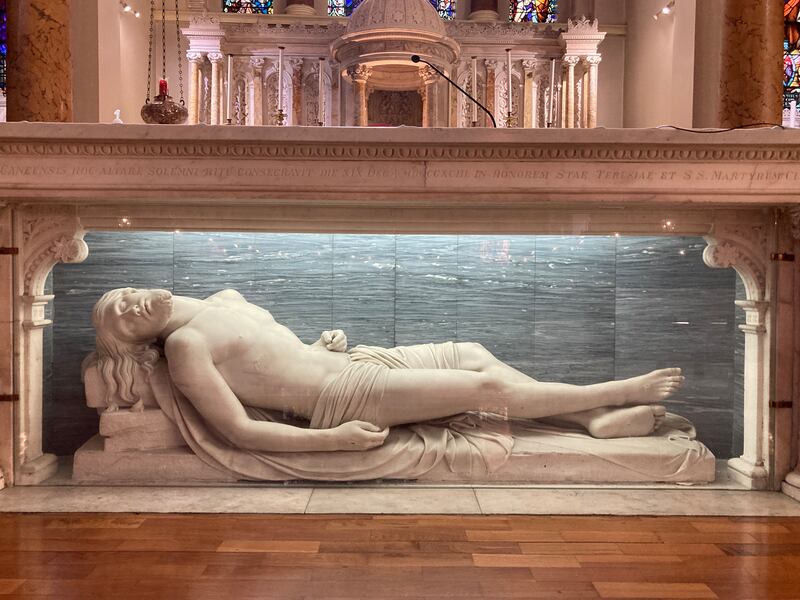
Visual classicism, the Irish and the Scandinavian would collide again in 19th-century Rome, through the friendship that blossomed between the neoclassical sculptors Irishman John Hogan and Dane Bertel Thorvaldsen. Hogan’s classicising religious sculptures bear the mark of Thorvaldsen’s influence but are inflected with a Catholic nationalist symbolism.
One of Hogan’s most admired sculptures, his Dead Christ, was produced in several versions, including one purchased for the Basilica of St John the Baptist, Newfoundland. This remote Canadian outpost had been a site for seasonal migration of Irish fishermen in the 18th century, its Irish name, Talamh an Éisc, a reference to that historical circumstance.
In a fictional journey to Newfoundland based on the model of Virgil’s Aeneid, the Eachtra Ghiolla an Amaráin, Irish poet Donncha Rua Mac Conmara satirised experiences of lived migration through Virgilian tropes interspersed with figures from Irish folklore and poetry.
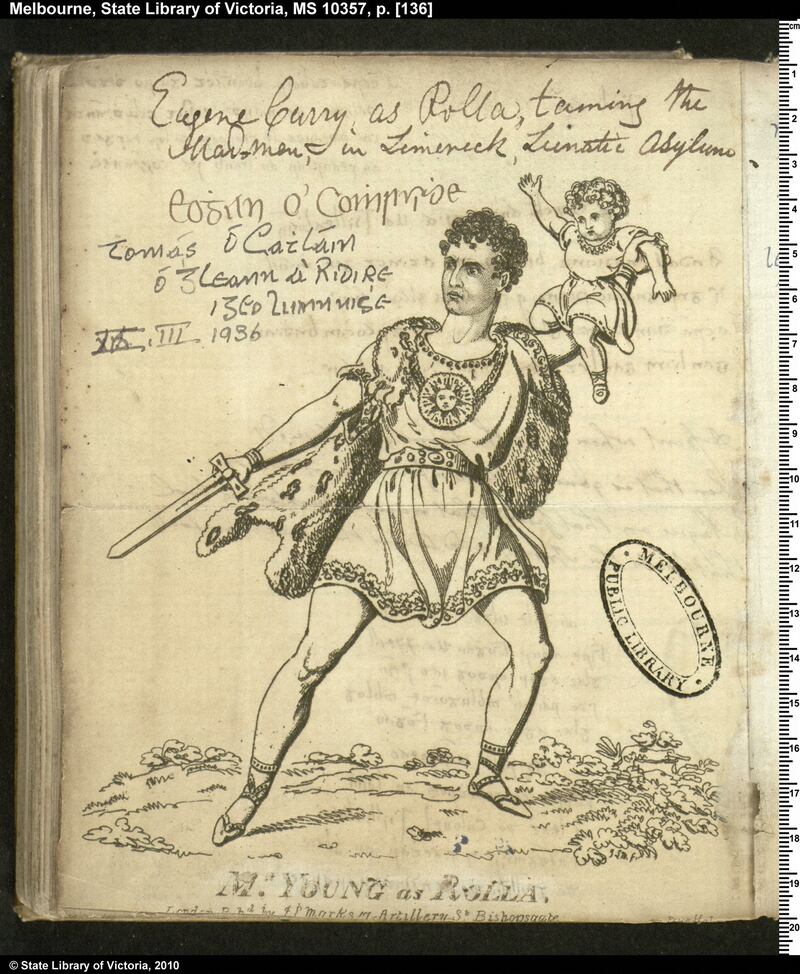
Anglo-Irish politics is also sent up through the lens of classical literature in 18th-century English works, such as A Trip to the Moon by Mr Murtagh McDermot. And while print was the dominant form for English texts, Irish-language texts from this period circulated at home and abroad in manuscript form, often adorned with classicising imagery (architectural motifs, classical insignia, heroes in classical dress) adapted to their Irish purpose.
These threads from classical antiquity are part of the Irish experience of migration. They represent assertions of cultural participation and strategies of resistance to exclusion.
Isabelle Torrance is Professor of Classical Reception and Director of the Centre for Irish Studies at Aarhus University, Denmark. Irish Migrations and Classical Antiquity, with a foreword by Mary McAleese, is published by Bloomsbury and free to download as an ebook, thanks to funding from the European Research Council (grant no. 818366).